

Neither Demon Nor Dread: The Hindu Vision of Wilderness and Wild Creatures
In many religious and cultural imaginations, the wilderness is treated as a place of danger: a zone beyond order, beyond law, and beyond human certainty. Forests become settings for fear, beasts become symbols of uncontrolled violence, and mountains or caves become the geography of exile. Hinduism offers a more layered and philosophically mature view. The wild is not merely an enemy of civilization. It is a sacred field of life, tapas, revelation, testing, and transformation.
Within Hindu Dharma, the forest is not opposed to the temple in any simplistic way. The temple gives form, rhythm, and ritual focus to sacred presence, while the forest reveals sacredness before architecture, before institutions, and before human ownership. Rivers, trees, animals, mountains, winds, herbs, serpents, birds, and unseen beings all participate in a wider cosmic order. This order is not sentimental nature worship; it is a serious metaphysical vision in which life is interdependent, spiritually charged, and morally meaningful.
The Sanskrit word aranya, often translated as forest or wilderness, carries deep civilizational significance. The Aranyakas, a major layer of Vedic literature, are literally associated with forest reflection. They stand between the ritual world of the Brahmanas and the interiorized philosophical vision of the Upanishads. This placement is revealing. The forest is not presented as a place where religion disappears; it is where ritual consciousness becomes contemplative, where outer offering begins to turn toward inner realization.
Hindu thought therefore understands wilderness as a zone of transition. It is where social identity loosens, where the senses encounter both beauty and threat, and where the seeker learns that the human being is not the center of existence. A person entering the forest must confront hunger, fear, silence, weather, darkness, and dependence. These conditions are not merely physical inconveniences. They become instruments of discipline, humility, and spiritual knowledge.
This is why the forest appears so frequently in Hindu scriptures and epic literature. The Ramayana is shaped by Rama, Sita, and Lakshmana’s life in the forest during exile. The Mahabharata repeatedly sends kings, sages, warriors, and grieving families into forests for instruction, penance, and moral reorientation. The wilderness is not empty background scenery. It is a living classroom where dharma is tested beyond courtly speech, royal status, and public reputation.
In the Ramayana, the forest is neither purely idyllic nor purely terrifying. It contains ashramas of sages, sacred rivers, hermitages, flowering trees, wild animals, rakshasas, longing, loss, and revelation. Rama’s exile is not merely a political misfortune; it becomes a journey through the moral complexity of life itself. The forest exposes the fragility of human plans and the depth of divine resolve. It also shows that dharma cannot be restricted to palaces, councils, or formal ceremonies.
Sita’s presence in the forest is especially significant. Her relationship with the natural world is marked by tenderness, courage, and moral sensitivity. The forest is not treated as a hostile masculine frontier to be conquered. It is also a realm of feminine strength, vulnerability, endurance, and sacred intimacy. Her story reminds readers that ecological spaces are never neutral abstractions; they are places where love, fear, memory, and ethical responsibility become embodied.
The Mahabharata deepens this vision through the Pandavas’ forest exile. Their time in the wilderness becomes a prolonged education in restraint, grief, philosophy, and endurance. Kings who once ruled from courts must learn from sages, animals, spirits, and unexpected encounters. Yudhishthira’s conversations during exile, including the famous questions of the Yaksha, demonstrate that wisdom often emerges away from the noise of power. The forest becomes a place where civilization is judged, not abandoned.
Hinduism also refuses to reduce wild creatures to symbols of evil. Animals may be fierce, gentle, mysterious, loyal, dangerous, or wise, depending on context. The lion, tiger, elephant, serpent, bull, mouse, peacock, eagle, cow, monkey, fish, tortoise, boar, and swan all carry theological, symbolic, and ritual significance. This variety reflects a key Hindu insight: life cannot be morally flattened into simple categories of pure and impure, useful and useless, sacred and profane.
The vehicles of Hindu gods and goddesses, known as vahanas, are central to this understanding. Shiva is associated with Nandi the bull, Vishnu with Garuda, Durga with the lion or tiger, Ganesha with the mouse, Saraswati with the swan, Kartikeya with the peacock, and Lakshmi with the owl in many traditions. These associations are not decorative mythology. They encode philosophical insight into strength, discernment, humility, speed, fertility, intelligence, watchfulness, and the transformation of instinct into sacred service.
Durga’s lion or tiger, for example, does not represent uncontrolled violence. It represents power mastered by divine intelligence. Ganesha’s mouse does not merely create contrast through size; it suggests that even restless desire and small, hidden impulses can be brought under wisdom. Nandi is not simply an animal companion of Shiva; he embodies patience, devotion, strength, and stillness. Garuda is not only a bird of flight; he becomes a symbol of liberation, vision, and protection against poisonous forces.
Serpents provide one of the richest examples of Hinduism’s nuanced approach to wild beings. Snakes often generate fear in ordinary human experience, yet in Hindu traditions they are also linked with fertility, subterranean waters, guardianship, time, death, kundalini energy, and cosmic support. Vishnu reclines upon Ananta Shesha, Shiva wears serpents as ornaments, and Nag Panchami honors serpent beings with reverence. The serpent is not simplistically demonized; it is approached with caution, respect, and symbolic depth.
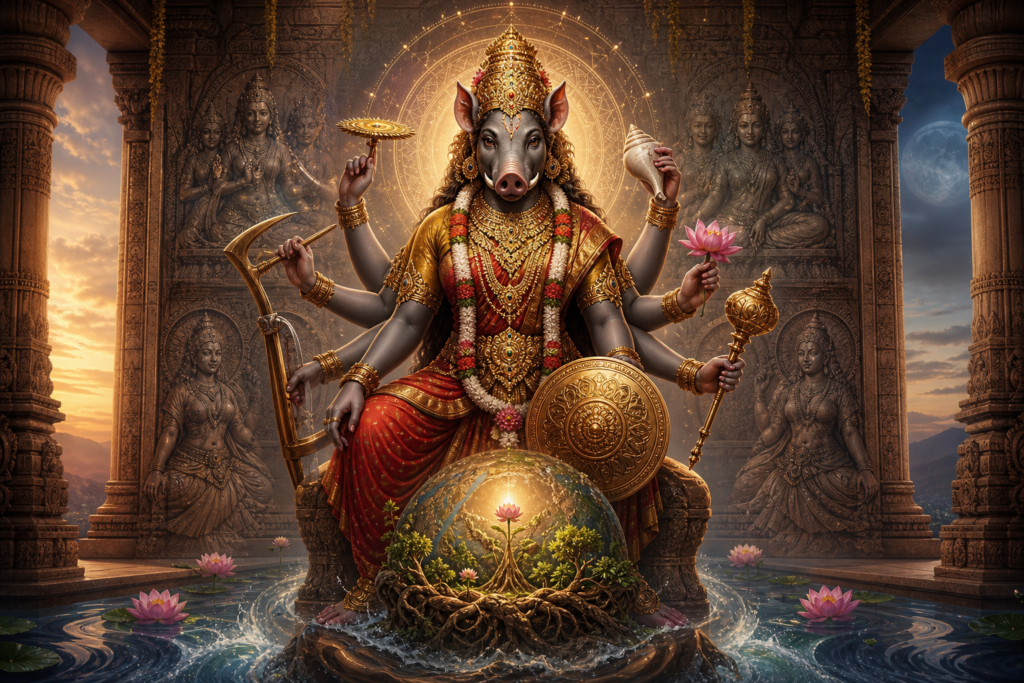
This vision is also evident in the avatar tradition. Vishnu’s incarnations include Matsya the fish, Kurma the tortoise, Varaha the boar, and Narasimha, the man-lion. These forms challenge any assumption that divinity must appear only in refined human shape. The divine may move through aquatic, amphibious, animal, hybrid, and cosmic forms. The sacred is not confined to human superiority. It can manifest through forms that disturb ordinary categories and force deeper recognition.
Narasimha is especially important because he stands at the boundary of human and animal, day and night, inside and outside, weapon and non-weapon. The form itself resolves a metaphysical crisis created by rigid conditions. In this sense, the wild aspect of divinity is not irrational chaos; it is a higher intelligence that exceeds legalistic manipulation. Narasimha reveals that dharma may appear fierce when protecting the innocent and correcting arrogance.
Hindu ecological ethics also arise from a broader metaphysical foundation. The Upanishads speak of the Self as the deepest reality in all beings, while the Bhagavad Gita repeatedly emphasizes seeing the same divine presence in diverse forms of life. Such teachings do not erase practical distinctions between species, duties, or social contexts, but they do restrain arrogance. The human being is morally accountable because consciousness, life, and sacred order extend beyond human convenience.
The concept of dharma is crucial here. Dharma is not merely personal morality or religious identity. It includes order, duty, harmony, right relation, and the sustaining principles of existence. Forests, rivers, animals, seasons, ancestors, gods, and human communities are woven into this network. When ecological balance is broken, the disruption is not only environmental; it is dharmic. Disorder in the outer world reflects disorder in conduct, desire, governance, and consciousness.
This is why ancient Hindu literature often links kingship with environmental responsibility. A righteous ruler is expected to protect forests, cattle, fields, waters, hermitages, and vulnerable beings. The prosperity of the land is not measured only by wealth, armies, or monuments. Rainfall, harvests, animal welfare, social harmony, and spiritual practice all belong to the same civilizational measure of well-being. Rajadharma therefore includes stewardship, not merely administration.
The ashrama system also reflects this forest-centered wisdom. In the classical model, vanaprastha, the forest-dwelling stage, follows the responsibilities of household life. This stage does not necessarily require a literal disappearance into dense woodland in every historical context, but it carries a profound principle: human life should gradually loosen its grip on possession, ambition, and social performance. The forest becomes a symbol of simplification, contemplation, and preparation for liberation.
In many Indian villages and regions, this sacred understanding took practical form through groves, temple forests, riverbank rituals, and local ecological customs. Sacred groves, often protected by community reverence for a deity or ancestral presence, have historically helped preserve biodiversity. These practices may vary by region, but their underlying logic is consistent: not every landscape exists for extraction. Some spaces must be approached through restraint, reverence, and continuity.
Such traditions also connect Hindu Dharma with wider Dharmic sensibilities found in Buddhism, Jainism, and Sikhism. Jainism gives extraordinary philosophical emphasis to ahimsa and the careful treatment of living beings. Buddhism develops compassion for sentient life and mindful awareness of interdependence. Sikh teachings emphasize service, humility, and reverence for divine order. Hinduism’s sacred ecology can therefore be understood as part of a broader Dharmic family of traditions that recognizes life as morally significant and spiritually connected.
This shared Dharmic horizon is important in the modern world. Ecological crises are often discussed in technical language: climate change, biodiversity loss, habitat destruction, pollution, and sustainability. Such terms are necessary, but they can become emotionally distant. Dharmic traditions add another dimension by asking how human desire, consumption, violence, forgetfulness, and spiritual alienation produce ecological damage. The crisis is not only in forests and rivers; it is also in consciousness.
Hinduism’s reverence for the wild should not be misunderstood as romantic denial. Forests can be dangerous. Wild animals can harm human beings. Disease, hunger, storms, venom, and predation are real. The Hindu view is compelling precisely because it does not require pretending that nature is always gentle. Instead, it teaches that danger and sacredness can coexist. Reverence does not eliminate prudence; it refines it.
This balanced view is visible in ritual life. Many Hindu practices involve offerings to rivers, trees, cows, serpents, birds, and planetary forces. At the same time, Hindu society developed agriculture, medicine, architecture, astronomy, statecraft, and urban civilization. The point was not to reject human development but to place development inside a moral and cosmic framework. Human beings may build, cultivate, and organize, but they must remember that they are participants in creation rather than absolute owners of it.
The cow occupies a distinctive place in this ethical imagination. Reverence for the cow is rooted in agrarian life, nourishment, maternal symbolism, and the economy of care. Yet the broader principle extends beyond one animal. Hindu thought repeatedly asks human beings to recognize dependence: on soil, milk, water, seed, rain, animal labor, plant life, sunlight, and unseen ecological processes. Gratitude becomes a civilizational discipline.
Trees also carry immense sacred importance. The Peepal, Banyan, Bilva, Tulasi, Amla, Neem, Ashoka, and other plants appear in ritual, medicine, folklore, and scripture. Their significance is not only botanical. Trees become living symbols of shelter, continuity, healing, fertility, memory, and divine presence. Sitting beneath a tree, circumambulating a tree, offering water to a tree, or protecting a grove are all ways of training the mind to see life as relational.
Mountains and rivers intensify this sacred geography. The Himalaya is not merely a geological formation; it is associated with tapas, pilgrimage, Shiva, Parvati, sages, and the descent of the Ganga. Rivers are mothers, purifiers, witnesses, and carriers of memory. The Ganga, Yamuna, Saraswati, Godavari, Narmada, Kaveri, and many others are embedded in ritual and civilizational consciousness. Water is not reduced to a resource; it is honored as life-bearing sacred presence.
The emotional power of this worldview remains evident even in contemporary life. Many people who grew up with Hindu customs remember being taught not to kick books, waste food, mock animals, pollute water, or treat plants carelessly. These practices may appear small, but they form a moral grammar. They teach that reverence begins not in abstract theory but in daily gestures: how food is received, how fire is handled, how water is used, and how living beings are addressed.
Hindu sacred ecology also offers a correction to modern loneliness. Urban life often separates human beings from seasons, soil, animals, darkness, and silence. The forest in Hindu thought restores proportion. It reminds the mind that not everything valuable is manufactured, monetized, or measured. Silence can teach. Darkness can humble. Wildness can reveal hidden attachments. A riverbank, grove, mountain path, or village shrine may become a site of philosophical awakening.
At the same time, the Hindu vision of the wild is not anti-social. The seeker returns from the forest with wisdom for society. Sages do not abandon the world out of contempt; they preserve knowledge, guide rulers, teach students, and maintain continuity between the seen and unseen orders. The forest and the city need not be enemies. A healthy civilization learns from both: the city offers organization, while the forest offers humility.
This insight has practical relevance for environmental ethics today. Conservation cannot succeed through regulation alone if the human imagination continues to see nature as inert material. Laws are necessary, but reverence supplies motivation. Technical expertise can measure ecological decline, but cultural memory can inspire restraint. Hinduism’s sacred view of forests and wild creatures therefore remains deeply relevant to environmental conservation, ecological balance, and sustainable living.
A careful academic reading also shows that Hindu traditions are not uniform in every region or text. Local practices differ, sectarian emphases vary, and historical conditions shape interpretation. Yet a strong civilizational pattern remains: wilderness is spiritually meaningful, animals are symbolically and ritually significant, and nature participates in dharma. This pattern is too consistent to be dismissed as incidental folklore.
Hinduism’s embrace of the sacred wild ultimately rests on a profound intuition: reality is larger than human fear and larger than human control. The forest is not merely a place of dread, and the beast is not merely a threat. Both may become teachers when approached with discipline, humility, and discernment. The wild reveals that the cosmos is alive with meaning, and that dharma must be lived not only among people but among rivers, trees, animals, ancestors, gods, and the unseen beyond.
In this vision, the sacred does not begin only when nature is tamed. It is already present in the cry of the bird, the patience of the tree, the stillness of the mountain, the movement of the serpent, the force of the river, and the silence of the forest path. Hindu Dharma invites humanity to enter that world neither with panic nor with arrogance, but with reverence. Such reverence may be one of the most urgent forms of wisdom for the present age.
Inspired by this post on Hindu Blog.










Leave a Reply
You must be logged in to post a comment.