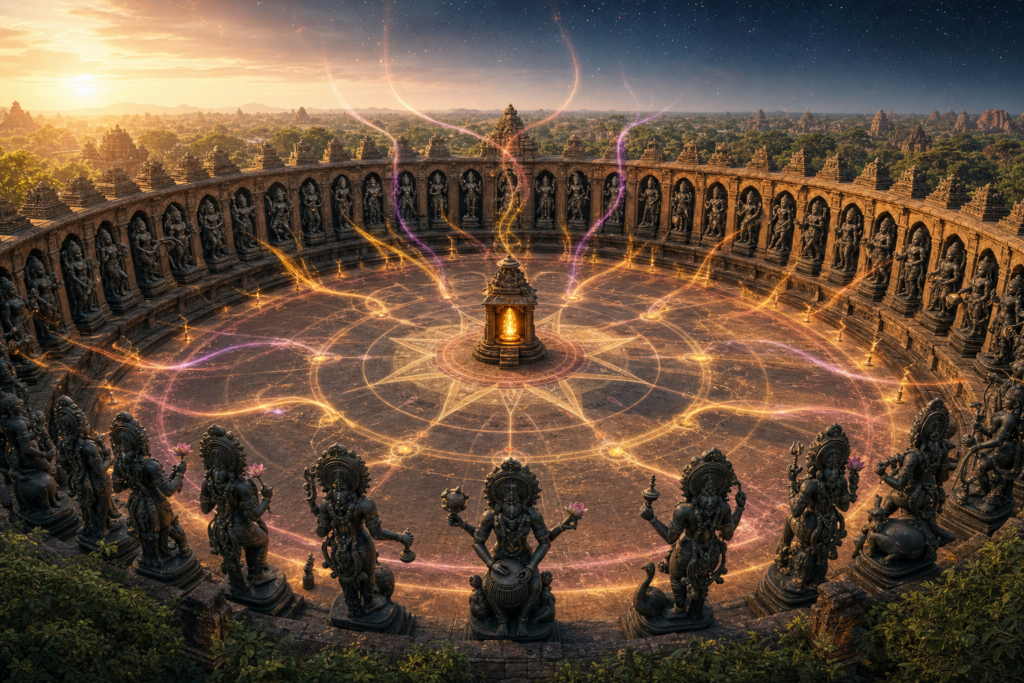
The Devi Mahatmyam preserves a striking account of cosmic balance restored through Mahamaya, the power of Adi Shakti. In the vastness of the primordial ocean, the downfall of the asuras Madhu and Kaitabha becomes a timeless lesson in Maya, humility, and spiritual discernment. Read as symbolism as well as history of ideas, the episode continues to guide seekers across dharmic traditions in understanding how wisdom overcomes arrogance.
At the dawn of creation, Lord Vishnu reclined upon Ananta, while Brahma emerged on the lotus from his navel. From Vishnu’s earwax arose two formidable asurasMadhu and Kaitabhawhose fury threatened Brahma and the very process of creation. The scene, drawn from Hindu scriptures, foregrounds the fragility of order when pride and aggression rise unchecked.
Brahma invoked Mahamaya, the radiant power of Devi, whose presence is celebrated in the Devi Mahatmyam as the ground of awakening and discernment. Responding to the hymn, the Goddess withdrew the veil (yoga-nidrā) from Vishnu, rousing him to action, and later cast her bewildering Maya upon the asuras. Thus the narrative locates Adi Shakti not merely as force, but as the very intelligence by which the cosmos recognizes and rectifies imbalance.
A great battle ensued between Vishnu and the asuras, said to endure for thousands of years. Under the subtle influence of Mahamaya, Madhu and Kaitabha, inflated with hubris, offered Vishnu a boonan inversion that exposes the absurdity of unchecked ego. Vishnu asked for the boon to slay them; they replied that death could come only where there was no water. Accepting their condition, Vishnu lifted them upon his thighs and slew them, bringing an end to their arrogance and safeguarding creation.
Hindu symbolism often interprets Mahamaya as the power that both veils and reveals truth, guiding consciousness toward viveka (discernment). The ocean evokes undifferentiated potential; the asuras personify rajasic and tamasic impulsesrestless craving and dull obstinacythat assail inner clarity. Vishnu’s thighs, above the waters, symbolize a stable foundation beyond the turbulence of illusion; there, the paradox of ego collapses under the weight of its own contradictions.
The emotional force of the story lies in the moment the asuras declare, “Ask a boon,” mistaking pride for strength. Many readers recognize this in ordinary lifewhen confidence hardens into conceit, insight recedes, and self-defeat begins. The Devi Mahatmyam frames this descent with precision: Maya does not merely deceive; it educates, revealing to the arrogant their limits and to the humble their strength.
The narrative’s resonance extends across dharmic traditions. In Buddhism, the recognition of māyā and the cultivation of prajñā (wisdom) align with the same arc from delusion to clarity. Jain philosophy identifies mohaniya karma, the deluding force, as a primary obstacle to samyak darshan (right vision). Sikh teachings warn against haumai (ego), directing seekers to wisdom through gurmat. Together with Hindu scriptures, these perspectives affirm a shared ethic: humility, discernment, and non-harm restore inner and outer order.
Practitioners frequently apply this teaching through reflective awareness: noticing when reactive impulses (like anger or vanity) surge, pausing to recover clarity, and acting from steadiness rather than agitation. In leadership and community life, this becomes a practical sadhanahonoring truth over triumph, process over posturing, and service over self-display. In personal relationships, the same insight loosens defensiveness and invites understanding.
As a teaching story, the downfall of Madhu and Kaitabha affirms that Mahamaya is not only a veil but a compassionate revealer. When wisdom awakens under the grace of Shakti, ego-driven force yields to dharma. This enduring lesson from the Devi Mahatmyam guides spiritual seekers and communities alike toward unity in diversityhonoring the many paths within Hinduism, Buddhism, Jainism, and Sikhism while embracing the shared pursuit of truth.
Inspired by this post on Hindu Blog.