The end of the Kurukshetra War is not narrated as a triumph but as a profound silence. After eighteen days of unrelenting combat that, in many traditional retellings, consumed nearly four million warriors, the field lay quietnot because of jubilation, but because no strength remained to lift another weapon. The Pandavas stood amid the bodies of brothers, teachers, sons, and grandsons. Victory, if it could be called that, was hollow.
Scale in the Mahabharata is more than arithmetic. The epic speaks of eighteen akshauhinis facing one anothereleven for the Kauravas and seven for the Pandavas. A single akshauhini, classically enumerated, includes 21,870 chariots, 21,870 elephants, 65,610 cavalry, and 109,350 infantry. Whether or not these numbers correspond to historical census, their narrative force is clear: the epic magnifies the human cost to ensure the moral reckoning cannot be ignored.
This reckoning frames the central insight often missed in surface readings: the Mahabharata warns against meaningless war even while acknowledging that a dharma-yuddhawar undertaken in defense of dharmamay, in extremis, be unavoidable. The text opens the war on the “dharmakṣetra,” a field of righteousness, to insist that moral truth, not martial prowess, must decide history’s course.
Long before the conches sounded, diplomacy was exhausted in Udyoga Parva. Kṛṣṇa’s embassy articulated a minimal demand for peacefive villagesonly to be scorned by Duryodhana. Vidura-niti warned against the arrogance of power, the folly of ignoring wise counsel, and the ruin that follows adharma. The tragedy is not that war came, but that every avenue to prevent it was despised.
Read through an ethical lens, the Mahabharata sketches criteria that modern theorists would call just war principles. There is just cause (redress of grave wrongs and violation of lawful succession), legitimate authority (the Kuru polity and its elders, even if compromised), right intention (restoration of order rather than conquest), last resort (after diplomacy fails in Udyoga Parva), probability of success (however uncertain, the Pandavas stake their case on dharma), and discrimination and proportionality (war codes that restrain means and spare non-combatants). These are not abstractions; they are tested, violated, and vindicated within the narrative itself.
The Kurukshetra War is punctuated by detailed laws of armed conduct. Fighting halts at dusk; duels are to be even-matched; the unarmed, the wounded, and those who surrender are to be spared; weapons are not to be used against civilians; and deceit in battle is censured. Violationsfighting after dark, attacking from behind, surrounding a lone combatantare marked as adharma within the story’s moral grammar.
Because those laws are broken, moral consequence follows. The killing of Abhimanyu inside the Chakravyuha, when rules of fair combat were abandoned, is singled out as a decisive descent into adharma. The Sauptika Parva records the night raid led by Aśvatthāman on sleeping soldiersan act the epic repeatedly condemns as beyond the pale. Even the deployment of terrible astras is hedged with censure and vows of restraint, warning that some means poison victory itself.
In the aftermath, the epic refuses triumphalism. Stri Parva gives voice to the wails of mothers and widows, insisting that political success without ethical vindication is moral failure. Gandhari’s grief and curse ring through the camp. Yudhiṣṭhira, overcome with remorse, initially rejects sovereignty. Bhīṣma, impaled yet luminous, answers with Shanti Parva and Anuśāsana Parvavast compendia on rajadharma, apaddharma, and personal ethics that dwarf the war books in length and weight.
Across these books, the teaching is unsparing: governance must heal what war destroys. The duty of a ruler is protection with minimal coercion, compassionate taxation, equitable justice, and ceaseless attention to the welfare of the most vulnerablewidows, orphans, laborers, and those left landless. The epigrammatic moral, often remembered as “ahimsa paramo dharmah dharma himsa tathaiva cha,” is given with nuance: nonviolence is the highest duty, and yet there are situations in which force used in the defense of dharma is also duty. The burden of that exception is heavy, not light.
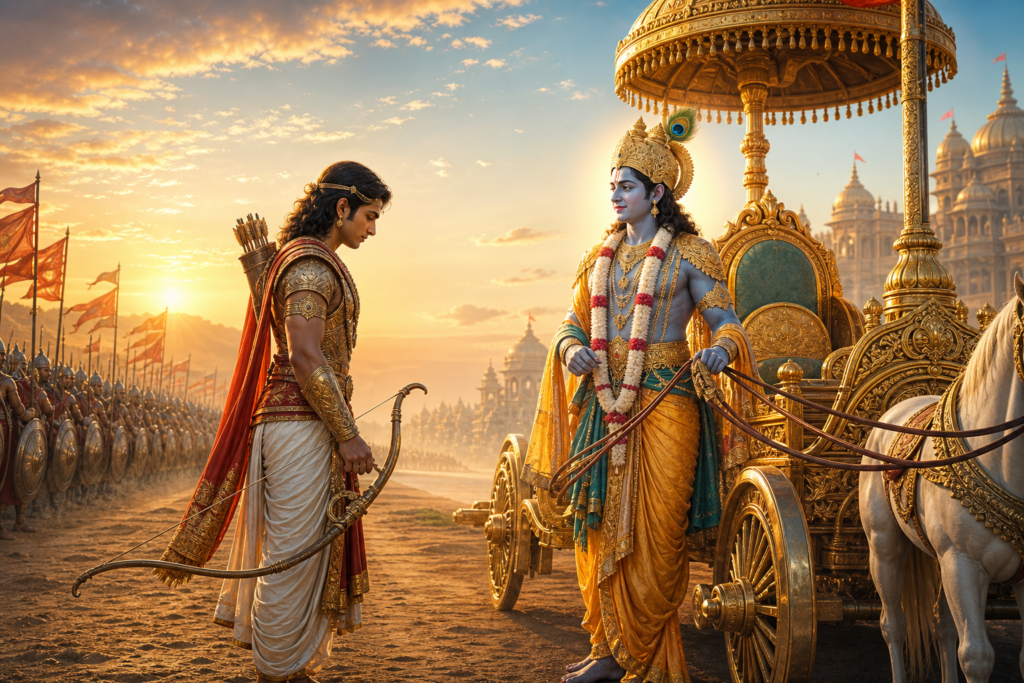
Against this canvas, the Bhagavad Gita stands not as a hymn to violence but as an inquiry into right action under crushing ambiguity. Arjuna’s paralysis on the eve of battle is the ethical vertigo of one who sees teachers and kin on both lines. Kṛṣṇa answers not with a call to conquest but with a discipline of discernment: act without hatred, relinquish attachment to results, purify intention, and perform sva-dharma as service to the order that sustains life. The Gita neither glorifies killing nor sanctifies passivity; it seeks the narrow path between cowardice and cruelty.
When the conches finally fall silent, the epic tallies losses not by trophies but by tears. Yudhiṣṭhira’s Ashvamedha is hesitant and heavy-hearted; it cannot erase the cost of Kurukshetra. If the war chapters dramatize the collapse of order, Shanti and Anuśāsana Parvas construct the architecture of recovery: restitution, restraint, humility, and relentless public welfare.
Placed alongside sister traditions in the dharmic family, the warning against meaningless war becomes brighter still. Jainism elevates ahiṃsā to unconditional primacy, holding up the ideal of radical non-harm. Buddhism, through Right Intention and Right Action, binds power to compassion and restraint, diagnosing violence as a failure of wisdom and empathy. Sikh teachings shape the sant-sipahi idealsaintliness first, the warrior’s defense of justice only as last resort. Read together, these dharmic traditions affirm a single chord: protect life, prevent harm, and if force is tragically required, subordinate it absolutely to ethics, compassion, and accountability.
Modern humanitarian law echoes what the epic dramatizes. Jus ad bellum (the right to go to war) and jus in bello (right conduct in war) are intelligible within Kurukshetra’s narrative frame: a society that neglects diplomacy, ignores elders’ counsel, and permits adharma in the name of victory destroys the very justice it claims to defend. The Mahabharata anticipates this verdict with narrative rather than statute.
At root, the catastrophe is institutional. A gambling hall replaces lawful succession; a blind throne tolerates injustice for the sake of family pride; the most trusted guardiansBhīṣma and Droṇahesitate at the edge of principle and participation. Structural weaknesses in the Kuru polity permit personal vices to metastasize into public calamity.
Leadership failure is diagnosed with clinical clarity. Dhṛtarāṣṭra’s attachment corrodes judgment; Duryodhana’s envy and hubris mobilize violence; Shakuni weaponizes grievance; even the noble falter when vows bind them to unworthy ends. The Mahabharata does not scapegoat; it maps complicity.
Counsel, in contrast, is luminous. Vidura-niti provides a statecraft manual on prudence, ethical risk, and peacemaking. Kṛṣṇa’s diplomacy demonstrates that humility can be strategically potent. Sanjaya’s truthful reporting to Dhṛtarāṣṭra models accountability in crisis. The text repeatedly shows that listening to wisdom costs less than learning from ruin.
Readers who have witnessed family estrangements, community polarizations, or organizational breakdowns may find these scenes painfully familiar. The spiral that begins with a slight and ends in devastation is not confined to kingdoms and kings. Kurukshetra is also an interior field, where resentment, pride, and fear can mobilize inner wars that leave relationships and communities in ash.
For those concerned with governance, Shanti Parva’s rajadharma remains specific and actionable: lighten taxes in times of distress; protect agriculture and artisanry; maintain impartial courts; guard against corruption; invest in roads, water, and granaries; elevate learning; secure borders without militarizing society; and, above all, ensure that state power remains a trustee for the weak. These duties frame the real work after any conflictrepair.
The epic even encodes a technical consciousness of scale and proportionality. The akshauhini calculus and the twelvefold division of the army into vyuhas are not only narrative devices but pedagogic tools that force attention to logistics, attrition, and the limits of force as an instrument of policy. Strategy that ignores cost becomes self-destructive; the Mahabharata insists one count beyond victory.
Notably, the longest books of the Mahabharata are not the war books but Shanti and Anuśāsana. This is literary engineering with a moral point: the true labor of civilization is reconstruction through dharma, not the spectacle of battle. A culture that remembers only the charge of Bhīma’s mace and forgets the obligations of rajadharma has misread the text.
The refrain “meaningless war” is therefore not rhetorical excessit is the lesson. When ambition, humiliation, or ideology eclipse dharma, war loses meaning even when it achieves objectives. Kurukshetra’s hollow victory is the epic’s way of underlining this: success that annihilates the conditions of a just peace is not success.
Dharmic unity sharpens this warning. Hindu, Buddhist, Jain, and Sikh teachings converge on the conviction that inner transformation precedes outer justice. A society that cultivates ahiṃsā, compassion, satya, and seva naturally reduces the likelihood of conflict; and when conflict threatens, it is more likely to choose dialogue, mediation, and forgiveness over force. This unity of ethical purpose is the durable path away from new Kurukshetras.
In contemporary geopolitics and civic life, the Mahabharata’s guidance is both sobering and hopeful. Sobering, because it shows how rapidly norms collapse when leaders valorize grievance; hopeful, because it demonstrates that even after catastrophe, communities can rebuild through principled leadership, social welfare, and truth-telling. The epic’s authority lies not in prescribing utopia but in mapping recovery.
What, then, is the “true message” of Kurukshetra’s end? It is that dharma must precede and survive force; that justice without compassion curdles into vengeance; that victory without restraint begets new violence; and that the work of peace is longer, harder, and ultimately nobler than any battlefield feat. The silence after the last conch is an injunction to listenso that future conches need not sound.
Taken as a whole, the Mahabharata invites a rigorous ethic for public life: exhaust diplomacy before arms; bind force to law and conscience; honor the limits of victory; center the vulnerable in policy; cultivate leaders who can hear unwelcome truths; and nurture dharmic unity across traditions so that common values can disarm conflict before it matures. In this way, Kurukshetra’s hollow victory becomes a living warningagainst meaningless war, and for meaningful peace.
Inspired by this post on Hindu Blog.