Kokamukha (also spelled Kokmukha or Kokamukhi) occupies a distinctive place in the Shakta imagination as a fierce, protective manifestation of Mahakali. Framed by the language of cremation-ground symbolism and guardianship, Kokamukha is remembered in temple traditions, scholastic glosses, and regional liturgies as the jackal-faced form of the Goddess who confronts fear, impurity, and death to restore cosmic balance.
Within Hindu scriptures and Puranic literature, enumerations of the Goddess’s terrifying and benevolent aspects vary across regions and periods. While pan-Indian compendia such as the Skanda Purana and Padma Purana systematize the pantheon of Devi and her manifestations, regional sthalapuranas, Tantric paddhatis, and oral priestly lists often preserve specialized epithets. Kokamukha appears in this liminal spaceknown to local temple communities and hinted at in inscriptional or iconographic contextseven when not universally standardized in widely circulated canonical recensions.
The name itself rewards careful philological attention. The second member of the compound, mukha, is the well-known Sanskrit term for “face.” The first member, koka, has been glossed in medieval and vernacular registers to signify a jackal in select regional lexica, even though mainstream Sanskrit typically prefers shrigala for jackal. The presence of dialectal, Prakrit, or Apabhramsha layers in Tantric and folk nomenclatures helps explain why Kokamukha coexists with more familiar Sanskritized descriptors within Shakta usage.
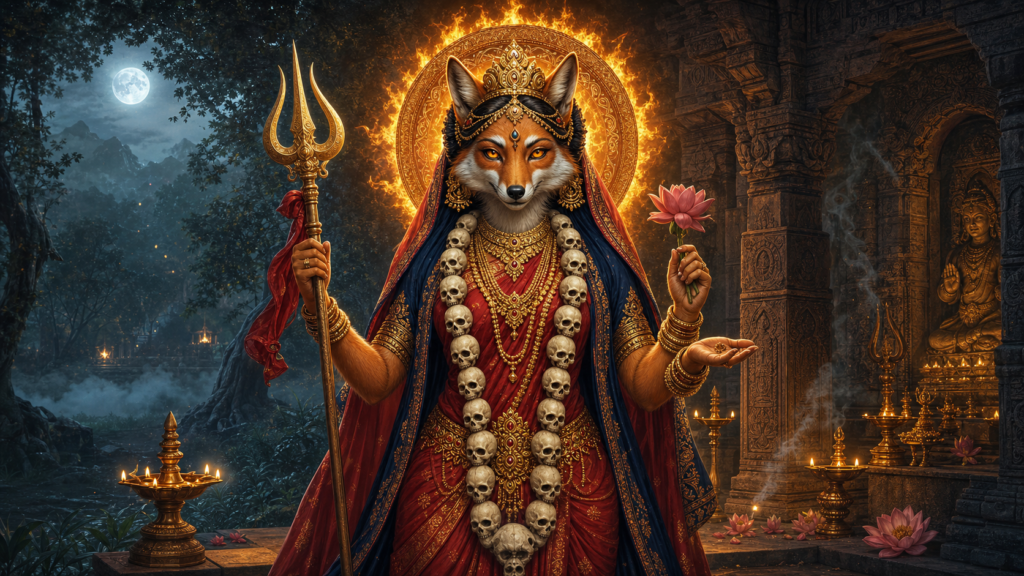
Iconographically, Kokamukha draws from the full grammar of Mahakali and the cremation ground. Textual and sculptural conventions suggest a visage with an elongated muzzle and upright ears, a garland of skulls (mundamala), disheveled hair, and a body adorned with bone and serpent ornaments. As with allied forms of Kali and Chamunda, the attributes frequently include a chopper (kartrika) and a skull-bowl (kapala), with posture set in a dynamic pratyalidha stance over a corpse (shava) that symbolizes the transcendence of ego and time.
The jackal-faced dimension is theologically precise rather than merely macabre. In Tantric hermeneutics, the jackal is a liminal beingdwelling at the threshold between village and wilderness, life and death, purity and pollution. By assuming the jackal’s face, the Goddess demonstrates fearless sovereignty over transitional spaces. She both sanctifies and governs the margins of society and consciousness, inviting practitioners to transform anxiety and aversion into discernment and fearlessness (abhaya).
Kokamukha’s profile resonates strongly with the cremation-ground (shmashana) ethos in which many fierce forms of Devi are situated. The howls of jackals, the flicker of funeral pyres, and the presence of scavengers are not portrayed as inauspicious in Shakta theology; rather, they are taught as uncompromising teachers of impermanence. Kokamukha embodies this instruction, converting the unsettling atmosphere of the boundary space into a sanctuary of awakening, protection, and transformative wisdom.
Historical and art-historical pathways to Kokamukha often lead through the Yogini traditions. The 64 Yogini temples of central and eastern IndiaHirapur (Odisha), Bhedaghat and Khajuraho (Madhya Pradesh), and related sitespresent animal-faced and human-faced Yoginis whose names were regionally transmitted and sometimes vary across inscriptional records, priestly handlists, and modern scholarship. In this matrix, a jackal-faced Yogini linked to Kali’s energy can be locally remembered as Kokamukhi or Kokamukha, even when epigraphs are fragmentary or when alternative readings exist.
Epigraphic evidence from the early-medieval period indicates the patronage of Yogini shrines by regional dynasties, alongside references to fierce goddesses in donative inscriptions. Where names are preserved, orthography and paleography can complicate identification, resulting in variant readings. The name Kokamukha is most responsibly treated as part of this fluid Tantric-epigraphic environment: a serious candidate borne out by temple memory and iconographic logic, but subject to ongoing scholarly scrutiny about exact textual anchors and historical trajectories.
Theological comparison with Chamunda is illuminating. Chamunda’s entourage, cremation-ground setting, and association with jackals create a close family resemblance with Kokamukha. Both communicate the Goddess’s sovereignty over decay and dissolution; both function as guardians at civilizational and psychological thresholds. The difference is one of emphasis and localized naming: Kokamukha foregrounds the jackal-faced identity as a primary iconographic key, while Chamunda’s broader profile integrates similar motifs under a more widely standardized name.
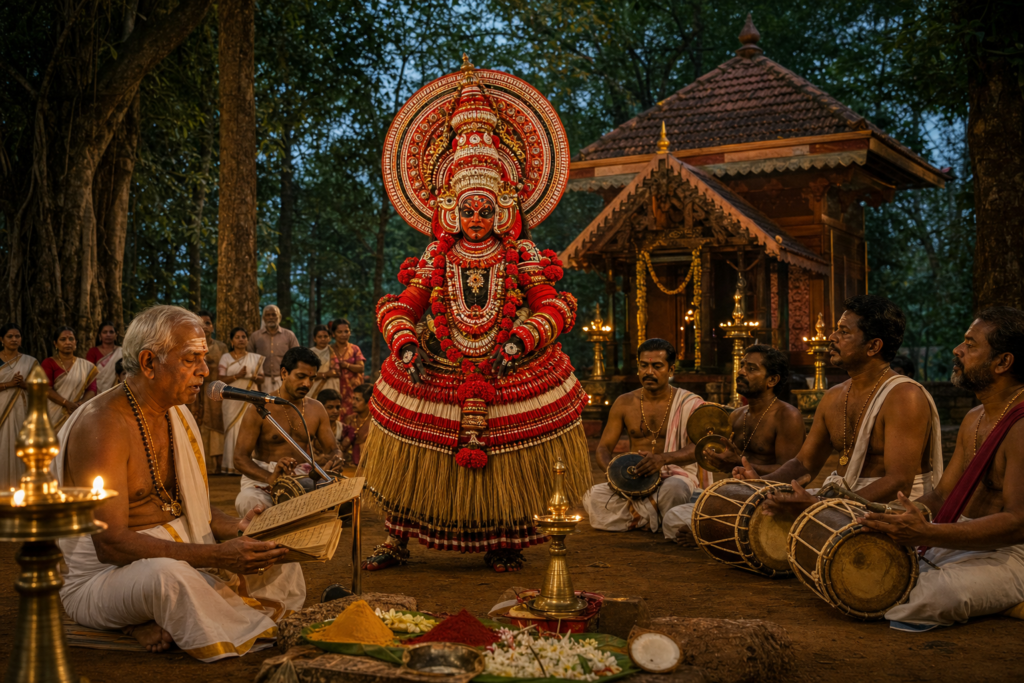
Ritually, Kokamukha’s logic aligns with practices observed during certain Navaratri evenings and especially Kali Chaudas (Naraka Chaturdashi) in parts of western India, when fierce forms of the Goddess are propitiated for protection and removal of obstacles. Shakta paddhatis describe offerings appropriate to cremation-ground iconography, though mainstream household and temple worship typically adopts vegetarian, sattvic substitutions in recognition of local dharmic norms. This duality reflects the broader Shakta principle that the same divine reality accepts multiple modes of approach, calibrated to time, place, and disposition.
Doctrinally, Kokamukha affirms the integrity of Shakti as both terrible and tender. The jackal-faced aspect declares that no corner of existenceincluding the feared and the rejectedlies outside divine care. By wearing the face of what society would push away, the Goddess reclaims and reintegrates it, healing the partitions created by fear. This reintegration is not only metaphysical but ethical: it invites compassion toward beings inhabiting the margins, and it instructs practitioners to confront inner shadow with steadiness.
Comparative dharmic perspectives reinforce this message of unity-in-diversity. In Vajrayana Buddhism, charnel-ground dakinis likewise transvalue boundary spaces into sites of awakening, a thematic parallel to Kokamukha’s symbolism. In Jain traditions, while nonviolence and restraint guide worship, protective yakshis and yakshas are entrusted with guardianship functions that echo the ethos of liminal safeguarding. In Sikh tradition, the valorized memory of Shakti in compositions such as the Chandi corpus emphasizes righteous courage under divine protection. Together, these perspectives underscore a shared civilizational insight: sacred power can appear fierce while serving compassion and moral clarity.
From a practitioner’s standpoint, the experiential language around Kokamukha is intimate and practical. Devotees and priests often describe the jackal-faced form as a presence that steadies the mind in grief, transitions, and crisisexactly the contexts that cremation-ground imagery dramatizes. Field observations at Shakta shrines suggest that devotees frequently report three outcomes from such worship: a sense of protective enclosure, a clear-eyed acceptance of impermanence, and a renewed commitment to ethical responsibility within family and society.
The semantics of sound add another layer to Kokamukha’s meaning. The night call of jackalshaunting yet rhythmicserves as a sonic emblem for liminality, much as temple bells mark thresholds. In ritual imagination, this soundscape teaches vigilance and wakefulness. Where fear once surged at the edge of the village or the edge of thought, Kokamukha’s guardianship reframes the boundary as a gate of discernment rather than a wall of anxiety.
It is also important to acknowledge scholarly caution. Not every temple sculpture with a canine-like muzzle is securely identified as Kokamukha, and not every regional text that mentions a jackal-faced goddess intends this specific epithet. Inscriptions may be incomplete; variant readings can be produced by weathering or by the scribal conventions of the time. Responsible interpretation compares textual typologies, local priestly memory, and iconographic markers before reaching a judgment, and remains open to revision as new evidence is documented.
Nevertheless, the convergences are compelling. The cremation-ground context, the guardianship function, the animal-faced signature, and the protective promise coherently align with Mahakali’s spectrum. Where temples or oral traditions name Kokamukha explicitly, that naming preserves a precise theological intuition: the Goddess wears the face of what is feared in order to bless and redeem it. Under that sign, the fiercest visage conceals the most unyielding compassion.
For readers tracing scriptural pathways, the Puranas remain vital for framing Devi’s cosmology, even when a specific epithet like Kokamukha is transmitted locally rather than pan-India. Skanda Purana and Padma Purana set the narrative grammar for the Goddess as slayer of adharma; Tantric compendia and regional manuals extend this grammar into specialized ritual ecosystems. The result is a layered archive in which a form such as Kokamukha is both recognizable by function and distinguishable by name in select locales.
For temple historians and epigraphists, Kokamukha invites ongoing integrative work: correlating fragmentary donative records, studying stylistic clusters in Yogini and Sakta shrines, and documenting priestly recitation lineages that conserve older lists of names. This effort benefits from collaboration across disciplines as well as from respectful engagement with living communities whose daily worship is the most continuous archive of all.
In practical spirituality, Kokamukha’s lesson is direct. Fear is not annihilated by denial but transformed by encounter; impurity is not spread by compassionate recognition but purified by it. The jackal-faced Mahakali stands where loss is raw and accompanies those who cross difficult thresholdsfunerals, migrations, ruptures, and personal reckoningswith the assurance that dharma remains possible and meaningful on the far side of change.
In the wider dharmic familyHinduism, Buddhism, Jainism, and Sikhismsuch teachings translate into a shared ethic of courage, service, and reverence for life. These traditions differ in doctrine and practice, yet converge on the conviction that sacred power, however fierce in aspect, protects, clarifies, and uplifts. Remembered in that spirit, Kokamukha is not a curiosity of esoterica but a living signifier of unity in the diverse ways the sacred meets the world.
Viewed this way, Kokamukha is both a particular and a principle: a particular form of Mahakali with a distinct jackal-faced profile, and a principle of spiritual guardianship at the world’s thresholds. The form educates perception, the principle instructs conduct. Together they proclaim a central truth of Shaktiwhat is most fearsome to the senses can be most healing to the heart when seen in the light of dharma.
Inspired by this post on Hindu Blog.