
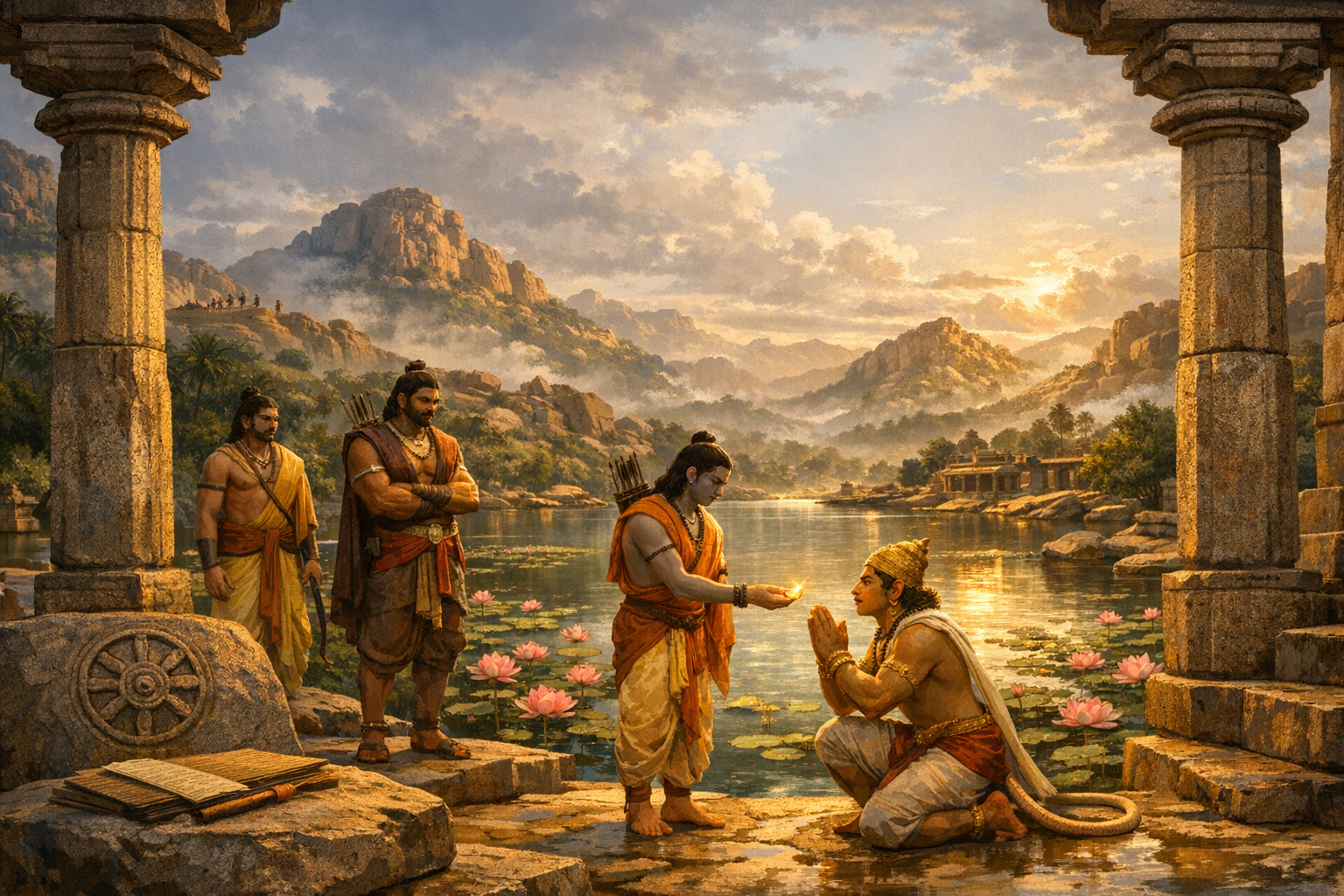
Kishkindha Kanda, the fourth book of the Valmiki Ramayana, forms the pivotal bridge between the wilderness of exile and the organized quest to recover Sita. It narrates the first sustained alliance between Sri Rama and the vanara communities, inaugurates Hanuman’s public emergence as an unparalleled emissary, and situates the drama within a vividly rendered sacred geography widely identified with present-day Hampi in Karnataka along the Tungabhadra River. The kanda’s thematic corefriendship, ethical statecraft (dharma), and disciplined service (seva)continues to resonate across Hindu, Buddhist, Jain, and Sikh reflections on righteous conduct and collective responsibility.
In the traditional recension, Kishkindha Kanda comprises 67 sargas (chapters), beginning with Rama and Lakshmana’s arrival at Rishyamukha, followed by Hanuman’s discerning approach, the forging of the Rama–Sugriva pact, the confrontation with Vali, Sugriva’s coronation, the monsoon interlude at Malyavanta hill, and the strategic dispatch of vanara search parties in all directions. It concludes with the decisive selection of Hanuman for the southern mission and Rama’s entrustment of the signet ringa compact token that will later authenticate Hanuman’s message in Lanka.
Hanuman’s first encounter with Rama is an exquisite study in diplomacy and spiritual insight. Approaching in the guise of an ascetic, Hanuman tests intent with refined language that seamlessly blends courtesy, political acumen, and theological literacy. The exchange not only cements trust but also models the classical Indic ideal of an emissary: one who unites truth, prudence, and compassion. From this moment, Hanuman’s rise is both narrative and ethical; he becomes the archetype of intelligent devotion in the Ramayana tradition.
The alliance with Sugriva (sandhi) is framed as a mutual undertaking of dharma: Rama vows to restore Sugriva’s rightful status, and Sugriva commits to mobilizing the vanaras for Sita’s search. The pact is solemnized in the presence of Lakshmana and Hanuman at Rishyamukha, a setting that underscores the sanctity of friendship (mitra-dharma) and the responsibilities of kingship (raja-dharma). In comparative perspective, the episode exemplifies a civilizational consensus found across dharmic traditions: legitimate authority must be grounded in justice, gratitude, and service to the common good.
The Sugriva–Vali conflict supplies the political backdrop. Sugriva’s exile and the seizure of his wife Ruma by Vali are framed as grave moral and legal violations. Rama’s intervention, culminating in the slaying of Vali, has long invited ethical scrutiny. The text offers layered justifications: the punishment of a sovereign who transgressed dharma, the restoration of lawful order, and the application of ksatra-dharma when no higher adjudicating authority could be convened. These arguments are not presented as mere expedients; they emerge from a jurisprudential ethos that prioritizes protection of the vulnerable and rectification of injustice.
The debate over Vali-vadha is one of the Ramayana’s most sophisticated ethical dialogues. Vali questions the propriety of Rama’s hidden shot; Rama responds with reasons rooted in dharma and state security, including the principle that rulers may act decisively against obstinate wrongdoers who endanger social order. Classical commentators also note Vali’s transgression in appropriating his brother’s spouse, a violation that undermined his moral title to rule. Read alongside Buddhist sila (ethical discipline), Jain ahiṃsa tempered by anekantavada (many-sided truth), and Sikh ideals of justice-oriented seva, the episode becomes a platform for multi-tradition reflection on the limits and obligations of righteous force.
Tara’s counsel to Vali and later to the court of Kishkindha offers a rare, incisive voice of statecraft from a queen renowned for prudence. Her measured warnings highlight the Indic appreciation for reasoned speech (niti) in moments of crisis. Tara’s presence also evidences a political culture in which women’s perspectives are integral to discernment, further enriching the kanda’s discourse on just governance and ethical restraint.
With Vali’s fall, Sugriva’s coronation restores constitutional order. Yet the narrative immediately examines royal accountability: as the monsoon rains close the passes and fill the gorges of Kishkindha, Sugriva delays action. Lakshmana’s sharp reprimand, delivered at Malyavanta, is not anger for anger’s sake; it is a reminder that sovereignty is stewardship. This tension between royal comfort and public duty is as relevant to modern policy debates as it was in ancient polity.
Once the rains recede, the mobilization is technical and thorough. Search parties are formed with explicit geographic briefs, timelines, and reporting linesan early template for campaign logistics. Senior leadership is distributed wisely: Jambavan as elder strategist, Angada as youthful commander, and Hanuman as the uniquely qualified envoy whose clarity of mind (mati) and fearlessness (abhaya) match the mission’s stakes.
Rama’s gifting of the signet ring to Hanuman serves an elegant semiotic function: it is both credential and covenant. The ring will later assure Sita of the message’s authenticity and symbolize the unbroken chain from Rama’s will to Hanuman’s action. In the long reception of the Ramayanawhether in Kamban’s Tamil epic, Tulsidas’s Ramcharitmanas, or the Baroda critical edition traditionthe ring remains a concise emblem of trust, service, and truth in transmission.
The landscape of Kishkindha is more than a backdrop; it is an active participant in meaning. The consensus of textual memory and local tradition identifies Kishkindha with the Hampi–Anegundi region of Karnataka along the Tungabhadra. Pampa Sarovar, Matanga Parvat, Rishyamukha, and Anjanadri are venerated place-names that align closely with the Ramayana’s descriptive cues. The monumental remains of the Vijayanagara Empire at Hampitoday a UNESCO World Heritage Siteoverlay this older sacred geography without erasing it, creating a palimpsest where epic memory and medieval urbanity converse.
Descriptions of Kishkindha celebrate a landscape alive with natural beautyvalleys veined with streams, caverns dense with echoes, and groves of holy trees sheltering diverse fauna. This ecological sensibility is not incidental; it affirms an ancient ethic of environmental reverence. The kanda’s attentiveness to seasonality (varsha), terrain constraints, and resource flows also discloses a practical intelligence about movement, supply, and communicationprecursors to what modern readers might call campaign logistics or environmental planning.
Philologically, the term vānara is intriguing. While popularly taken to mean “monkey,” many scholars note a layered semantics: vana-nara (forest-dweller), a tribal confederation, or a class of semi-divine forest people. The Ramayana itself treats the vanaras as morally and politically responsible agentscapable of counsel, treaty, and sacrifice. This reading is inclusive rather than exclusionary: it honors living communities and landscapes as co-architects of dharmic history, aligning with a broader South Asian respect for indigenous wisdom.
Hanuman’s profile in Kishkindha Kanda is that of an exemplary emissary. Trained in grammar, scripture, and statecraft, he embodies the union of knowledge (jnana) and action (karma). His humility before Rama coexists with bold initiativequalities celebrated across dharmic traditions. For many readers, this synthesis parallels the Buddhist bodhisattva’s compassionate courage, the Jain ascetic’s disciplined resolve, and the Sikh sant-sipahi ideal of contemplation wedded to service.
From an intertextual standpoint, Kishkindha Kanda invites comparative study. Kamban amplifies the emotional register of friendship and loyalty, Tulsidas underscores the devotional energy that propels Hanuman forward, and the critical edition helps clarify earlier narrative layers. These streams do not compete; they deepen one another, modeling an approach to scripture that is plural, respectful, and dialogican approach that has long characterized the civilizational ethos of Bharatavarsha.
For those engaging the geography directly, several nodes stand out around Hampi and Anegundi: Anjanadri (traditionally associated with Hanuman’s birth), Pampa Sarovar (linked with Shabari and the narrative’s turn toward Kishkindha), Rishyamukha (site of the initial parley with Sugriva), Matanga Hill (a vantage point tied to ascetic memory), and the Malyavanta Raghunatha temple complex (evoking the monsoon sojourn). Visiting these sites with ecological sensitivityhonoring sacred trees, minimizing noise in wildlife corridors, and supporting local communitiestranslates textual reverence into living practice.
Ethically, Kishkindha Kanda probes a perennial question: how should righteous power respond to gross injustice? The text’s answer is neither cynical nor utopian. It asks rulers to be guardians, not predators; friends to be steadfast, not expedient; and envoys to be truthful, not theatrical. Set beside the shared values of dharma, ahiṃsa, karuṇā, anekantavada, and seva across Hinduism, Buddhism, Jainism, and Sikhism, the kanda offers a common grammar of responsibility that strengthens inter-tradition understanding and unity.
In narrative terms, the kanda ends where the next must begin: with Hanuman poised for flight. The alliance is secured, the kingdom stabilized, the rains have passed, and the search has been methodically planned. What follows in Sundara Kanda will be heroic and intimate, but its conditions are created herethrough ethical decision, competent organization, and trust forged in truth.
Kishkindha Kanda thus stands as a multidimensional achievement: a study in political ethics, a celebration of sacred landscape, a manual of leadership and logistics, and a luminous preface to Hanuman’s epic service. Read with care, it invites contemporary communities to rediscover shared dharmic values, engage heritage with humility, and translate reverence into responsible action.
Inspired by this post on Hindu Pad.
