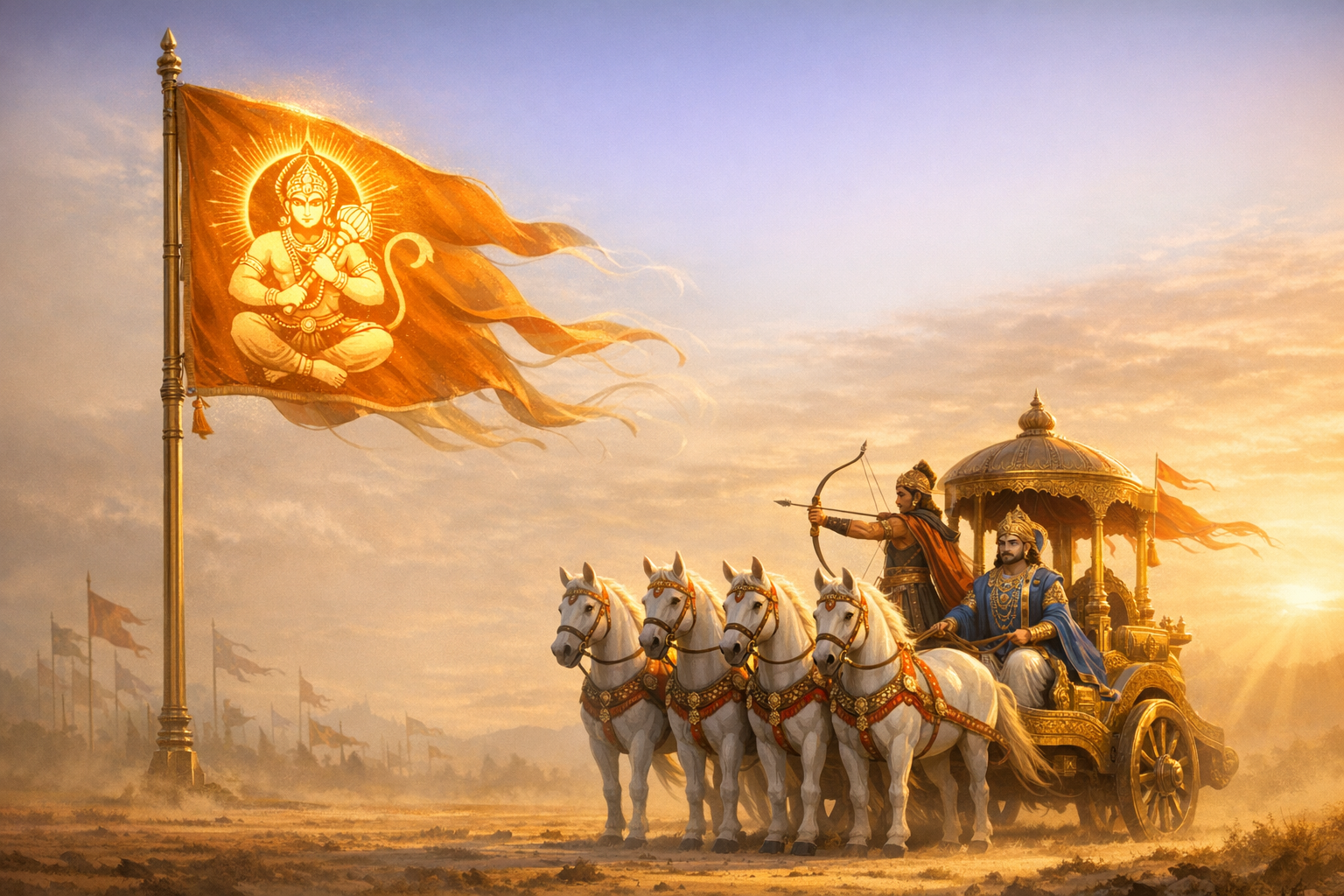
Among the most arresting emblems in the Mahabharata is the Kapi Dhvajathe “ape-banner” flying from Arjuna’s chariot as the Kurukshetra War begins. Far from being mere decoration, this standard operates simultaneously as scriptural marker, military signal, moral compass, and spiritual safeguard. Read carefully, it weaves Treta and Dvapara Yugas together through Hanuman’s presence, binding the valor of Arjuna to the devotional steadfastness of Rama’s foremost bhakta, and aligning human will with divine guidance under Krishna’s charioteership.
Scriptural anchoring is explicit. In the Bhagavad Gita, the very scene-setting of the battlefield names Arjuna as kapidhvajaḥ“ape-bannered” (Bhagavad Gita 1.20). The Sanskrit compound is transparent: kapi means monkey or ape, and dhvaja means banner or flag. The epithet is not a poetic aside; it situates the reader within a visual field of dharma-yuddha, marking Arjuna’s chariot with a symbol instantly intelligible to contemporaries. Banners were battlefield semioticssigns that conferred recognition, rallied troops, and encoded meaning. Calling Arjuna “kapidhvajaḥ” is therefore both descriptive and interpretive.
What, then, does Hanuman’s presence signify? At one level, it establishes a continuity of dharma across ages. Hanuman is inseparably linked to Rama of the Treta Yuga, while Arjuna’s guide is Krishna in the Dvapara Yugatwo avatāras of Vishnu joined through the same paragon of bhakti and service. The banner silently proclaims that righteous struggle is never severed from steadfast devotion. It is an emblem of lineage, blessing, and fidelity to the Supremeseva on the masthead of shaurya.
Traditional narratives amplify this claim through a widely told legend: Arjuna once boasted of building a bridge of arrows capable of bearing any weight. Hanuman challenged the claim, and the structure collapsed under the gentle tread of the Vāyu-putra. Only when Krishna, the indwelling sustainer, supported the bridge did it hold. Humbled, Arjuna received Hanuman’s boon: presence upon his flag in the great war. Scholarly editions note that specific details of this episode circulate robustly in later retellings and regional lore; yet the legend’s explanatory power for the Kapi Dhvaja remains unmatched in the devotional imagination, because it dramatizes an ethical arcstrength purified by humility, ability tempered by reliance on the Divine.
There is also a family-of-forces dimension. Hanuman and Bhima are both born of Vāyu, the wind principle. In the Mahabharata’s Vana Parva, Bhima encounters Hanuman and receives a boon of protection and strength. The Pandava war effort is thus repeatedly linked to the Vāyu-tattvavital force, momentum, and breath. Arjuna’s banner extends that current into the command chariot of the Pandava army, synchronizing prāṇa (life-force), kṣātra (martial virtue), and bhakti (devoted service) as an integrated field in which strategy and spirituality mutually reinforce.
A tactical reading underscores the psychological potency of banners. Dhvajas in ancient Indian warfare carried totemic power, designed to hearten one’s own ranks and unnerve the opposition. Hanuman’s figuresynonymous with fearlessness, self-mastery, and unwavering loyaltycommunicated invincibility by association. In many narrative traditions, Hanuman’s roar on the field strikes dread into hostile hearts. Whether taken literally or as memory-metaphor, the effect is consistent: the Kapi Dhvaja operates as psychological warfare in favor of dharma, amplifying morale at decisive moments.
Philosophically, the banner aligns elegantly with the chariot allegory prominent in Indic thought. The Kaṭha Upanishad likens the body to a chariot, the senses to horses, the mind to reins, and the buddhi (discriminating intelligence) to the charioteer. On Kurukshetra, Krishna occupies the charioteer’s seatembodied buddhi and morewhile Arjuna embodies the struggling self, seeking clarity amid conflict. In this hermeneutic, the flag atop the chariot represents the direction-setter of aspiration and prāṇa. Hanuman, as the concentrated energy of Vāyu and the epitome of focused devotion, presides over the chariot’s intention. He sanctifies purpose, steadies breath, and points the campaign of life toward righteous ends.
Viewed through yoga, that imagery becomes almost technical. Breath-work (prāṇāyāma) stabilizes attention; unwavering attention stabilizes action. Hanuman’s presence on the banner literalizes prāṇa-guided purpose. The warrior’s focus must be as strong as Hanuman’s vow to Ramaekāgratā (one-pointedness) in service of dharma. In this sense, the Kapi Dhvaja instructs: mastery of the battlefield begins with mastery of breath, mind, and motive.
The protective dimension, firmly rooted in customary accounts, is equally compelling. At war’s end, Krishna bids Arjuna descend before he himself steps off the chariot; only after Krishna and the banner’s divine presence depart does the chariot combust, consumed by astras it had silently withstood throughout the war. Many recensions and commentarial traditions explain this as the residual power of previously invoked celestial weapons, held at bay by Krishna’s and Hanuman’s guardianship. The didactic point is unmistakable: victory and even survival rode upon divine grace coupled to human courage.
The Kapi Dhvaja also functions as an ethical sign. Hanuman epitomizes dāsya-bhaktidevotional service without ego. Arjuna’s journey in the Gita begins with moha (despondent confusion) and culminates in clarity and surrender to action aligned with dharma. Set above the chariot, Hanuman’s image declares that right action is sourced in right devotionservice to the highest truth, free from vanity. This is the antidote to both moral paralysis and reckless pride.
Intertextuality enriches the symbol further. The Mahabharata repeatedly integrates diverse deities and pathsArjuna’s acquisition of the Pāśupata weapon from Śiva, the presence of Krishna as charioteer, Durga’s blessing before battle in certain traditions, and, here, Hanuman’s banner. The Kapi Dhvaja thus models unity-in-diversity intrinsic to Sanatana Dharma: Vaishnava devotion, Shaiva tapas, and Shakta protection co-operate rather than compete. The emblem proclaims complementarity across sampradāyas and across yugas.
This unifying logic gracefully extends across the broader dharmic family. The dhvaja is a pan-dharmic motif of spiritual triumph: Buddhism venerates the victory banner (dhvaja) among auspicious symbols; Jain traditions crown temples with ensigns of purity and conquest over the inner foe; Sikh gurdwaras raise the Nishan Sahib as a living standard of service and courage. In each case, a flag marks the alignment of community, principle, and practice. Arjuna’s Kapi Dhvaja stands fully within this shared Indic semiotics of victory-with-virtue.
A military-historical glance provides additional context. Pre-modern South Asian armies used distinctive ensigns to aid unit cohesion, command-and-control, and signaling under the noise and dust of combat. The dhvaja was not an ornament but a communications device in a pre-electronic battlespace. By emblazoning Arjuna’s standard with Hanuman, the narrative grants the Pandava C-in-C’s principal field commander a rallying symbol recognized at once by ally and adversary. Semiotics sharpened strategy.
From a cultural-history perspective, the Kapi Dhvaja helped encode the Rama-Krishna continuum into popular memory. For devotees and readers, seeing Hanuman above the friend of Krishna stitches epic cycles together into a single moral fabric: dharma is perennial, its guardians communicate across ages, and devotees become bridges between avatāras. This is pedagogy by iconthe banner teaches continuity as much as it signals command.
For many practitioners, the emblem resonates intimately. The image evokes the experience of chanting the Hanuman Chalisa before a difficult task: breath calms, mind steadies, and intention clarifies. The same triad governs Arjuna’s readiness on Kurukshetraprāṇa regulated, purpose purified, action released under wise guidance. The banner reminds communities and individuals alike that success in the outer arena begins with alignment in the inner one.
Symbolic density also extends to rasa. Hanuman embodies vīra-rasa (heroic sentiment) inseparable from karuṇā (compassion) and dāsya (service). The Kapi Dhvaja refracts these rasas into the warrior’s dharma: courage without cruelty, power yoked to protection, and victory consecrated by humility. This is precisely the sensibility the Gita cultivates in Arjunadetached action grounded in the welfare of the world (lokasaṅgraha).
It bears emphasis that while specific narrative layers around the Kapi Dhvaja vary across textual recensions and later purāṇic or regional lore, the core scriptural datumkapidhvajaḥ in Bhagavad Gita 1.20anchors interpretation. On that foundation, commentarial traditions, temple arts, and performative retellings have preserved a consistent hermeneutic: Hanuman’s presence signals divine sanction, ethical restraint, psychological fortitude, and tactical clarity.
The symbol’s contemporary relevance is immediate. In leadership, education, or public service, the Kapi Dhvaja’s lesson holds: let breath guide attention, let attention purify intention, and let intention align action to a higher principle. Place courage at the service of compassion; place skill under the guardianship of wisdom. As on Kurukshetra, sustainable success depends on that integration.
Summatively, three concentric meanings emerge. Textually, the banner identifies Arjuna and binds the Gita’s battlefield to a trans-epic moral universe. Strategically, it is a potent standard that coordinates and inspires. Spiritually, it consecrates purpose, uniting bhakti and kṣātra under Krishna’s guidance. The Kapi Dhvaja is therefore not an accessory but a thesis in cloth: dharma is victorious when strength bows to wisdom, and when devotion steadies the reins of power.
By bringing Hanuman to Arjuna’s chariot, the Mahabharata offers a compact of unity across dharmic traditions and across time. The Kapi Dhvaja invites every seeker and every community to raise a standard worthy of the fight: fearless, humble, and devoted to the welfare of all.
Inspired by this post on Hindu Pad.