Among the ten principal avatāras of Vishnu, Parashurama (Bhārgava Rāma) and Rama (Rāghava) illuminate a profound civilizational arc. Their signature weaponsthe axe (parashu) and the bow (Kodanda)function not merely as instruments of combat but as portable philosophies that map how power, technology, and ethics evolve as societies mature. Read as sacred symbols within the Ramayana and wider Hindu scriptures, these weapons reveal a movement from corrective severity to codified restraint, from raw force to rule-bound sovereignty, and from clan-level adjudication to statecraft grounded in dharma.
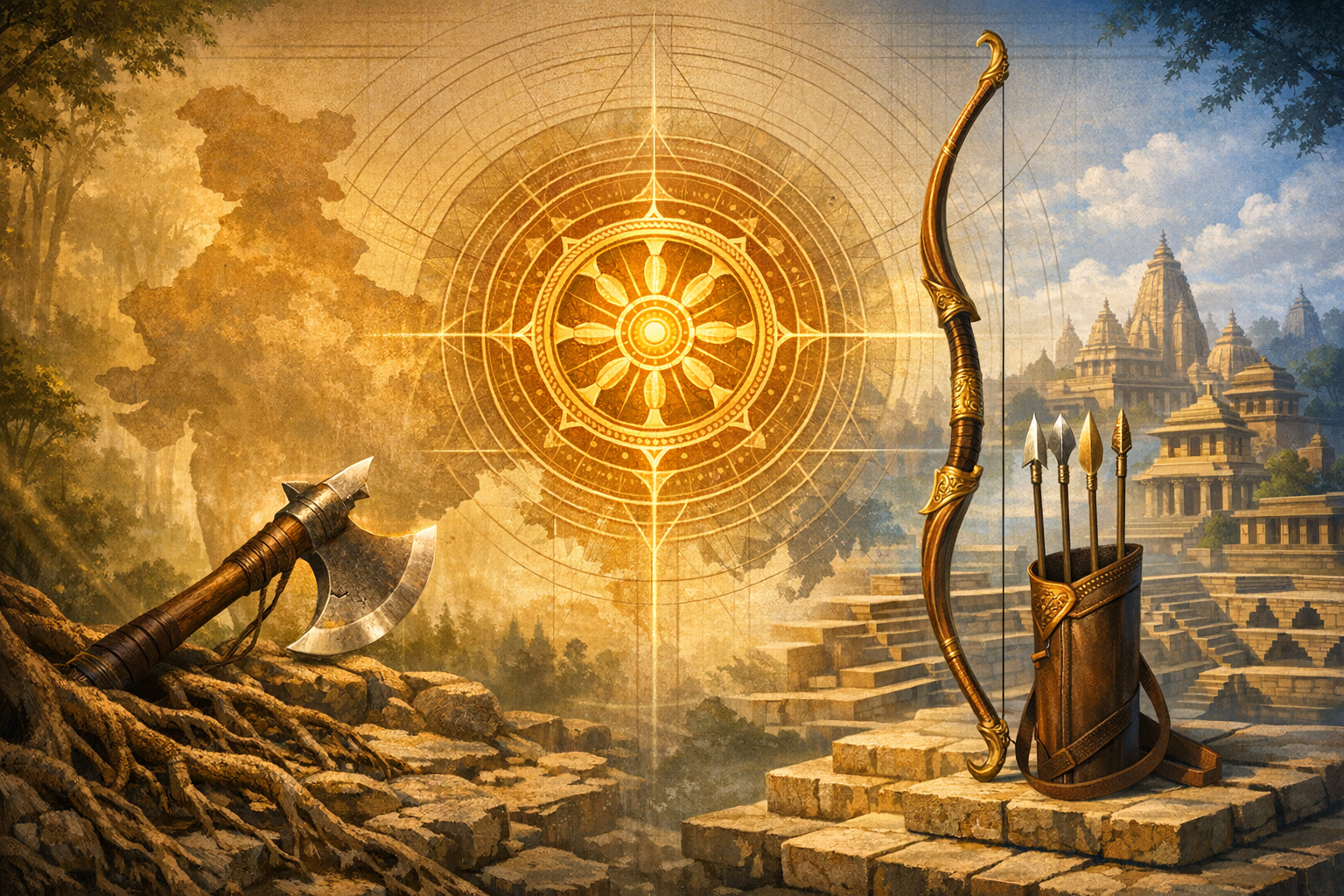
In Indic thought, avatāras appear not to upend reality but to recalibrate it. Each descent clarifies a needed balance for a particular historical and moral condition. Positioned in this tapestry, Parashurama embodies intense rectification and the uncompromising pruning of adharma, while Rama anchors maryadaorder, measure, and lawful kingship. The weapons they hold thus serve as hermeneutic keys: the parashu signals near-field intervention and foundational clearing; the bow conveys distance, foresight, and calibrated application of force across space and time.
Seen this way, the axe and the bow are not only martial tools but “texts” one learns to read. The axe teaches the cutting away of excesswhether forests encroaching on arable land or pride encroaching on justice. The bow, by contrast, demands poise, attention, and discipline; it introduces space between impulse and action, turning warfare into a practice governed by codes, timings, and limits. Together, they narrate the shift from elemental correction to institutional ethics.
Technically, the parashu associated with Parashurama is a formidable implement. Traditional iconography depicts either a single- or double-bladed axe with a pronounced beak for shearing through densitywood, armor, or entrenched defiance. The parashu’s power is as much moral as material: Parashurama receives it from Shiva, the archetype of dissolution and renewal, signifying the sanctioned removal of that which no longer sustains life or order. Across the subcontinent’s pre- and proto-historic periods, axes cleared forests, opened agrarian frontiers, and enabled settlement; the weapon analogizes that civilizational act of making room for dharma to take root.
Purāṇic and epic narratives situate Parashurama as the stern corrector of kshatriya excess, a Brahmin-warrior who embodies the fusion of knowledge and force (brahma-kshatra). The recurring motif of “twenty-one times” is not a ledger of vengeance but a metaphor for cyclical pruninga reminder that political power periodically requires ethical audit. Myths linking Parashurama to the emergence of the Konkan and Kerala littorals and to the establishment of sacred settlements dramatize an enduring truth: before culture flourishes, land, mind, and institutions must be de-silted of obstruction.
Rama’s weapon, by contrast, is the bowvariously named Kodanda in traditionalong with a repertoire of sacred astras (missiles empowered by mantra). Dhanurveda, the classical “science of the bow” and an Upaveda traditionally associated with the Yajurveda, codifies the engineering and ethics of archery. Ancient Indian bow technology ranges from self bows of bamboo and wood to powerful composites binding horn, wood, and sinew, with strings prepared from plant fibers or animal sinews. Arrowheads vary by functionbroadheads for armor, crescent (ardhachandra) for cutting, and bodkins (naracha) for piercingreflecting a sophisticated understanding of ballistics, materials, and mission specificity. The bow converts strength into controlled arc and trajectory; it industrializes intent into proportionate effect.
Beyond hardware, Rama’s arsenal features astras such as the Brahmastra, Agneyastra, and Aindrastra, each accessed through mantra-vidyā. These are not indiscriminate superweapons; they demand interior discipline, correct invocation, and ethical restraint. In the Ramayana, divine weaponry becomes an externalized conscience: potency in one’s hand must be matched by sobriety in one’s heart. Such armaments therefore stand for a late stage in civilizational ethicswhere knowledge, governance, and force are interlocked and rule-bound.
Read through the lens of civilizational evolution, Parashurama’s axe represents a founding phase: clearing, recalibrating, and re-grounding kshatra so that society can breathe. Rama’s bow represents consolidation: the phase of maryada when the sovereign submits himself to norms stricter than those he enforces. One is the emergency surgery that saves the patient; the other is the steady regimen that confers lasting health.
Kshatra Dharmaethics of power and protectionthreads across both. With Parashurama, kshatra appears as an uncompromising rectifier that halts systemic drift. With Rama, kshatra is perfected in maryada, demonstrating timing, proportionality, and due process in conflict. Rama becomes “Maryada Purushottama” precisely because the use of force is not abandoned but refined into law-abiding guardianship.
The weapons also map inner evolution. The axe cuts the roots of avidyā (ignorance), lobha (greed), and mada (pride). The bow cultivates viveka (discernment) and dhāraṇā (steadiness). The Mundaka Upanishad encapsulates this interior Dhanurvidya: “pranavo dhanuh; sharo hy atma; brahma talakshyam ucyate”Om is the bow, the self is the arrow, and Brahman is the target. The spiritual path thus recasts the battlefield within: first the removal of inner thickets, then the focusing of attention toward the highest aim.
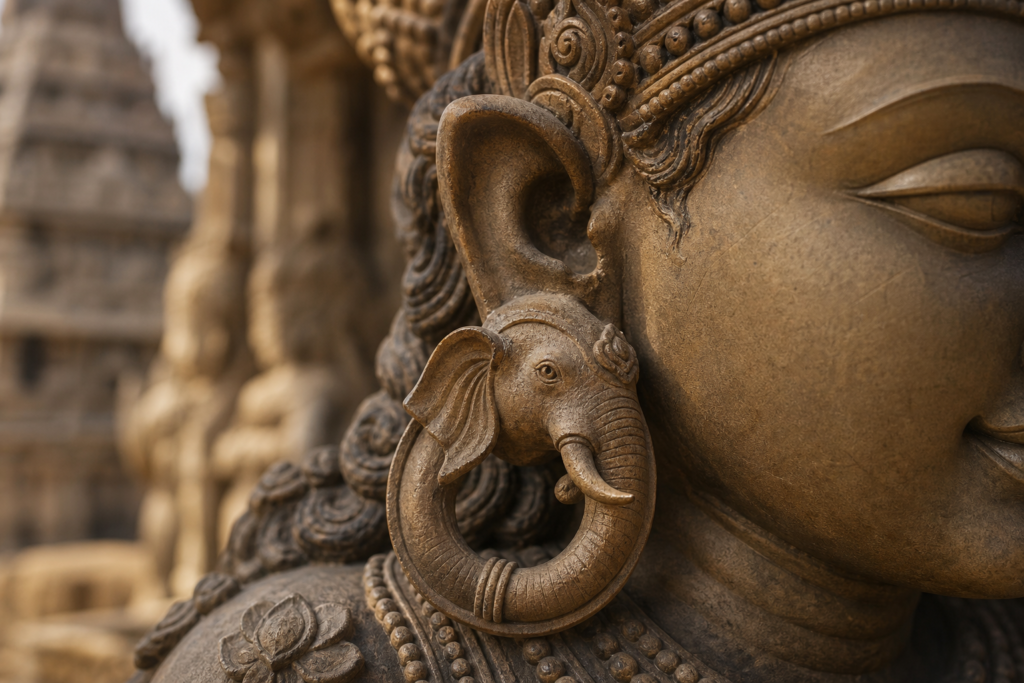
Iconographically, the parashu resonates across dharmic traditions: Shiva’s axe cleaves away decay and restores rhythm; Ganesha’s parashu trims obstacles. The bow likewise appears as an emblem of calibrated strength: Rama in the Ramayana, Arjuna in the Mahabharata, and regional depictions of dharmic guardians who defend through precision and control. The recurrence suggests a shared semiotics of powerits rightful place is in service of cosmic and social balance.
Warfare ethics in the Ramayana sharpen this point. Combatants observe codes of engagement: no attacks on the unarmed, the sleeping, or non-combatants; duels are honored; surrender is accepted. Even where violations occur, the narrative underlines censure and consequence. The bow, by its very mechanics, becomes an allegory for such codesdistance creates deliberation; the archer must sight, assess, and release only when the act is just and necessary.
From a socio-technical vantage, these symbols mirror material history. Early agrarian expansions required axes to clear dense canopies and extend cultivable tracts; the metaphor of civilizational forestry is apt for Parashurama’s mission. As polities complexified, ranged weapons and their manualscodified in Dhanurveda and arthashastric literaturehelped standardize training, logistics, and battlefield norms. In this light, the parashu is the tool of foundation, the bow the tool of administration.
Purāṇic memories place Parashurama at numerous thresholds: founding settlements, consecrating spaces, and mentoring heroes. These storiesregardless of historical datingcarry a consistent pedagogic meaning: before culture can be built, there must be uncompromising clarity about what it excludes. Cultural health requires pruning as much as planting.
Parallels across Dharmic traditions reinforce this integrated ethic. Buddhism elevates dhamma-vijayavictory through righteousnessas the superior conquest; Jainism insists on ahimsa paramo dharmah while recognizing the necessity of self-discipline and social duty; Sikh dharma synthesizes sant-sipahi, the saint-soldier ideal, aligning courage with compassion. Such ideals converge with Kshatra Dharma’s central teaching: force, if and when used, must be the minimal, precise, and last resort in defense of life and justice.
This convergent ethic maps onto a single principle: the calibration of means to ends. The axe symbolizes necessary severitysurgery, not vengeancewhen corruption or cruelty calcify. The bow symbolizes proportion and deliberationlaw over impulseso that peace is protected without mirroring the disorder it resists. Both together describe the dharma-yuddha paradigm: fighting without hatred; defending without domination; restoring, then restraining.
One narrative hinge in the Ramayana dramatizes the handover between paradigms: the encounter between Parashurama and Rama after the breaking of Shiva’s bow at the svayamvara. When Rama strings the Vishnu bow with tranquil mastery, Parashurama recognizes the new dispensation and withdraws. The episode is less a contest than a liturgy of successionraw corrective power saluting rule-bound sovereignty. Symbolically, the axe bows out once the bow has fully learned restraint.
For governance and leadership, the lesson is stark. Foundational phases sometimes demand Parashurama-like claritydecisive removal of entrenched harm. Consolidation requires Rama-like constancypredictable institutions, equal justice, and restraint as a virtue, not a concession. The former creates space; the latter sustains trust.
For contemporary seekers and citizens alike, these weapons remain living metaphors. Many will recognize the “axe-moment” in personal lifethe disciplined cutting away of addictions, false beliefs, or harmful habits. Many will recognize the “bow-moment”the patient drawing back of attention, the measured release of speech and action only when aligned to purpose. The narrative power of Parashurama and Rama lies in making such inner ethics publicly consequential.
Held together, the parashu and the Kodanda reveal a single dharmic intention: to protect life, meaning, and dignity with the least necessary force, and to rebuild order so it outlives any one champion. That intention is shared across Hinduism, Buddhism, Jainism, and Sikhism, which all insistin their own idiomsthat power is ethical only when yoked to compassion and truth. In this unity of principle lies the civilizational promise of the Ramayana: a society where courage is guided by conscience, and where the instruments of war finally become instruments of wisdom.
Inspired by this post on Hindu Blog.