Vrishabha Pooja on Jyeshtha Purnima (Vrishabha Archana) stands as an agrarian rite of gratitude and protection across rural India. In 2026, the observance falls on 29 June, when communities, especially in Andhra Pradesh and Telangana where the full moon is known as Eruvaka Pournami, honor the vrishabh the ox or bull for its partnership in ploughing, sowing, and transport.
Jyeshtha Purnima is the full-moon day of the Jyeshtha month in the Hindu lunar calendar. The date is determined by the Purnima tithi as per the local panchang, which can cause regional differences in the exact observance window; households and temples therefore align their puja with the prevailing tithi at their location while keeping the public celebrations on the civil date.
Across dharmic traditions, the bull embodies steadfast dharma, patient strength, fertility, and the grounded stability of the earth element. In the Shaiva idiom, Nandi the vrishabha seated before Shiva symbolizes attentive devotion, discipline, and guardianship; in Jain memory, Rishabhanatha (Adinatha) bears the bull as his emblem, evoking ethical restraint and skillful livelihood; Buddhist and Sikh ethical frameworks similarly emphasize compassion toward beings and dignity of labor, values that animate the farm-centered thanksgiving enacted on this full moon.
Anthropologically, Vrishabha Pooja marks the seasonal turn toward sowing in monsoon-fed tracts. The thanksgiving grants social visibility to draught animals, reaffirms reciprocal care between humans and cattle, and seeks auspicious conditions for rainfall, soil moisture, and plant vigor. The practice also consolidates village cooperation through shared meals, seed exchange, and collective maintenance of ploughs, carts, and water channels.
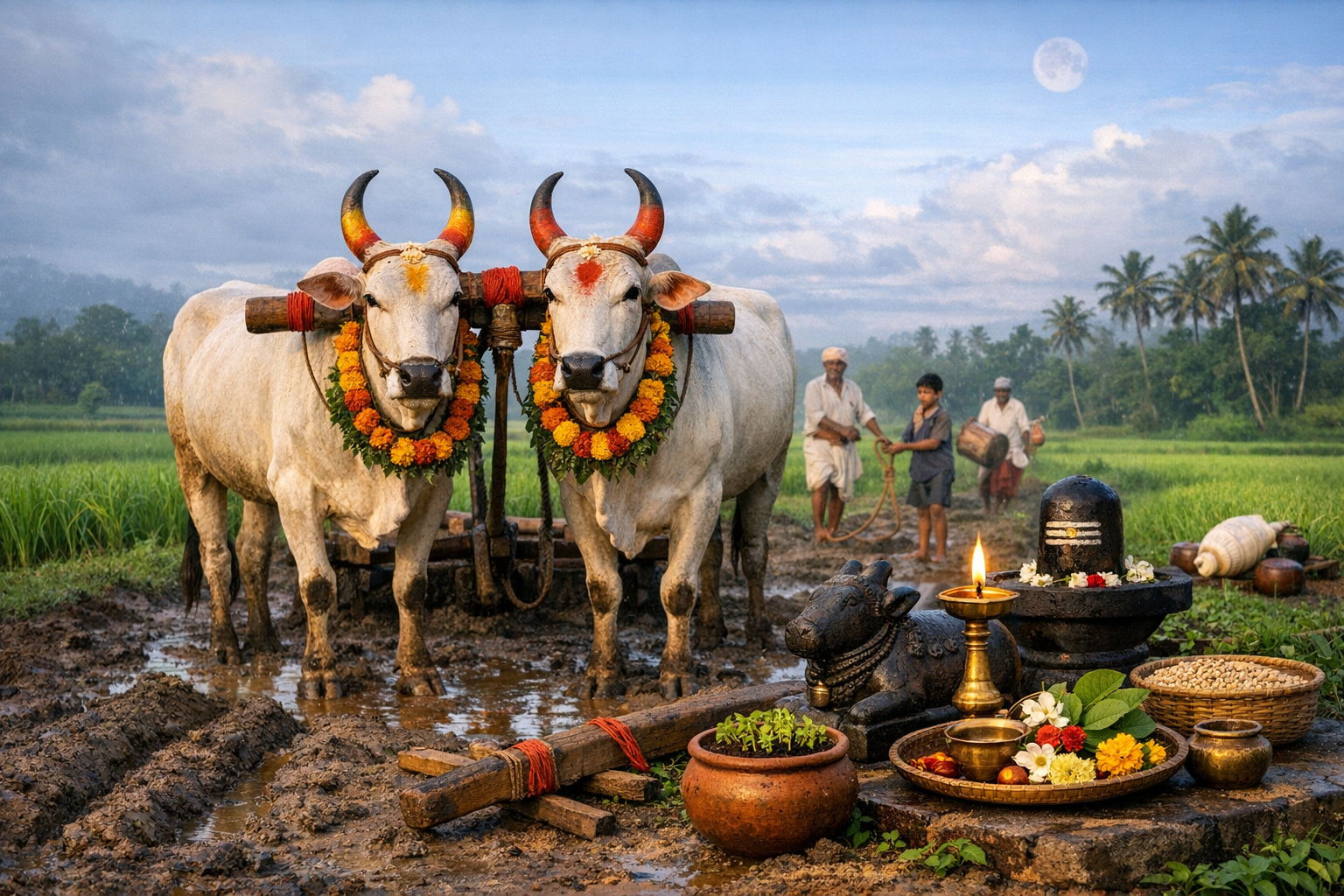
On Eruvaka Pournami in Andhra Pradesh and Telangana, farmers clean cattle sheds and implements, wash and groom oxen, decorate horns with turmeric, kumkum, and natural colors, and garland the yoke. The first furrows are ritually drawn, seeds are blessed, and children join elders in leading the pair of oxen with music and lighted lamps, tying the annual cycle of learning, labor, and reverence into a single village procession.
The rite has an agronomic subtext. By foregrounding the value of cattle care, it reinforces manuring, composting, and on-farm nutrient cycles central to sustainable agriculture. Panchagavya-based preparations and dung-compost amendments improve soil structure and microbial activity when used judiciously as part of integrated nutrient management, aligning with contemporary ecological farming goals in Rural India.
A typical Vrishabha Archana begins with cleaning the puja space, the cowshed, and the implements, followed by lighting a deepa and taking sankalpa for season-long abundance and safety of animals. A Nandi or vrishabha murti or image is placed facing a Shiva altar or outdoors near the plough and seed baskets so that ritual and field life are consciously linked.
Invocation commonly includes chanting Om Namah Shivaya and the Mahamrityunjaya mantra, along with recitations from Sri Rudram where available. The vrishabha is gently anointed with water and sandalwood paste; turmeric and kumkum mark the forehead, and a raksha-sutra may be tied around the yoke as a protective vow.
Abhisheka is performed to Nandi or the vrishabha image with panchamrita milk, curd, ghee, honey, and sugar and clean water, followed by alankara with bilva leaves for Shiva, flowers, and a fresh garland. The sequence is paced so as not to distress a living animal; where a murti is used, the offerings are symbolic and the edible items are reserved as naivedya and later distributed.
The archana proceeds with names of Shiva and Nandi, aarti with camphor or ghee lamps, and circumambulation of the plough, seed baskets, and the pair of oxen. Prasada is shared with the household and neighbors, while the animals are fed a mixture of green fodder, gram, and jaggery as a sweet thanksgiving.
Ankurarpanam the ceremonial sprouting is carried out by placing pre-soaked seeds in a small pot of clean soil, or by ritually sowing the first lines in the field. The act aligns intention (sankalpa), lunar timing (tithi), and ecology (seasonal moisture) to inaugurate the sowing window.
Community aspects often include annadana, exchange of saved seed varieties, and collective decisions about staggered sowing to manage rainfall uncertainty. Dana to goshalas or to animal shelters is encouraged, as is practical service such as cleaning water troughs and shade structures.
Ethical guidelines are integral: avoid heavy loads and loud fireworks, use only non-toxic natural pigments on horns, provide shade and water throughout the day, and, where possible, obtain basic veterinary checks for deworming and hoof care before fieldwork intensifies. Ahimsa is the governing principle, and the thanksgiving loses its meaning if animal well-being is compromised.
Urban households and the diaspora can observe Vrishabha Pooja by installing a Nandi image, performing a brief abhisheka and archana, supporting farmers through fair procurement, and contributing to animal welfare and sustainable agriculture initiatives. Even balcony Ankurarpanam with a few sprouting seeds becomes a mindful way to reconnect with the food system.
For 2026, Jyeshtha Purnima occurs on 29 June. While public celebrations commonly take place in the morning, the preferred window is when Purnima tithi prevails locally; temples and families therefore consult a regional Panchang or trusted almanac to synchronize the puja with the lunar timing.
Beyond Andhra Pradesh and Telangana, the spirit of Vrishabha worship appears in varied forms: Nandi abhisheka in Shaiva temples in Karnataka and Tamil Nadu, cattle-centered thanksgiving in parts of Maharashtra and Odisha, and household offerings in North Indian districts where the day otherwise foregrounds Vat Purnima. The variations reflect India’s cultural diversity converging on a shared ethic of gratitude.
Jyeshtha Purnima also intersects with region-specific observances such as Dev Snan Purnima in Odisha and Guru-centered recitations in some Vaishnava and Shaiva lineages. Rather than competing, these practices complement one another in affirming interdependence among nature, community, and the sacred.
In a climate-uncertain era, Vrishabha Pooja doubles as a social protocol for resilience: it times early-season operations, assembles labor, refreshes safety norms, and motivates stewardship of soil and water. The ritual therefore functions as both spiritual invocation and practical risk management in monsoon agriculture.
Simple naivedya such as plain cooked rice, curd, seasonal fruits, and jaggery is adequate; the emphasis is on purity of intention and cleanliness of implements rather than opulence. Using clean vessels, untreated fodder, and potable water aligns ritual purity with animal health.
Observed as Vrishabha Pooja, Vrishabha Archana, or Eruvaka Pournami, the day weaves devotion, ecology, and community into one continuum. By honoring the vrishabh and the labor that sustains food security, households participate in a dharmic tradition that unites Hindu, Buddhist, Jain, and Sikh sensibilities around gratitude, non-harm, and shared responsibility for the living world.
Inspired by this post on Hindu Pad.