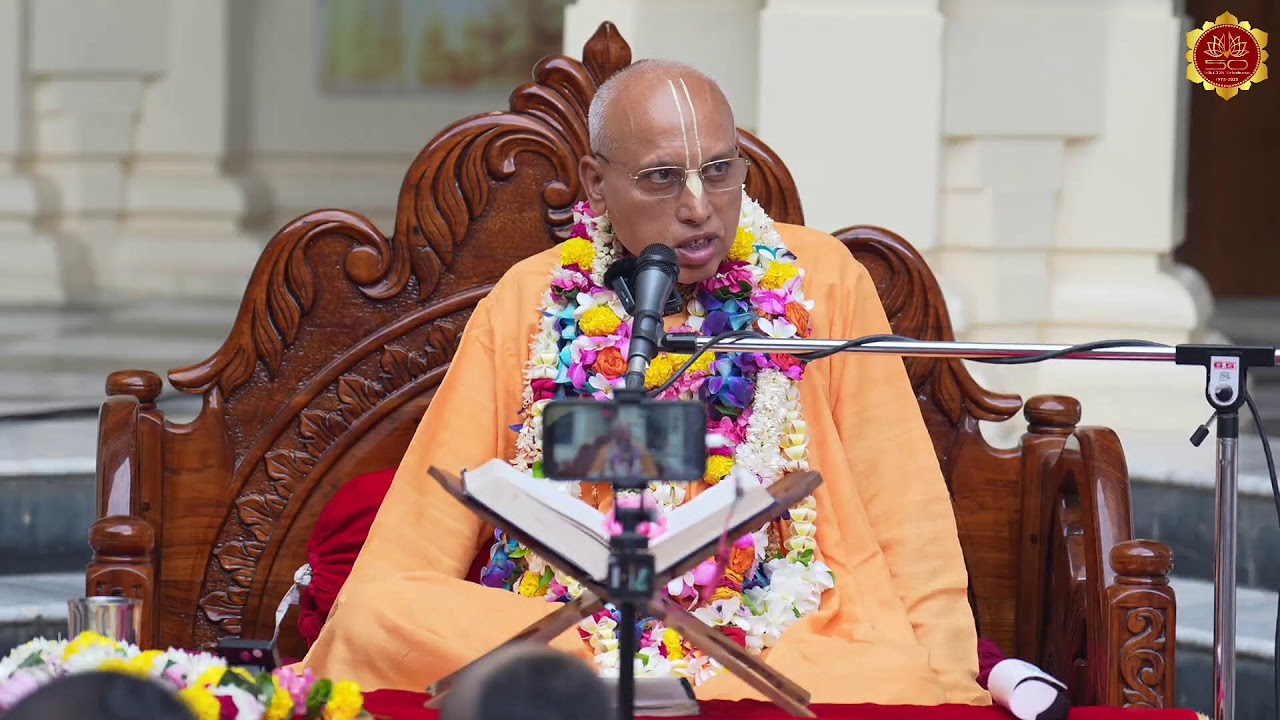
In a discourse associated with ISKCON Vrindavan and the teachings of H.H. Bhakti Ashraya Vaishnava Swami, the account of Bali Mahārāja offers a clear, compelling meditation on humility in devotion. The narrative centers on Bali’s profound self-effacement before Kṛṣṇa and Balarāma, a disposition that reframes spiritual eligibility not as status, austerity, or learning, but as the sincere abandonment of pride.
Bali Mahārāja ascribed to himself the degraded status of a demoniac birth and therefore denied any spiritual qualification to be honored by the presence of Kṛṣṇa and Balarāma. This radical humilitydainyastands as an exemplar within the bhakti tradition: the less one asserts self-importance, the more one becomes receptive to divine grace. Rather than diminishing his stature, Bali’s self-understanding illuminated the devotional principle that true greatness rests in surrender.
The narrative also contrasts this humility with the risk faced by even advanced renunciants on the paths of jñāna and yoga: when ego and subtle pride are not relinquished, their practices do not culminate in pleasing the Lord. The insight is not a critique of these disciplines but a reminder of their shared ethical centerhumility. Across dharmic pathways, whether in bhakti, jñāna, yoga, or rigorous ethical cultivation, inner softness of heart remains the decisive measure of spiritual maturity.
This emphasis on humility supports a wider spirit of unity among the traditions of Hinduism, Buddhism, Jainism, and Sikhism. In each, the lessening of egothrough devotion, insight, non-violence, meditation, or sevaopens space for compassion and wisdom. The lesson of Bali Mahārāja therefore encourages mutual respect across diverse practices, reinforcing unity in spiritual diversity and the shared pursuit of truth and ethical refinement.
For contemporary seekers, the practical application is clear: cultivate devotion free from self-congratulation, allow study to soften the heart, and let discipline be guided by empathy. Many pilgrims and students of Vedic wisdom find that reflecting on Bali’s example transforms daily practiceintegrating remembrance of Kṛṣṇa with service and humility toward all beings. In this way, spiritual progress is measured not by titles or techniques, but by the quiet disappearance of pride.
Ultimately, the account of Bali Mahārāja affirms a simple, proven principle: devotion refined by humility invites divine favor and fosters harmony among paths. When bhakti, jñāna, and yoga are anchored in egolessness, they become complementary streams of one river, guiding the practitioner toward the same ocean of compassion, clarity, and enduring peace.
Inspired by this post on Dandavats.