
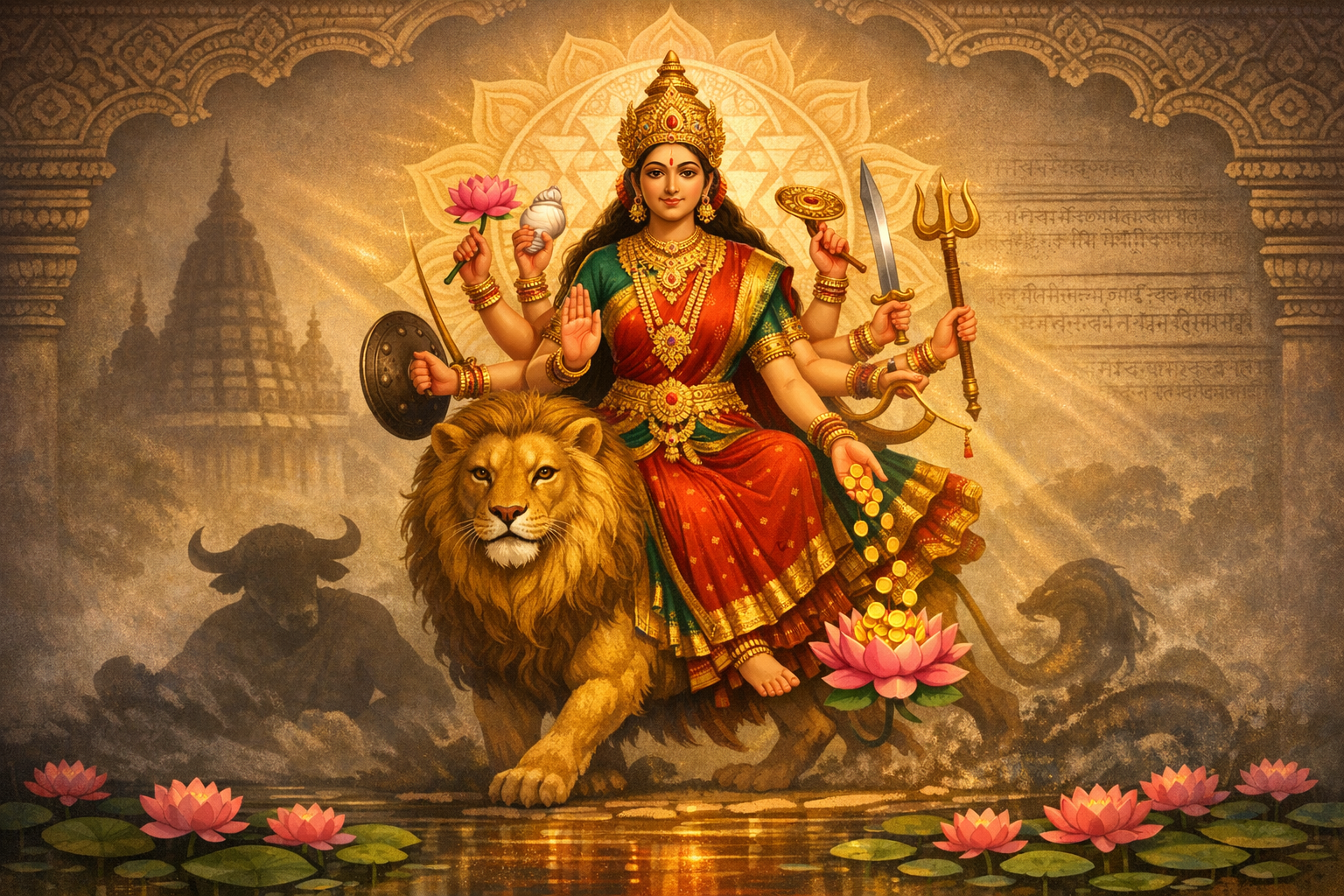
Did Goddess Lakshmi ever slay demons? Within Hindu religious history, the answer is nuanced. In Vaishnava theology Lakshmi (Śrī) is primarily the benevolent bestower of prosperity and auspiciousness, while demon-slaying is typically associated with Durga or Kali. Yet in Shakta literature and key regional traditions, particularly in western Maharashtra, the fierce, composite form Mahalakshmi is explicitly linked to the defeat of powerful asuras—most prominently Kolhasura in the Karavira (Kolhapur) tradition and Mahishasura in the Mahishasuramardini cycle of narratives preserved around the Devi Mahatmya. Understanding why these accounts coexist requires careful attention to scripture, sectarian synthesis, and living temple practice.
Across classical texts and living practice, Lakshmi appears in two overlapping registers. First, as Śrī or Kamala, she is Vishnu’s consort and the embodiment of abundance, order, and grace. Second, as Mahalakshmi within Shakta frameworks, she functions as the supreme Shakti alongside Mahakali and Mahasaraswati, a triadic articulation of the cosmic power that protects dharma and annihilates adharma. This second register—particularly vivid in the Devi Mahatmya ritual ecosystem and in regional sthala-mahātmyas—grounds the association of Mahalakshmi with demon-slaying.
Kolhasura’s defeat is a hallmark of the Karavira (Kolhapur) Mahalakshmi tradition. The Skanda Purana’s Karavira Mahatmya narrates how the demon-king Kolhasura gained formidable power through tapas, subjugated beings in the Karavira region, and received a boon that made him nearly invincible. Mahalakshmi, revered locally as Ambabai, confronts and kills Kolhasura, thereby restoring cosmic and social order. In many retellings, a dying Kolhasura petitions that the sacred city bear his name—hence Kolhapur—while Mahalakshmi chooses to abide there for the benefit of devotees. The theology here unmistakably frames Mahalakshmi as a martial, protective Shakti whose compassion is inseparable from her power to end tyranny.
Mahishasura’s defeat—famous throughout India—is preserved most authoritatively in the Devi Mahatmya (also known as the Durga Saptashati) embedded in the Markandeya Purana. The text’s second charita recounts how the combined energies (tejas) of the gods manifest in a supreme goddess who slays Mahishasura, the buffalo-demon emblematic of tamas, arrogance, and unrestrained power. While popular usage often names the victorious deity “Durga” or “Chandika,” the ritual and commentarial traditions surrounding the Devi Mahatmya also venerate her as Mahadevi and, in many regional and liturgical streams, as Mahalakshmi. This is why later stotras—such as the widely recited Mahalaxmi Ashtakam—glorify “Mahalakshmi” with epithets including “Mahishasuramardini,” reflecting the integrated identity of the goddess across Shakta and Vaishnava idioms.
From a textual-historical perspective, the divergent names—Durga, Ambika, Chandika, Mahadevi, Mahalakshmi—do not necessarily indicate separate deities so much as layered epithets of the one Shakti. Puranic narrative technique routinely uses multiple names to register different functions: nurturing, protective, and annihilative. In this hermeneutic, ambrosial Śrī and martial Mahalakshmi are not contradictory figures but complementary revelations of the same divine presence. The name “Mahalakshmi” in particular signals a magnified aspect of Lakshmi operating at the level of cosmic defense and restoration.
Iconographically, this synthesis is evident in Mahishasuramardini images across the subcontinent: a many-armed goddess, often lion-mounted, wielding the trident, discus, conch, sword, and bow—gifts from the devas—strikes down Mahishasura. In Maharashtrian contexts influenced by Karavira Mahatmya, similar martial iconography and liturgy are explicitly associated with Mahalakshmi (Ambabai). In liturgical performance, kirtans and puranic pravachans emphasize how the goddess’s weapons symbolize not violence for its own sake, but the severance of adharma from collective life.
The theological stakes of these narratives are significant. If Lakshmi’s core function is to uphold auspicious order (śrī), then demon-slaying stories associated with Mahalakshmi dramatize the indispensable truth that order sometimes requires decisive action. The destruction of asuric forces becomes an allegory for removing inner poverty (daridra), arrogance (mada), delusion (moha), and inertia (tamas)—conditions that obstruct dharma. In this reading, Mahalakshmi’s victory over Kolhasura and the goddess’s triumph over Mahishasura are not only cosmic events but also timeless templates for ethical self-cultivation.
Ritually, these strands converge during Navaratri. Households and temples recite the Devi Mahatmya to honor the goddess as the protector of the moral cosmos, while Lakshmi Puja—especially in the Ashwin and Kartik months—is observed to invite śrī into the rhythms of family and community. For many devotees, the felt experience is integrative: Durga’s courage, Lakshmi’s grace, and Saraswati’s wisdom are facets of the same divine reality, invoked according to circumstance and need.
Regionally anchored traditions reinforce this unity. In Kolhapur, the Mahalakshmi Temple’s annual observances keep the Kolhasura-killing legend alive in collective memory, while affirming Mahalakshmi as the city’s living heart. Pilgrims report a palpable sense of protection and abundance, testifying that the narrative’s power lies as much in present-tense devotion as in textual antiquity. The sacred geography (tirtha-kshetra) and the puranic narrative (mahātmya) together shape a religious ecology in which myth, history, and ethical imagination are intertwined.
From the standpoint of comparative dharmic traditions, these goddess narratives harmonize with a broader civilizational reverence for compassionate, protective wisdom. Buddhism venerates Tara as swift, liberative compassion; Jain traditions honor protective yakshis such as Padmavati; and the Sikh Dasam Granth’s Chandi di Var retells the goddess’s battle against demonic forces to inspire valor and righteousness. Rather than fragmenting communities, these convergences illuminate a shared dharmic ethos: the triumph of courage, clarity, and compassion over fear, confusion, and oppression.
To synthesize: yes, in Shakta scriptures and in the revered Maharashtrian tradition of Ambabai at Kolhapur, Mahalakshmi is portrayed as a demon-slayer—overcoming Kolhasura and, in the devotional assimilation around the Devi Mahatmya, celebrated as Mahishasuramardini. In strictly Vaishnava portrayals focused on the domestic Śrī-Lakshmi, demon-slaying is not central; yet these modes are not rivals. They are complementary lenses on a single theological constant: the protective, restorative power of Shakti that sustains the world and the moral life.
For readers seeking sources, the Devi Mahatmya (Markandeya Purana) provides the canonical Mahishasura narrative and attendant liturgy; the Skanda Purana’s Karavira Mahatmya preserves the Kolhasura account and the sanctity of Kolhapur’s Mahalakshmi Temple. Together they demonstrate how Puranas and sthala-mahātmyas work in tandem: universal myth articulated through the particular holiness of place, translating profound metaphysics into lived devotion.
Ultimately, the question “Did Lakshmi kill any demons?” opens onto a larger insight central to Hinduism’s spiritual tapestry and to the unity of dharmic traditions: the divine feminine does not merely bestow prosperity; she also removes the roots of suffering—personified as asuras—so that prosperity can be just, wisdom can be stable, and compassion can be fearless.
Inspired by this post on Hindu Pad.






Leave a Reply
You must be logged in to post a comment.