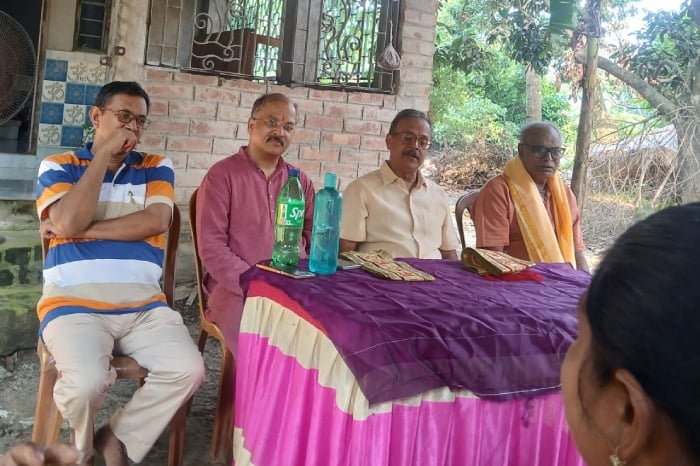
At the state-level Devasthan Bhoomi Sanrakshan Parishad convened by Maharashtra Mandir Mahasangh, a wide coalition of temple trustees, legal scholars, and community representatives voiced firm opposition to the proposed ‘Devasthan Inam Abolition Act 2026’. Their core contention centered on parity: participants questioned why Devasthan inam lands associated with Hindu temples appear to be singled out, while Waqf properties are reportedly treated under different exemptions and frameworks. The appeal that emerged was not oppositional for its own sake, but a call for equal, transparent, and constitutionally consistent governance of all religious endowments across Maharashtra to preserve social harmony and uphold the principle of unity among India’s Dharmic traditions.
Beyond immediate objections, participants sought to clarify what is at stake when traditional religious endowmentsespecially temple landsare reclassified or brought under sweeping state action. Many trustees explained that Devasthan lands are not private holdings in a conventional sense; they are trust properties held for specific religious, charitable, and community purposes in continuity with historical grants and customary obligations. These purposes typically include maintaining worship, sustaining temple staff, funding annadanam and pilgrim services, caring for temple tanks and sacred groves, and supporting local cultural life. Alterations to tenure or control can therefore reconfigure a complex ecosystem of faith, philanthropy, local livelihoods, and intangible heritage.
Historically, “inam” denoted grants made by rulers or local authoritiesoften revenue-free or concessionalso that religious and charitable institutions could function in perpetuity. In the case of Devasthan inams, the beneficial ownership lies with the deity or religious trust, and trustees exercise fiduciary duties to use the income exclusively for religious and charitable objects. In legal terms, this is a specialized subset of trust property whose character is defined by purpose, usage, and donor intent rather than ordinary market utility. Any reform that extinguishes, vests, or repurposes these lands must therefore be narrowly tailored to protect the trust’s beneficiary purpose and the community rights attached to it.
While the precise contours of the proposed Devasthan Inam Abolition Act 2026 have not been publicly codified in full detail, discussants expressed converging apprehensions. First, abolition of the “inam” tenure might lead to vesting mechanisms or administrative controls that dilute temple autonomy over endowment assets. Second, uncertainty about compensation, revenue usage, and continuity of rituals could disrupt the daily functioning of institutions that rely on in-kind produce and rental income from these lands. Third, an abrupt, one-sided approach risks widening distrust if other religious endowmentssuch as Waqf properties or trusts associated with Buddhist viharas, Jain derasars, and Sikh gurdwarasare not simultaneously brought under analogous standards of oversight, transparency, and due process.
The constitutional frame heavily informs this debate. Articles 25 and 26 of the Constitution of India protect freedom of religion and the right of religious denominations to manage their own affairs in matters of religion, subject to public order, morality, and health. Article 14 guards equality before the law, prohibiting state action that is arbitrary or discriminatory. Article 27 precludes compelled taxation for the promotion of any particular religion, and Article 300A ensures that no person is deprived of property save by authority of law. Judicial pronouncementsfrom the Shirur Mutt case to subsequent rulings concerning state oversight of religious endowmentshave repeatedly held that while the state may regulate secular aspects to prevent mismanagement, any takeover or curtailment must be proportionate, temporary, and directed to remedying specific, demonstrable malfeasance rather than effecting a permanent displacement of trusteeship or beneficial ownership.
Participants contrasted the proposed approach to Devasthan lands with frameworks currently governing other religious endowments in India. Waqf properties function under the Waqf Act, 1995 (as amended), with dedicated boards and statutory protections defining management, alienation, and oversight. Institutions associated with Sikh gurdwaras or specific regional endowments likewise operate under bespoke statutes. The consensus in the Parishad was that any reform in Maharashtra should institute a neutral baseline of accountabilityapplied uniformly to Hindu, Buddhist, Jain, Sikh, and Islamic endowmentsso that no single tradition bears a disproportionate regulatory burden and the constitutional promise of non-discrimination is honored in both letter and spirit.
The socio-economic footprint of temple lands is both tangible and intangible. Devasthan holdings often support local agriculture through leases to cultivators, sustain seasonal employment linked to festivals and pilgrim hospitality, and finance heritage conservation of structures, tanks, and sacred groves that double as community commons and biodiversity micro-habitats. Income from these assets underwrites annadanam, educational support, basic healthcare camps, and repairsservices that directly reinforce social cohesion. Participants cautioned that sudden tenure abolition, even if well-intentioned, may trigger avoidable litigation, stall critical maintenance, and interrupt rituals that anchor regional culture.
Concerns articulated at the Parishad included questions about record integrity and administrative feasibility. Land records for Devasthan inams can span multiple eras and revenue regimes; reconciling them requires careful archival work, survey-grade mapping, and due notice to all stakeholders. Trustees highlighted that indiscriminate changes risk compounding encroachment disputes, multiplying title ambiguities, and overburdening courts. A reform path premised on meticulous verification, transparent consultation, and phased implementation would mitigate these risks and build trust across communities.
Several constructive proposals emerged to strengthen governance without impairing endowment purpose. A statewide inventory and GIS mapping of Devasthan landspublished in open data formatscould anchor clarity. Model lease templates with fair rent benchmarks, cultivation safeguards, and grievance mechanisms would professionalize asset use. Ring-fencing endowment revenue into auditable accountsdedicated solely to religious, charitable, and heritage functionswould reinforce fiduciary discipline. Periodic third-party audits and public dashboards, balanced with privacy norms, could make compliance visible and replicable.
Legal scholars at the conclave underscored safeguards rooted in established jurisprudence. Any state intervention should be time-bound, problem-specific, and subject to judicially reviewable standards; the objective must be rectification of mismanagement, not a standing displacement of denominational control. Non-alienation clauses, prior sanction requirements, and transparent tendering for leases can deter asset stripping while respecting religious autonomy. Where disputes arise, specialized tribunals or fast-track benches familiar with endowment law can expedite resolution, reduce transaction costs, and protect the continuity of worship and service.
Crucially, the Parishad framed its critique as a plea for an even-handed policy architecture across all religious endowments in Maharashtra. A single, neutrality-driven regulatory grammararticulating common definitions of endowment purpose, non-alienation, trustee fiduciary duties, audit norms, disclosure thresholds, and penalties for breachwould honor Article 14’s equality mandate. Such a parity blueprint would apply uniformly to temple trusts, Waqf institutions, Buddhist viharas, Jain derasars, and Sikh gurdwaras, nurturing interfaith confidence and safeguarding the shared civilizational assets of India’s Dharmic and other traditions.
From an implementation standpoint, a consultative white paper could precede any bill, laying out problem statements substantiated by data, reviewing options from other Indian states, and estimating impacts on devotees, tenants, and local economies. Structured hearings with trustees, devotees, tenant farmers, heritage architects, archivists, and financial auditors would ensure that the final framework is empirically grounded. Pilot projects in select districtstesting digitized records, model leases, and audit dashboardscan validate design choices before statewide rollout. Where tenure rationalization is unavoidable, just compensation, continuity guarantees for rituals and services, and explicit revenue-protection covenants should be non-negotiable.
The Parishad’s broader message resonated with the imperative of unity among Dharmic traditions. Speakers emphasized that Hindu, Buddhist, Jain, and Sikh institutions share a common commitment to seva, learning, and community welfare, and that legal regimes should strengthen these bonds rather than sow new divisions. Ensuring identical due process, proportional regulation, and transparent oversight across all endowments would enhance public confidence, reduce avoidable controversy, and allow trustees to focus on worship, welfare, and heritage conservation.
In sum, opposition to the proposed ‘Devasthan Inam Abolition Act 2026’ was articulated through a constitutional, institutional, and socio-economic lens. Participants urged the Maharashtra Government to revisit the approach, anchor reforms in equality and neutrality, and prioritize the protection of endowment purpose over wholesale tenure disruption. A balanced frameworkcombining rigorous transparency with respect for religious autonomywould better serve devotees, local communities, and the state’s cultural heritage. By adopting equal, transparent rules for all religious endowments, Maharashtra can advance both good governance and the interfaith trust essential to a plural, democratic society.
Inspired by this post on Hindu Jagruti Samiti.