A single volume of the Bhagavad Gita, received unexpectedly on a New York City sidewalk, initiated a chain of events that linked diaspora outreach, language learning, and community formation in Burma (Myanmar). The episode demonstrates how a canonical dharmic text can catalyze personal growth and institutional leadership, while reinforcing unity across Hindu and Buddhist traditions.
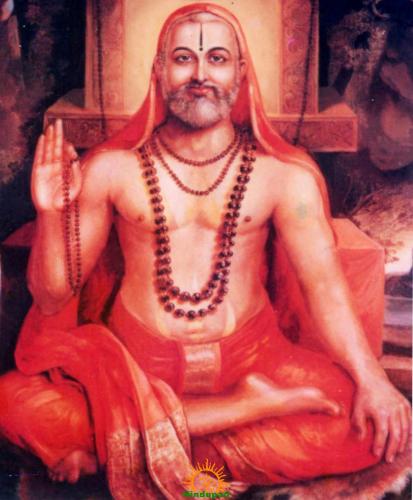
During a medical convention in New York City, a group of Burmese physicians encountered a book distributor who displayed the Dasavatar painting from the Gita and identified Lord Buddha within that visual narrative. Intrigued by the artwork and recognizing a familiar figure esteemed in their own tradition, they purchased the volume, only later realizing it was not a treatise on Buddhism alone. Wishing to place the text with someone more closely aligned to Hindu philosophical study, they delivered it to a Hindu physician in Burma who was a staunch follower of Sankharacharya. Perceiving the work as centered on Bhakti, he set it aside among journals and professional literature.
Some time thereafter, the physician’s college‑age son, motivated to improve his English, noticed what he described as a ‘big thick English language book’ in the office corner. With no initial interest in metaphysics, he adopted the Gita as a practical instrument for vocabulary acquisition, progressing slowly and consulting a dictionary for every second or third term. What began as a utilitarian reading plan evolved into sustained, disciplined study.
By the conclusion of the sixth chapter, the student had achieved functional proficiency in English and, more importantly, experienced a profound inner shift. He embraced devotional practice, later receiving initiation as Srivas Pandit prabhu, and eventually served as regional secretary for Burma. His leadership contributed to the establishment of multiple temples and preaching centers, inspiring waves of new practitioners across the country. Notably, his father also subsequently accepted initiation, underscoring the familial and community dimensions of transformation. The entire trajectory traces back to a single Gita initially distributed thousands of miles away in New York City.
From a comparative‑religions perspective, the narrative underscores an often‑overlooked point of dharmic interconnectedness: in certain Vaishnava enumerations, the Dasavatar includes the Buddha, reflecting historical cross‑currents and mutual acknowledgments among traditions. What surfaced here was not sectarian competition but a bridgean instance of recognition that allowed a text associated with Hinduism to resonate within a Buddhist cultural milieu. Such exchanges align with the broader ethos of unity in spiritual diversity that characterizes dharmic thought.
In sociological terms, this case illustrates how diaspora book distribution functions as a knowledge‑transfer mechanism. A text travels transnationally, is temporarily shelved, then reenters circulation through a new reader’s immediate needin this case, English language acquisition. The pathway exemplifies a non‑linear diffusion pattern in which spiritual literature finds relevance through multiple, sometimes unexpected, entry points.
The language‑learning arc of the story tracks closely with research on content‑based instruction and incidental vocabulary acquisition. Intensive reading, supported by frequent dictionary consultation, is known to expand lexical depth and reading fluency, particularly when the material sustains motivation. The Gita’s compact yet conceptually rich verses provided a high‑yield environment for repeated encounters with key academic and philosophical vocabulary, thereby accelerating comprehension.
There is also a cognitive synergy at work. The sixth chapter of the Gita, with its emphasis on dhyana and sustained attention, dovetails with principles of metacognition that support deliberate practice. The student’s slow, word‑by‑word engagement inadvertently mirrored contemplative learning strategiesmaintaining focus, regulating effort, and reflecting on meaningwhich together strengthened both linguistic proficiency and spiritual receptivity.
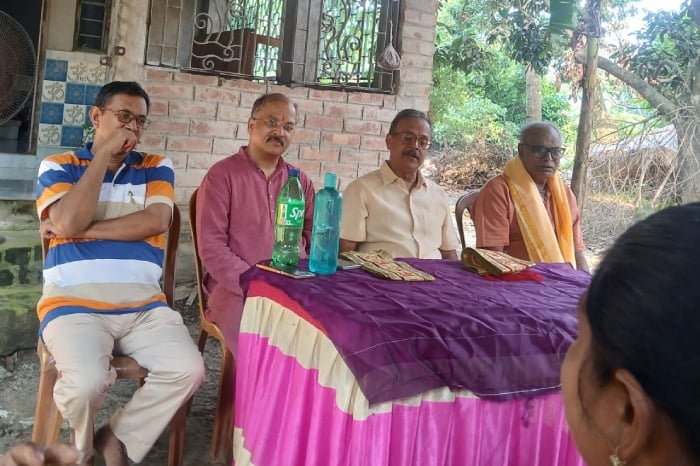
Institutionally, the downstream effects reveal a classic diffusion‑of‑innovation curve: an initial exposure (the street distribution), an early adopter (the student), legitimacy through initiation and service (Srivas Pandit prabhu’s role), and subsequent scaling (temples and centers). Each stage amplified social proof and access, enabling broader community participation. Photographs of a new temple under construction and group portraits from one of the centers in Burma attest to this tangible ripple effect.
Equally important is the narrative’s inter‑tradition resonance. The father’s alignment with Sankharacharya and the family’s Buddhist cultural background did not preclude a respectful, evolving engagement with Bhakti. Rather than opposing paths, the outcome reflects complementary emphases within a shared civilizational spacedharma as an overarching horizon within which Hinduism, Buddhism, Jainism, and Sikhism affirm ethical living, discipline, compassion, and pursuit of truth.
As a case study in dharmic unity, the episode suggests practical lessons: meet learners where they are, honor the plurality of motivations (language study, aesthetics, devotion), and allow texts to do quiet work over time. When presented without coercion and with genuine respect for all paths, scriptures like the Bhagavad Gita can invite self‑directed exploration that enriches both personal development and community well‑being.
Ultimately, this account demonstrates the enduring potency of thoughtful book distribution. A single, well‑placed Gita simultaneously nurtured English proficiency, awakened devotional life, catalyzed leadership, and supported community institutions in Burmaall while affirming harmony among dharmic traditions. The enduring lesson is clear: knowledge shared with humility can travel far, cross cultural boundaries, and return home as flourishing communities.
Inspired by this post on Dandavats.