
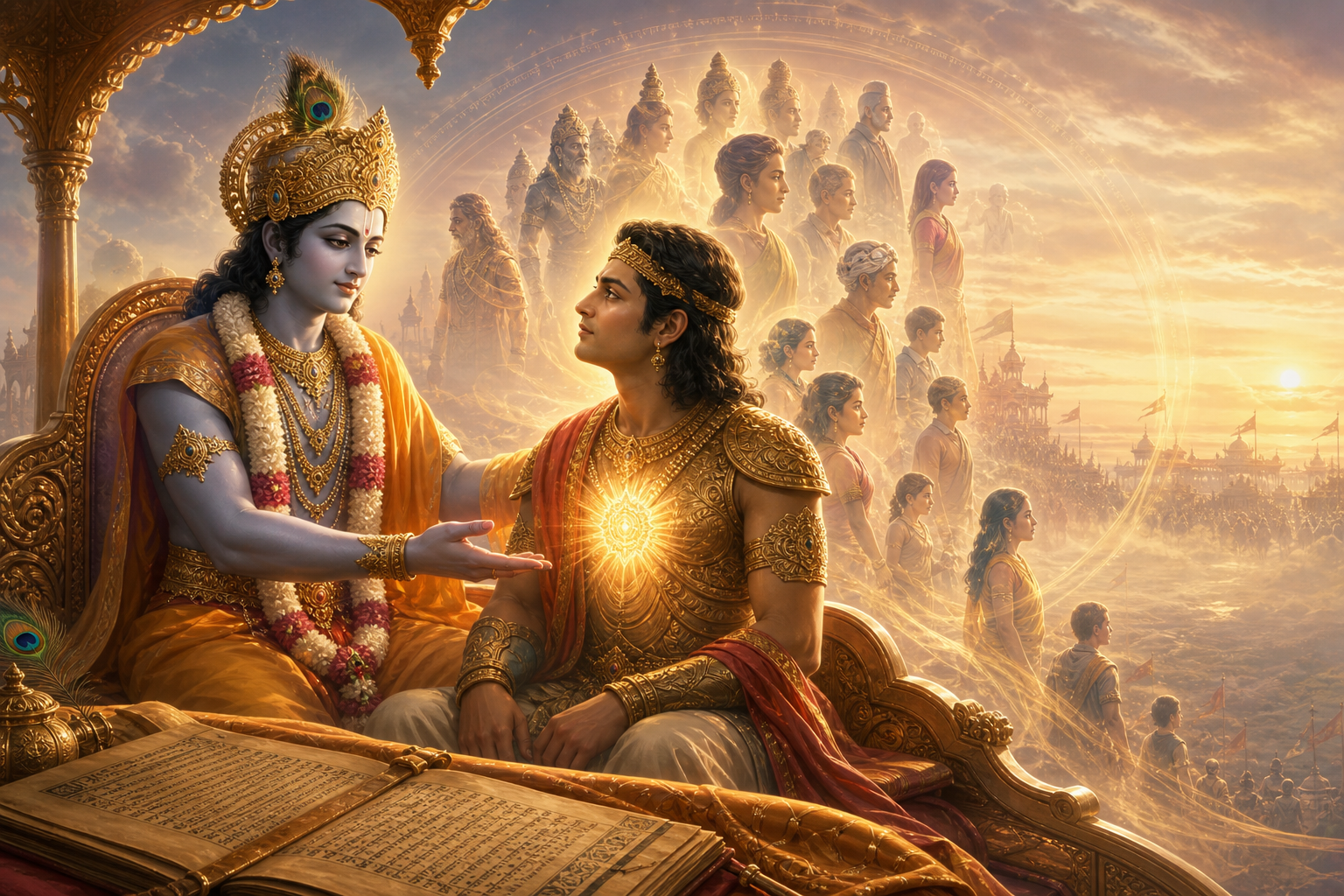
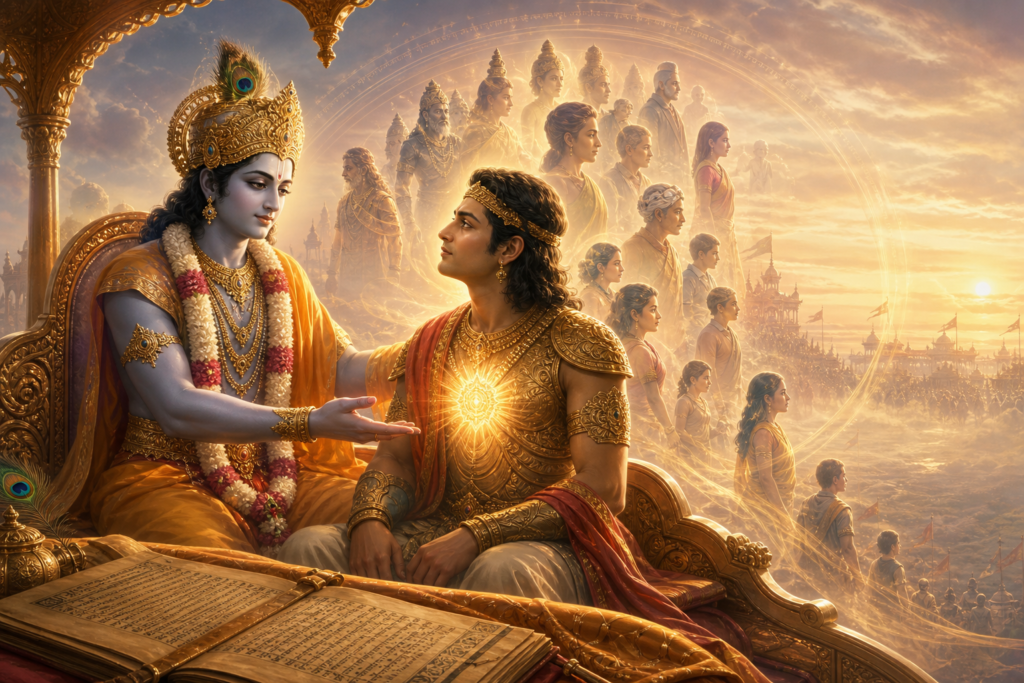
Bhagavad Gita 2.12 stands at the threshold of Krishna’s spiritual instruction to Arjuna, and its significance is far greater than a single theological statement. The verse presents a foundational claim of Vedic philosophy: the individual self, the Supreme Being, and the plurality of conscious persons are not temporary inventions of the body. When this teaching is reflected upon carefully, the title “If You Deny God, You Deny Yourself” becomes a concise way of expressing a deeper philosophical insight. To deny the Supreme Person is not merely to reject a doctrine; it is to weaken the very basis by which personal identity, moral responsibility, love, duty, and spiritual growth become intelligible.
The verse traditionally reads: na tv evāhaṁ jātu nāsaṁ na tvaṁ neme janādhipāḥ; na caiva na bhaviṣyāmaḥ sarve vayam ataḥ param. A careful rendering is: “Never was there a time when I did not exist, nor you, nor all these kings; nor in the future shall any of us cease to be.” Spoken by Śrī Krishna on the battlefield of Kurukṣetra, this statement directly answers Arjuna’s grief, confusion, and moral paralysis. Krishna does not begin with a sentimental consolation. He begins with ontology, the study of what truly exists.
The immediate setting is important. Arjuna is not facing an abstract intellectual puzzle; he is standing between two armies, overwhelmed by the prospect of fighting teachers, elders, relatives, and friends. His crisis is ethical, emotional, social, and spiritual at once. Krishna’s reply therefore does not dismiss emotion, but places emotion within a larger vision of reality. Human grief becomes distorted when the self is reduced to the body alone. By teaching the permanence of conscious identity, Krishna introduces a disciplined way to feel deeply without being governed by ignorance.
Bhagavad Gita 2.12 is technically precise. Krishna says that He existed, Arjuna existed, and the assembled rulers existed in the past; all will continue to exist in the future. The verse does not describe a vague merging into nothingness, nor does it suggest that individuality is an illusion without value. It affirms continuity, plurality, and relationship. In Vaishnava interpretation, this is a decisive statement that the jiva, the individual soul, remains eternally distinct from Bhagavan while depending upon Him. This distinction is not alienation; it is the basis of loving relationship.
The phrase “If You Deny God, You Deny Yourself” can therefore be understood philosophically rather than polemically. The individual self is not self-created, self-sustaining, or self-explanatory. Consciousness points beyond matter because matter, as ordinarily experienced, does not produce self-awareness, moral longing, devotion, or the search for ultimate truth in a fully satisfactory way. When the Supreme source of consciousness is denied, the human person is easily reduced to chemistry, social construction, appetite, fear, or political identity. The Gita challenges such reduction by grounding personhood in an eternal spiritual reality.
This teaching has direct relevance for modern life. Many people experience a quiet fragmentation: professional success may coexist with loneliness, constant communication may coexist with inner isolation, and material comfort may coexist with anxiety. The Gita’s diagnosis is not that the world is meaningless, but that life becomes unstable when the self forgets its relationship with the Divine. In this sense, Krishna consciousness is not an escape from the world. It is a reorientation of identity so that work, family, duty, learning, and service can be performed with spiritual clarity.
Academic discussions of Bhagavad Gita 2.12 often note that it introduces the distinction between the body and the self developed further in the following verses. Krishna will soon compare bodily change to childhood, youth, and old age, and then explain that the wise are not bewildered by the transition called death. Verse 2.12 prepares the ground for that reasoning. Before discussing reincarnation, discipline, yoga, or dharma, Krishna establishes that the subject of experience is enduring. The body changes, the mind changes, social roles change, but the conscious self remains the witness and participant across change.
The verse also protects dharma from becoming merely external. If the self were only the body, then duty would be limited to temporary advantage. If identity were only psychological preference, then morality would shift with desire. Krishna’s teaching provides a more stable foundation: every living being is spiritually significant because every being is an eternal self related to the Supreme. This vision deepens compassion. It also strengthens responsibility, because actions affect the soul’s journey and shape consciousness beyond immediate results.
Within Sanatana Dharma, this insight harmonizes with a broad family of dharmic traditions that honor self-discipline, inner purification, non-violence, truthfulness, and liberation from ignorance. Hindu, Buddhist, Jain, and Sikh traditions differ in metaphysical language and theological emphasis, yet they share a serious concern for overcoming ego-centered living and awakening a higher moral and spiritual awareness. A unifying reading of Bhagavad Gita 2.12 therefore need not be sectarian. It can invite deeper reflection on consciousness, responsibility, reverence, and the dignity of life.
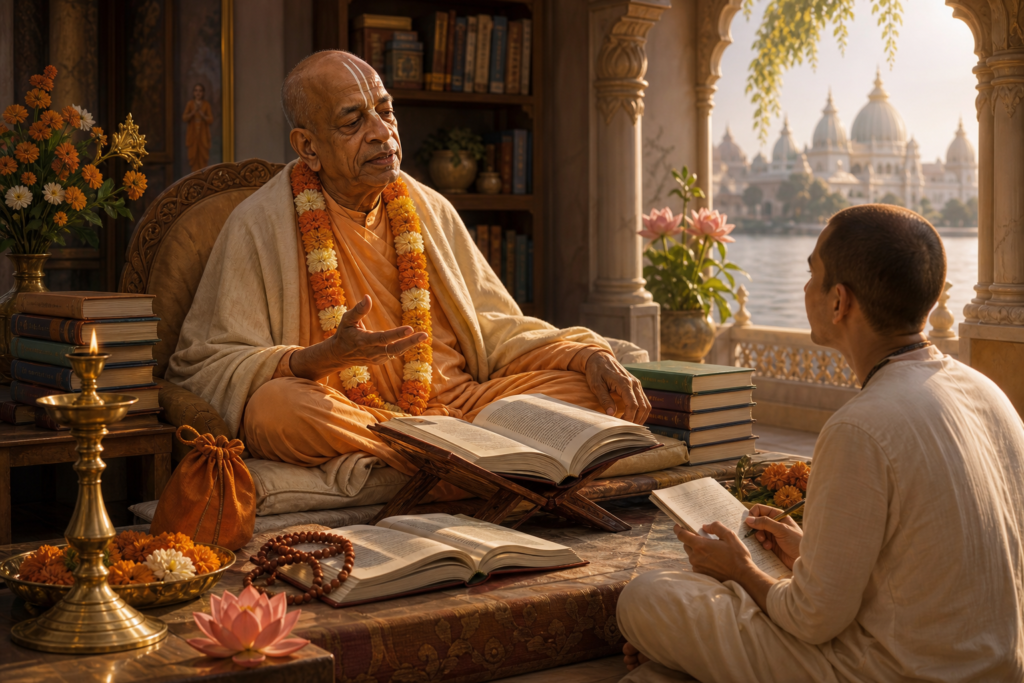
At the same time, the Gita’s own theistic voice should not be flattened. Krishna speaks as the Supreme Teacher who knows the past, present, and future. His instruction is not speculative in the ordinary sense; it is revelatory knowledge given to a sincere student. Arjuna’s transformation begins when he stops arguing from confusion and accepts the need for guidance. This guru-shishya relationship is essential to the Bhagavad Gita. Knowledge is not merely accumulated; it is received, contemplated, tested in conduct, and realized through disciplined living.
H. G. Vaisesika Dasa’s broader style of teaching often emphasizes practical devotion, scriptural literacy, community service, and the lived application of Krishna’s words. In that spirit, Bhagavad Gita 2.12 is not only a verse to be admired; it is a verse to be practiced. Its practice begins when a person asks: What is being protected when the ego feels threatened? What remains when praise and blame pass away? What kind of life becomes possible when identity is no longer confined to the temporary body?
The denial of God can take many forms. It may appear as explicit atheism, but it may also appear as practical forgetfulness among people who nominally accept religion. When daily choices are governed only by consumption, resentment, vanity, or fear, the Divine center has effectively been displaced. The Gita’s concern is not labels; it is consciousness. A person may speak religious language and still live in self-forgetfulness, just as another may begin from doubt yet honestly move toward truth through humility, inquiry, and ethical discipline.
For this reason, Krishna’s teaching should be approached without hostility toward sincere seekers. The goal is not to condemn, but to illuminate. Denying God, in the Gita’s framework, is spiritually damaging because it obscures the source of the self’s meaning. Yet the remedy is not aggression; it is education, reflection, association with saintly persons, chanting of divine names, study of scripture, and service. The Vaishnava tradition presents bhakti as both intellectually coherent and emotionally nourishing because it reunites knowledge with love.
The word “self” in this discussion must also be handled carefully. In modern culture, selfhood often means personal branding, preference, emotional assertion, or individual autonomy. The Gita’s atman is deeper. It is not the ego that demands recognition, nor the mind that fluctuates under pressure. The atman is the enduring conscious principle, distinct from the body and mind, capable of realizing its relationship with Paramatma and Bhagavan. Self-realization therefore does not inflate the ego; it corrects it.
This correction has emotional consequences. When a person identifies only with temporary conditions, every loss feels absolute. Aging becomes humiliation, disagreement becomes a threat, and death becomes annihilation. Krishna does not ask Arjuna to become cold or indifferent. He asks him to become wise. Wisdom allows grief to be honored without surrendering to illusion. It allows love to become less possessive and more sacred. It allows duty to be performed without the despair that arises from thinking the temporary is ultimate.
Bhagavad Gita 2.12 also offers a powerful response to moral relativism. If the self is eternal and accountable, actions cannot be dismissed as private impulses without consequence. Karma is not a crude system of punishment; it is the moral structure of reality through which consciousness is educated. Divine law is not arbitrary domination, but the order by which the soul learns, matures, and turns toward liberation. In this framework, freedom is meaningful because choices participate in a larger spiritual ecology.
The verse further clarifies why devotion is not irrational dependency. If Krishna is the eternal Supreme Person and the self is an eternal conscious being, then relationship with Krishna is not imposed from outside. It is the recovery of the soul’s natural orientation. Bhakti does not erase individuality; it perfects individuality through loving service. This is why the Gita can speak of surrender without destroying dignity. Surrender to the Divine is not self-negation. It is the end of false selfhood and the awakening of true selfhood.
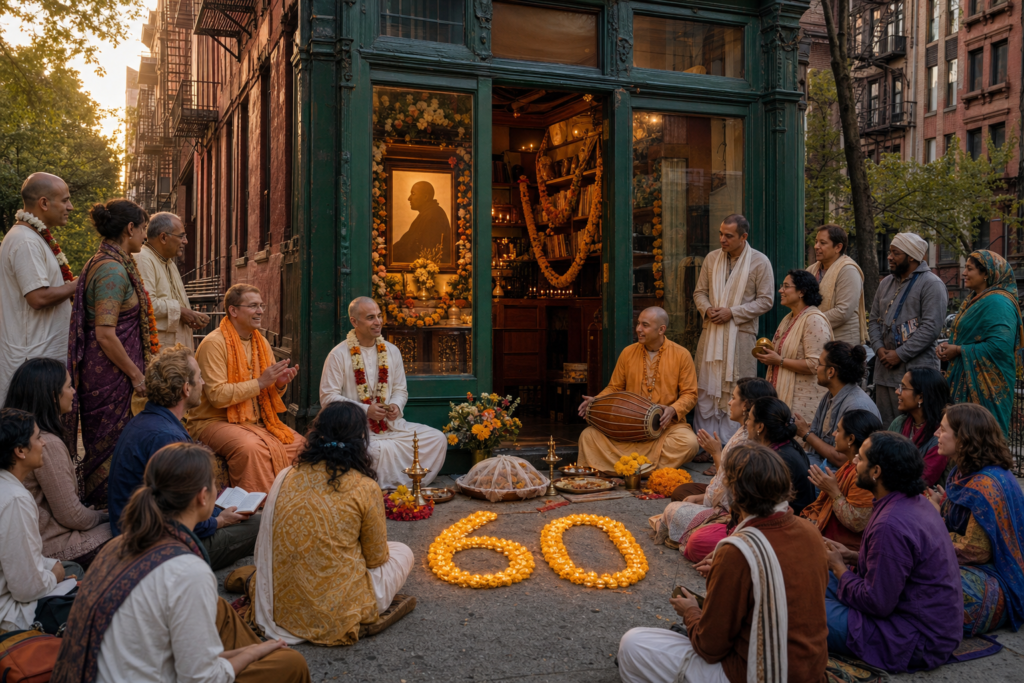
Such a view has practical implications for community life. Temples, study groups, kirtan gatherings, and satsanga are not merely cultural events. They are environments designed to help people remember what ordinary life makes them forget. A community centered on the Bhagavad Gita should cultivate humility, hospitality, scriptural seriousness, and mutual respect across dharmic traditions. The test of spiritual knowledge is not only verbal accuracy, but whether it produces steadiness, compassion, integrity, and service.
The New Jersey setting referenced in the original title is also meaningful in a contemporary diaspora context. For Hindu communities outside India, the Bhagavad Gita often functions as both scripture and anchor. It helps families transmit dharma across generations, gives young seekers a philosophical vocabulary for identity, and offers professionals a way to integrate ambition with ethics. In multicultural societies, Gita wisdom can be presented with confidence and respect, neither diluted into vagueness nor hardened into sectarian defensiveness.
A serious reading of Bhagavad Gita 2.12 therefore resists two extremes. One extreme reduces religion to sentiment and avoids philosophical discipline. The other turns philosophy into abstraction and forgets the human heart. Krishna’s teaching unites both. It gives Arjuna metaphysical clarity precisely because Arjuna is suffering. It offers truth not as a weapon, but as medicine. The verse is powerful because it speaks to the scholar, the devotee, the grieving person, the ethical actor, and the confused modern mind at the same time.
The enduring message is that God, self, and relationship belong together. To know the self fully, one must understand its source. To understand God meaningfully, one must recognize the self as more than matter. To live dharmically, one must act from this recognition rather than from temporary identification. Bhagavad Gita 2.12 thus becomes a doorway into the entire spiritual architecture of the Gita: the soul is eternal, Krishna is eternal, and the path of wisdom is to live in conscious relationship with that truth.
In the end, the verse does not merely ask whether one believes in God as a proposition. It asks whether life is being lived from the level of the eternal self or from the anxieties of the temporary body. That question remains urgent in every age. When the Divine is forgotten, the self becomes misunderstood; when the self is misunderstood, duty becomes confused; when duty is confused, suffering multiplies. Krishna’s answer is both simple and profound: existence is not accidental, identity is not temporary, and spiritual realization begins by remembering the eternal relationship between the soul and the Supreme.
Inspired by this post on Dandavats.







Leave a Reply
You must be logged in to post a comment.