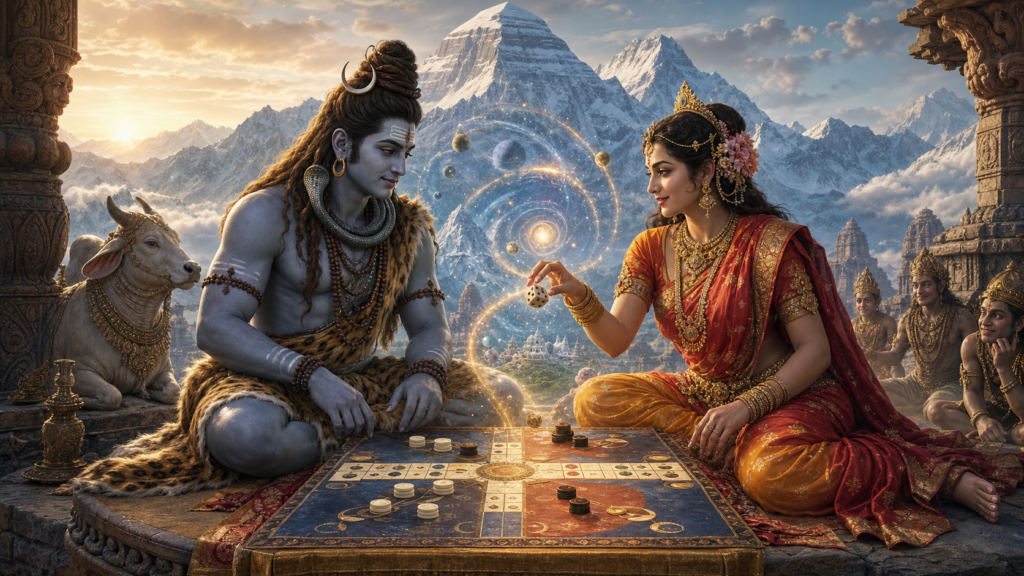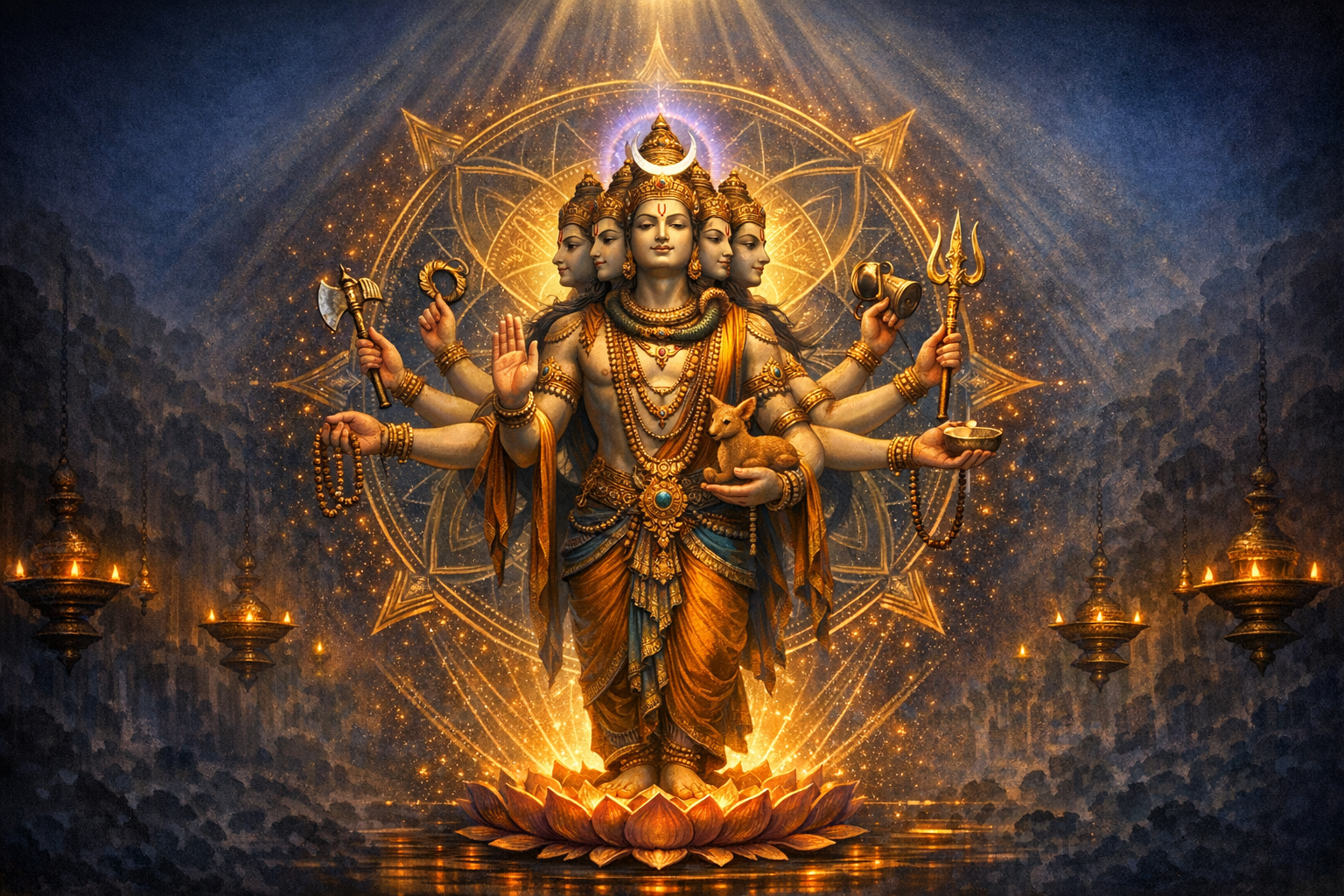
In popular art, Śiva is often portrayed with two hands and a single, tranquil visage; in the Natarāja form, the image expands to four hands around a single face. Textual sources such as the Śiva Purāṇa and allied Āgamas, however, preserve a more expansive cosmic visualization: Dashabhujeshwara, the ten-armed Lord who manifests as Pañchamukha Śiva, the five-faced form that embodies the totality of divine functions and directions.
The name Dashabhujeshwara combines “daśa” (ten), “bhujā” (arms), and “īśvara” (Lord), signaling a theologically dense icon in which multiplicity conveys mastery rather than mere ornamentation. Pañchamukhaliterally “five-faced”is the correlative title, and together these epithets frame a canonical image that communicates the philosophical core of Śaivism: one supreme consciousness expressing infinite powers and purposes.
Scriptural accounts situate the five-faced icon within the Pañcabrahma doctrine, most directly tied to the Pañcakṛtyathe fivefold acts of sṛṣṭi (emanation), sthiti (sustenance), saṃhāra (reabsorption), tirobhāva (veiling), and anugraha (grace). Across Purāṇic and Āgamic literature (with variations by school), the faces align with these functions: Sadyojāta, Vāmadeva, Aghora, Tatpuruṣa, and Īśāna. While enumerations and emphases vary among texts and regional traditions, the central purport remains stable: a single Reality operates through distinct modalities.
In established iconographic mapping preserved in Śaiva Tantras and Śilpa-Śāstras, Tatpuruṣa faces east, Aghora south, Vāmadeva north, and Sadyojāta west, with Īśāna looking upward as the transcendental apex. This directional geometry does not aim at topographic realism but at a symbolic cartography of consciousness, placing the devotee at the center of a sacred mandala. The arrangement facilitates liturgical circumambulation (pradakṣiṇā) and mantra-recitation keyed to each face and function.
The ten arms of Dashabhujeshwara admit layered readings. On one plane, they signal sovereignty over the daśa-dik (the ten directions), announcing that no vector of existence escapes the Lord’s auspicious governance. On another, the “ten” gesture toward the pañca-jñānendriyas and pañca-karmendriyas (the five cognitive and five active faculties), implying that in Śiva they are harmonized, mastered, and ultimately transcended. What might appear as excess thus becomes a grammar of completeness.
Attributes (āyudhas and mudrās) commonly seen in this form include triśūla (trident), ḍamaru (hourglass drum), pāśa (noose), aṅkuśa (goad), paraśu (axe), mṛga (deer), akṣamālā (rosary), kapāla (skull-bowl), and the bow Pināka with arrow, along with abhaya and varada gestures that promise fearlessness and grace. Specific combinations differ across regions and manuals; such flexibility is faithful to the tradition, which prescribes principles for balance and meaning more than a single immutable checklist.
Seen as visual theology, these implements narrate Śiva’s presence in cosmic rhythm (ḍamaru), discernment that severs bondage (triśūla), the drawing-in and guiding of beings (pāśa and aṅkuśa), the cutting of inertia (paraśu), and the serenity of nature under enlightened care (mṛga). Meanwhile, akṣamālā and kapāla recall meditative count and impermanence, while Pināka and arrow compress the potential of action into a poised, ethical will.
Juxtaposed with Natarāja, Dashabhujeshwara is less about a single kinetic theme (cosmic dance) and more about a fully articulated metaphysical map. Both are true to Śaiva doctrine; they illuminate different facets of the same supreme principleone by movement and cadence, the other by totalized functions and directional sovereignty.
Another frequent embodiment of the five-faced theology appears as Pañchamukha liṅga, where each cardinal face is sculpted upon the liṅga’s shaft and Īśāna crowns the summit. This form is particularly prevalent in South Indian and Himalayan temples, and in states like Odisha where mukhaliṅgas display refined regional idioms. The continuity from liṅga to visage signifies that the transcendent (liṅga) and the manifest (mukhas) are inseparable poles of one reality.
Ritually, Pañchamukha Śiva is propitiated through abhiṣeka while intoning the Pañcabrahma mantras“Sadyōjātaṁ,” “Vāmadevāya,” “Aghorāya,” “Tatpuruṣāya,” and “Īśānāya”with appropriate nyāsas and directional turns where prescribed by the liturgy. Mahāśivarātri and Kārttika observances often foreground this iconography in temple programs, where the sequencing of mantras and circumambulation choreographs a lived experience of the fivefold acts.
For many devotees, the first encounter with a Pañchamukha murtilamps glinting on ten burnished armsis quietly transformative. Awe replaces intimidation as the logic of the form becomes audible in mantra and visible in prasad-filled hands: everything that arises, subsists, dissolves, veils, and is ultimately graced stands affirmed in a single presence.
From a contemplative standpoint, practitioners sometimes align breath and awareness with the five faces, beginning in the east (Tatpuruṣa) at dawnlike inhalation, descending through day’s arc (Vāmadeva and Aghora), duskward exhalation (Sadyojāta), and resting in the upturned Īśāna as witness-consciousness. Though such mappings differ by lineage, they share an aim: to internalize the altar such that the devotee moves in synchrony with Śiva’s five acts.
The syllables of the mahāmantra “Na–Ma–Śi–Vā–Ya” are also taken by many traditions to correspond to the five faces and five elements (earth, water, fire, air, ether). In this reading, Dashabhujeshwara is not merely a sculptural feat; it becomes a mnemonic device for embodying sacred sound, matter, mind, and the liberating awareness that pervades them all.
Art-historically, multifaced and multiarmed Śiva imagery matures across the post-Gupta and early medieval eras. The triple-faced Maheshmurti at Elephanta, the magnificent reliefs at Ellora’s Kailāsa (Cave 16), and numerous southern mukhaliṅgas trace a lineage of innovation guided by Āgamic canons. Chola and Hoysala ateliers further refine proportional canons and attribute placement, yielding icons in bronze and stone that communicate both metaphysical density and aesthetic poise.
Regional idioms deserve notice. In Tamil and Karnataka regions, an emphasis on fluid drapery and dynamic limb disposition often accents the icon’s rhythmic grammar. In Odisha, the mukhaliṅgas and attendant deities bring an architectural clarity to the five-faced concept; in Himalayan shrines, wood-carved heads may articulate directional theology within compact sancta suited to mountain environments.
Temple śilpa does not merely illustrate doctrine; it enables it. The circumambulatory paths, lamp-led ritual vistas, and the sequencing of shrines frequently echo the fivefold structure, so a pilgrim’s body “learns” the iconography through feet and breath as much as through eyes and ears.
Comparative perspectives across dhārmic traditions clarify meaning rather than blur it. In Buddhism, multi-armed icons such as Avalokiteśvara suggest boundless upāya (skillful means); in Jain contexts, guardian deities and celestial beings sometimes share the same symbolic language of attributes and directionality; in Sikh thought, the non-iconic emphasis on Ik Oṅkār affirms the one, attributeless Absolutea principle that Śaiva theology likewise posits behind all forms. Within this shared civilizational family, multiplicity in images is widely understood as an artistic-theological method for conveying the One’s immeasurable capacities.
Accordingly, Dashabhujeshwara does not imply “many gods,” but one consciousness portrayed through many functionsan insight equally at home in Vedāntic non-dualism and the ritual specificity of Śaiva Āgamas. This unity-in-diversity is a hallmark of the broader Indic spiritual imagination, which invites respect for multiple modes of approach while remaining anchored in a single ultimate Reality.
From a practical standpoint for home worship, Pañchamukha Śiva icons can be honored with simple offeringswater abhiṣeka, bilva leaves, lamp, incense, and the recitation (even abbreviated) of the Pañcabrahma names. Traditional lineages may add nyāsa, mudrā, and dik-based turns; householders are encouraged to follow their inherited paramparā or consult local priests when incorporating the fuller liturgy.
Frequently asked clarifications arise around the “ten arms” and “five faces.” Iconographic manuals allow for variability: some temples show more than ten arms to emphasize specific attributes; others render the five-faced doctrine on a liṅga rather than a full anthropomorphic body. Both approaches conform to scriptural intent, which prioritizes symbolic integrity over uniformity of pose.
In education and public discourse, Dashabhujeshwara offers a lucid example for distinguishing polytheistic caricatures from Indic theologies of manifestation. The image’s complexity becomes an ally in interfaith understanding: it demonstrates how a single Absolute may be honored without denying philosophical coherence, ethical responsibility, or contemplative depth.
Ultimately, the power of Dashabhujeshwara lies in its capacity to draw intellect and devotion into partnership. The icon’s grammar is rigorous enough for scholars of Śilpa-Śāstra and Purāṇas, yet its presence remains immediately accessible to a devotee lighting a lamp on Mahāśivarātri. In that shared field of attentionacross disciplines and communitiesthe five faces and ten hands illumine one heart of compassion and wisdom.
In summary, Pañchamukha, Dashabhujeshwara embodies the Pañcabrahma theology, correlates to directions, mantras, and faculties, and stands as a visual-contemplative method for realizing the One in the many. It bridges text and temple, scholarship and sādhanā, and it resonates across the dhārmic spectrum with a unifying message: countless expressions, one indivisible truth.
Inspired by this post on Hindu Pad.