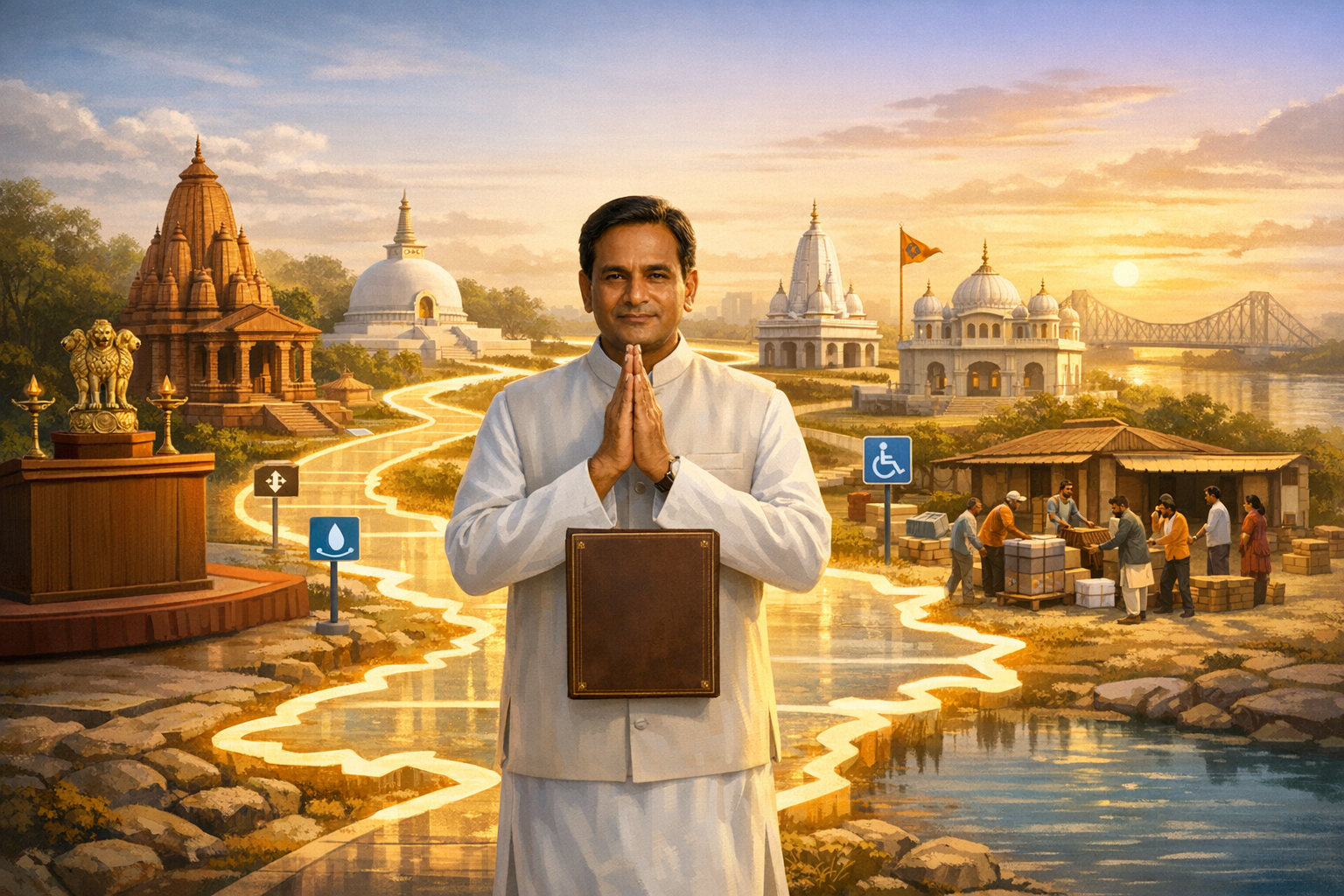
Suvendu Adhikari’s swearing-in as West Bengal’s first Chief Minister from the Bharatiya Janata Party, followed by a highly visible circuit of temple and ashram visits, marks a pivotal moment in Bengal’s cultural politics. The carefully choreographed movement from the constitutional oath to a sacred yatra communicated an immediate governance message: cultural heritage, sacred geography, and social service institutions will be foregrounded as instruments of cohesion, service delivery, and identity in the new political dispensation.
In political-communication terms, this sequencing is best read as a transition from state ritual to civil-religious symbolism. The oath-taking anchors constitutional legitimacy; the subsequent temple and ashram outreach situates leadership within Bengal’s lived traditions and networks of trust. Such a twin-track performancelegal-formal authority complemented by cultural legitimacycan stabilize early perceptions of a new administration while signaling policy priorities around heritage, pilgrimage infrastructure, and community partnership.
West Bengal’s sacred landscape is plural and historically dense, with Shakta, Shaiva, and Vaishnava traditions interwoven alongside vibrant Sikh, Buddhist, and Jain presences. Any “oath-to-pilgrimage” choreography in Bengal, therefore, acquires additional resonance: it interfaces not with a monolith but with a civilizational ecosystem. When framed within India’s constitutional guarantees (Articles 25–28) and the ethos of “Vasudhaiva Kutumbakam,” such outreach can serve as an inclusive platform cultivating unity among dharmic traditionsHinduism, Buddhism, Jainism, and Sikhismwhile respecting all citizens’ rights and beliefs.
The reported engagements with institutions such as the Bharat Sevashram Sangh, and interactions with spiritual leaders including Swami Pradiptananda (Kartik Maharaj), underscore the strategic relevance of service-oriented dharmic organizations in Bengal. Bharat Sevashram Sangh’s longstanding record in relief, education, and healthcare positions it as a natural partner in social protection, disaster response, and youth development. Aligning governance with such civic capacitywithout compromising institutional autonomycan accelerate last-mile delivery and foster bipartisan goodwill.
Temple and ashram circuits also intersect with economics and urban planning. A governance blueprint that improves multi-nodal pilgrimage connectivity (roads, sanitation, safety, and signages), augments wayfinding and accessibility (including for the elderly and persons with disabilities), and invests in heritage conservation (structural stabilization, archival documentation, and craft revival) can expand Bengal’s cultural economy. When paired with transparent Religious Endowments oversight, capacity-building for temple managements, and community tourism standards, this raises both trust and footfall while preserving sanctity.
Technically, the emerging model blends four policy layers: symbolic politics (legitimacy-building through sacred geography), heritage governance (conservation and living-traditions support), social-sector partnership (leveraging dharmic institutions for service delivery), and place-based economic development (pilgrimage corridors and creative industries). Internationally, similar models have lifted regional incomes where culture is protected as a public good and curated as shared heritage rather than partisan property. Bengal’s plural civilizational capital is well-suited to such a framework.
Unity across dharmic traditions deserves deliberate emphasis. An inclusive itinerary that engages not only Hindu temples and ashrams but also Buddhist viharas, Jain derasars, and Sikh gurdwaras signals a cohesive dharmic commons. This respects doctrinal diversity while foregrounding shared valuesahimsa, seva, dana, karunaand builds bridges among communities that have historically collaborated in education, philanthropy, and artisan production. Such gestures reduce polarization and strengthen a collective guardianship of Bengal’s heritage.
Safeguards are equally essential. To uphold constitutional impartiality, governance initiatives anchored in cultural heritage should be codified via non-discriminatory criteria, audited funding, and heritage-first rather than party-first selection of projects. Independent technical panels for conservation, public disclosure of grants and tenders, and citizen-reporting dashboards for temple-town services improve accountability. Legal clarity regarding property, rituals, and festival logistics prevents friction and encourages community-led stewardship.
Measurable outcomes should be tracked. Indicative metrics include: heritage site condition ratings; number of pilgrimage nodes upgraded; transit times and accident rates on key corridors; sanitation/hygiene compliance during major yatras; inclusive access indicators (ramps, tactile paving, multilingual signage); heritage-skills livelihoods created; artisanal cluster revenues; and reported instances of communal friction (target: sustained reduction). Transparent publication of this dataset fosters public trust.
Communications dynamics also matter. By situating public messages around shared civilizational assets, social-service partnerships, and inter-tradition respect, the administration can decouple heritage from zero-sum politics. This aligns with unity-seeking strands within Sanatana Dharma and related dharmic traditions, which celebrate multiplicity of marga (paths) and Ishta (chosen ideals) while nurturing a common ethical horizon.
For residents, such a turn in Bengal’s politics evokes memory as much as policy. Many families recount formative encounters with temples, viharas, derasars, and gurdwaras not merely as sacred spaces but as places of learning, refuge, and cultural literacy. When governance strengthens these institutions with fairness and competence, it reinforces everyday dignity and belongingespecially for the young, the elderly, and those who rely on community networks during crises.
In sum, the movement from oath to pilgrimage under WB CM Suvendu Adhikari is not a detour from governance but a declaration of its cultural grammar. If implemented with constitutional fidelity, fiscal transparency, and inter-dharmic inclusivity, this model can redefine Bengal’s politics as stewardship of a shared inheritancewhere temples and ashrams, viharas and derasars, gurdwaras and mathas together anchor service, solidarity, and a confident, plural civilizational future.
Inspired by this post on Struggle for Hindu Existence.