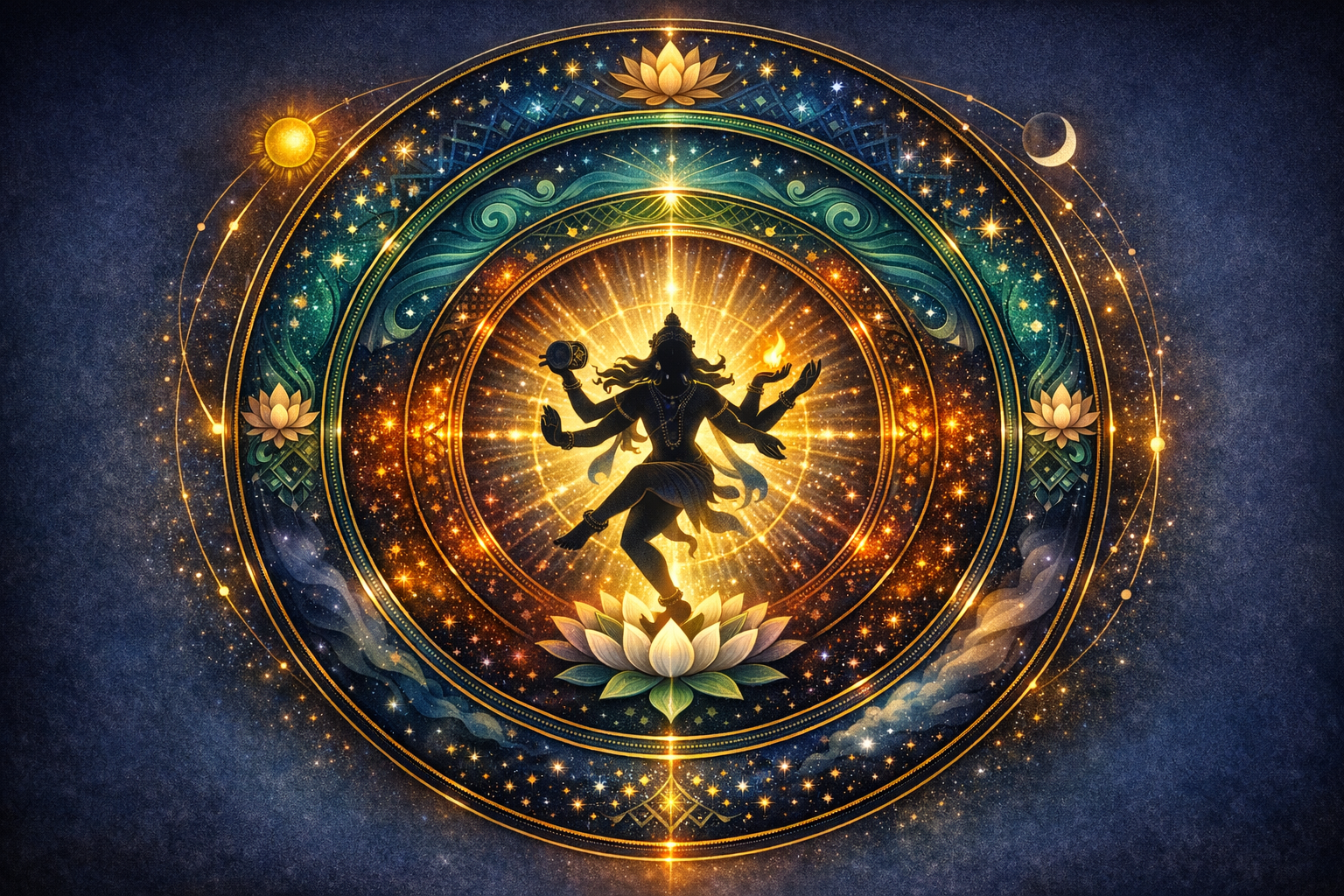
Kalachakra, from kāla and cakra, the wheel of time, is among the most fertile and enduring images in Hindu cosmology and philosophy. It evokes a universe that does not merely move forward in a straight line but turns, renews, and reveals itself in cycles. This study presents a rigorous, fivefold interpretive framework for the symbolism of Kalachakra, showing how Hindu thought understands time as an intelligent order that shapes cosmos, society, body, ritual, and liberation in a single, integrated vision.
Across the Vedas, Upanishads, Puranas, and Tantra, time is not inert duration; it is a formative principle allied with consciousness and dharma. In the Bhagavad Gita, the declaration kālaḥ asmi crystallizes a profound insight: time gives rise to all appearances, gathers them, and invites discernment beyond them. In Śaiva, Vaiṣṇava, and Śākta streams alike, this wheel of time is mirrored in divine play, in avatāra cycles, and in the dance of Nataraja, binding lawfulness, creativity, and compassion into a living whole.
This fivefold account is grounded in the classical doctrine of Pañcakṛtya, the five divine functions. While Hindu literature preserves multiple enumerations of time and its cycles, a fivefold schema maps most directly to creation, preservation, dissolution, concealment or veiling, and grace or revelation. Each of these functions turns as a wheel in the Kalachakra, and each is associated in many traditions with a presiding form of divinity. The five together create a comprehensive grammar for apprehending time as sacred order.
The interpretive move from Pañcakṛtya to five wheels is neither arbitrary nor merely poetic. In Purāṇic cosmology, in the Nataraja icon, and in Śrīvidyā and Pañcarātra lineages, the five functions structure the very logic of manifestation and its return to source. The Kalachakra thus appears as five concentric, interpenetrating wheels that operate simultaneously on macrocosmic, sociocultural, psychophysical, ritual, and contemplative planes.
Wheel One Sṛṣṭi, the wheel of creation, is commonly linked with Brahmā in Purāṇic registers and with the creative aspect of Śakti in Tantric registers. Cosmically, it signifies the emergence of form, measure, and rhythm from undifferentiated potential. The language of ṛta in the Vedas captures this stabilizing of pattern; the first turn of the wheel is a charter of intelligibility, enabling astronomy, calendar, and ethics to be meaningful at all.
In lived practice, the Sṛṣṭi wheel is mirrored in the springing forth of breath at dawn, in the first syllable of mantra during japa, and in the āvāhana that commences ritual. Within the person, it is the stirring of prāṇa and intention that gathers scattered energies into constructive attention. In a seasonal key, it resonates with spring and the sap of potentiality; in an ethical key, with initiative that aligns with dharma rather than mere impulse.
Wheel Two Sthiti, the wheel of preservation, is typically entrusted to Viṣṇu, the principle of sustaining order. Cosmically, Sthiti maintains the parameters set by creation, ensuring continuity of cycles: the seasons keep faith with the sun, tides hearken to the moon, and life systems hold their complex equilibria. The Sthiti wheel underscores that time is not only change but also dependable recurrence, the basis for promise, duty, and community.
In the body, Sthiti appears as steady posture and even breath; in ritual life, as daily nityakarma that upholds a sacred ecology of time. Midday, often a moment of fullness, symbolizes this wheel’s nutritive power. Ethically, it is the sphere of stewardship: to preserve is neither to freeze nor to exploit but to tend patterns that foster flourishing across generations.
Wheel Three Saṁhāra, the wheel of dissolution, is associated with Rudra or Śiva. Cosmically, it is the gathering in of forms when their purposes are spent. The emphasis here is not annihilation for its own sake but the return of names and shapes to their source, making possible fresh cycles. In the icon of Nataraja, the fire in his hand and the circle of flames, the prabhāmaṇḍala, encode this transformative completion, as the dancer writes and erases in a single rhythm.
In personal practice, Saṁhāra is the graceful exhalation, the willingness to release habit and possession. Twilight rites and Pradosha evoke this wheel’s contemplative beauty: endings are honored as teachers, not feared as failures. Emotionally, it invites resilience grounded in insight, where letting go is an act of trust in the continuity of the larger order of kāla.
Wheel Four Tirodhāna, the wheel of concealment or veiling, traditionally linked with Īśvara in some Śaiva mappings and with the pedagogic play of Māyā in Śākta thought, acknowledges that the sacred is never exhausted by visible form. Cosmically, Tirodhāna allows partiality of perspective so that beings engage, explore, and learn; it is the condition for history and story, for radical novelty and human freedom within limits.
Psychologically and ritually, Tirodhāna names the lawful obscurations that drive seeking and practice. Night and winter often symbolize this wheel, not as darkness opposed to light but as incubation and gestation. In contemplative work, recognizing veiling without cynicism becomes a mature stance; it prevents naïve absolutism and honors humility before mystery.
Wheel Five Anugraha, the wheel of grace or revelation, is frequently attributed to Sadāśiva in Śaiva sources and to the compassionate aspect of the Divine across sampradāyas. Cosmically, it is the disclosing of the whole through the part, the moment in which the finite is seen to be rooted in the infinite. Anugraha completes the circle, revealing that each wheel already bore the signature of the Real.
In practice, Anugraha can dawn as a quiet comprehension in study, a turn of heart in service, or a lucid pause in pranayama when awareness rests free of grasping. Iconographically, Nataraja’s abhaya hasta, the gesture of fearlessness, and the foot raised for release declare this liberating function. Soteriologically, Anugraha aligns with mokṣa, where time is known as sacred play and the person finds repose in the timeless ground.
The five wheels are not five steps in a line but five interwoven movements that co-arise and support one another. Creation presupposes preservation and dissolution; concealment makes grace possible; grace, in turn, reframes creation as already luminous. Kalachakra symbolism thus resists reduction to a single mechanism; it is a polyphony that rewards patient contemplation and disciplined living.
Nataraja’s image offers a concentrated visualization of the Kalachakra. The encircling aureole of flames denotes the wheel of time; the ḍamaru drum sounds creation, the fire performs dissolution, the planted foot subdues forgetfulness, and the other confers fearlessness, while the dancing body sustains order. This icon does not illustrate a doctrine; it enacts the fivefold time-power as a single, gracious dance.
Within Śrīvidyā, the Pañcakṛtya structure is deeply internalized: the Goddess, as Lalitā Tripurasundarī, is the sovereign of time’s artistry, and worship cycles rehearse the five functions in sequence and simultaneity. In Pañcarātra, the theology of manifestation and maintenance articulates complementary principles by which order is upheld and renewal is assured. Such lineages preserve practice architectures that keep time sacred rather than merely scheduled.
Indian astronomy and calendar science, from Vedāṅga Jyotiṣa to classical siddhāntas, give the Kalachakra explicit astronomical content. The sun’s course and lunar phases map a nested set of cycles tithi, pakṣa, māsa, ṛtu, ayana, and varṣa that anchor temple festivals and personal observances. The panchāṅga that guides daily practice is thus not a convenience but a devotional instrument calibrated to the wheel of time.
On a microcosmic register, the five wheels resonate with the pañca kośa doctrine. The emergence and stabilization of experience through annamaya, prāṇamaya, manomaya, vijñānamaya, and ānandamaya kośas repeat the larger rhythms of creation, preservation, dissolution, veiling, and grace within the person. Yogic anatomy, with its chakras and nāḍīs, further refines how breath and awareness can be oriented to this fivefold dynamic.
Breath practice exemplifies this orientation. The natural cycle of inhalation, retention, exhalation, and stillness can be contemplated as creative arising, sustaining, releasing, and revealing. When done with studied attention and ethical grounding, such pranayama becomes more than technique; it is a direct education in the grammar of Kalachakra as it is inscribed in the living body.
Ritually, the day offers a concise theater for the five wheels. Dawn sandhyā evokes Sṛṣṭi’s freshness; the fullness of midday ritually sustains; twilight honors Saṁhāra’s refinement; the quiet of night attends Tirodhāna’s incubation; and the pre-dawn hush can disclose Anugraha’s clarity. The same rhythm extends to seasons and to life stages, allowing households and communities to practice a time ecology aligned with dharma.
At civilizational scale, yuga theory places the Kalachakra in a grand periodicity of flourishing, strain, and renewal. The ethical tenor called yuga-dharma marks how communities adapt their expression of eternal principles to the character of the time. This elasticity safeguards continuity without rigidity, and reform without amnesia, demonstrating the intelligence of a cyclical vision over merely linear expectations.
Kalachakra also provides a bridge among dharmic traditions. In Vajrayāna Buddhism, the Kalachakra system distinguishes outer, inner, and alternative cycles, harmonizing cosmology with yogic transformation; the family resemblance to the Hindu Pañcakṛtya grammar is evident in the shared insistence that time is both law and path. In Jain cosmology, the great wheel of ascending and descending halves, utsarpiṇī and avasarpiṇī, offers a majestic account of ethical and spiritual cadence across vast epochs.
In Sikh thought, the emphasis on Akal, the Timeless, and on the primacy of the One before whom time turns, offers a complementary axis for reverent engagement. These perspectives differ in metaphysical emphasis yet converge practically: time is sanctified through remembrance, ethical discipline, and service. Read together, such insights strengthen a shared commitment to unity in spiritual diversity across Hinduism, Buddhism, Jainism, and Sikhism.
A practical fivefold contemplation can align personal life with the five wheels. Begin the day by noticing the creative stir of breath and intention; through the day, preserve steadiness in action and speech; at day’s end, consciously let go of residues; honor the limits of knowledge with humility; and cultivate receptivity to insight and grace in study, prayer, or silence. This simple discipline translates a vast cosmology into a humane, sustainable rhythm of living.
For students of iconography and scripture, the five wheels supply a robust comparative lens. Nataraja’s dance, Purāṇic accounts of kalpas and manvantaras, Upanishadic meditations on the kośas, and Pañcarātra ritual handbooks can be read as layered commentaries on the same grammar. The result is not scholastic accumulation but integrative understanding, where technical detail illuminates practice and practice, in turn, clarifies doctrine.
Scholarly nuance remains essential. Different lineages articulate the five functions and their deities with variation, and some streams emphasize triadic or other enumerations. Such plurality is a strength, not a weakness; it signals a tradition confident enough to use many lenses for one truth. The Kalachakra’s five wheels are thus best received as a guiding mandala rather than as a single, exclusive map.
Ultimately, the five wheels of Kalachakra disclose an ethics and an aesthetics of time. They invite creativity without hubris, stewardship without stagnation, endings without despair, humility without cynicism, and openness without credulity. To live by this wheel is to discover that time is not an adversary to be beaten but a sacred partner in the realization of wisdom and compassion.
Inspired by this post on Hindu Blog.