
Samhara—often translated as dissolution—designates Shiva’s transformative function within Hindu cosmology. In the cycle of creation and return, this form is not a synonym for violent destruction; it is a sacred clearing that dissolves exhausted forms so that life, wisdom, and dharma may re-emerge with greater clarity. Properly understood, the Samhara form of Shiva is a theology of compassionate renewal, a disciplined philosophy of change, and a contemplative practice that helps seekers let go of what no longer serves the common good. The symbolism and meaning of the Samhara form of Shiva therefore integrate metaphysics, ritual, psychology, and ethics into a single, coherent vision of spiritual transformation.
Hindu philosophy frames this process through the doctrine of the five divine acts (pañcakṛtya): sṛṣṭi (emanation), sthiti (sustenance), saṁhāra (dissolution), tirobhāva (concealment), and anugraha (grace). Samhara is inseparable from the other acts; in fact, it makes room for anugraha, the outpouring of liberating insight. The dissolution of forms is thus a phase in a rhythmic whole, not a terminal catastrophe. Cycles may span from brief personal transitions to vast cosmic intervals (kalpas and pralayas), yet the principle remains consistent: what is completed dissolves, so that what is true can shine without obstruction.
Scriptural foundations present this vision with reverence and precision. Vedic hymns such as Śrī Rudram (Taittirīya Saṁhitā, Yajurveda) hail Rudra-Shiva as the one who withdraws and renews the worlds. The Śvetāśvatara Upaniṣad describes Rudra as the singular divinity who governs time and transformation. Purāṇic literature—including the Śiva Purāṇa and Liṅga Purāṇa—elaborates the doctrine of cyclical dissolution and re-creation, while the Āgamas (e.g., Kāmikāgama) detail ritual frameworks that align the practitioner with Shiva’s five acts. Philosophical systems such as Śaiva Siddhānta and Kashmir Śaivism (Pratyabhijñā, Spanda) interpret Samhara as the pulsation whereby Consciousness reabsorbs its manifest expressions back into its own undivided nature.
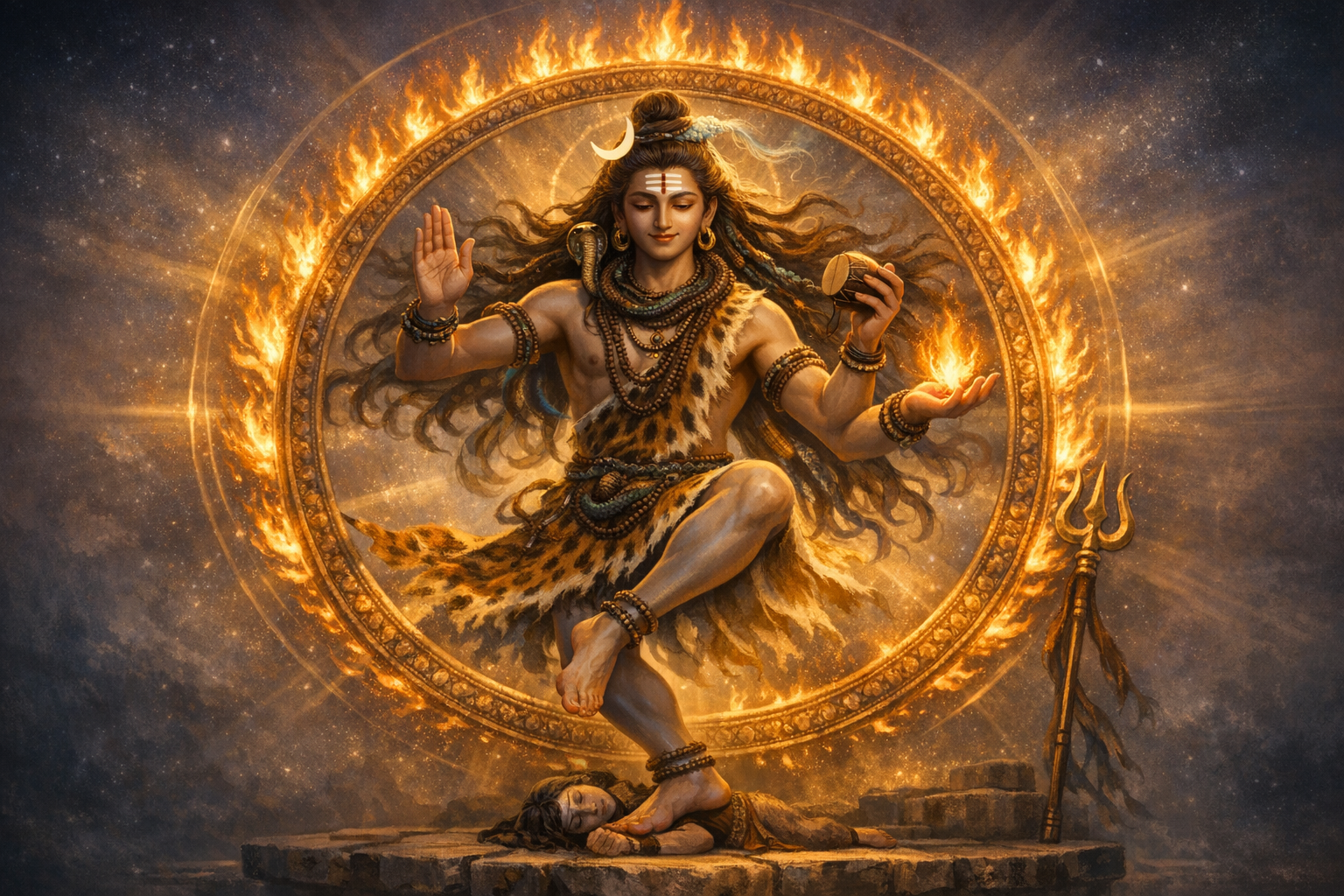
Iconography distills these teachings in compelling visual language. Shiva as Naṭarāja—the Lord of Dance—encapsulates Samhara within the ānanda-tāṇḍava. The ring of fire (prabhāmaṇḍala) symbolizes the totality of manifest reality undergoing perpetual emergence and return. The lifted hand in abhaya offers fearlessness, while the drum (ḍamaru) signals genesis and rhythm. Flames in the other hand represent the power of reabsorption; the trampling of the dwarf Apasmara overcomes forgetfulness and dullness. Most importantly, the raised foot confers grace (anugraha), revealing that Samhara never stands apart from compassion; it is mercy enacted through removal of obscurations.
Other iconic forms emphasize complementary aspects of Samhara. As Tripurāntaka, Shiva dissolves the three cities of hardened ego and ignorance, an allegory for the unraveling of the three impurities (mala-traya) in Śaiva Siddhānta. Narratives of Andhakasura’s defeat convey how unbridled craving collapses under insight. As Mahākāla and Kālābhairava, Shiva presides over time and the liminal thresholds of life and death, demonstrating that wisdom remains sovereign where forms are most transient. None of these symbols license violence; rather, they dramatize the disciplined removal of inner obstructions that sustain suffering.
Cremation-ground imagery (śmaśāna-vāsin) intensifies the teaching of impermanence. Vibhūti (sacred ash) recalls that all compounded things resolve into elemental simplicity. The tiger skin, serpents, and matted locks are not emblems of menace; they signify mastery over instinct, time, and the ascetic’s untethered freedom. The trident (triśūla) evokes discernment that pierces the three guṇas (sattva, rajas, tamas), enabling the practitioner to rest in the witness-awareness that is never consumed by change. When approached meditatively, these motifs evoke humility, clarity, and a commitment to compassionate action.
Philosophically, Samhara names an inward return. In Kashmir Śaivism, saṁhāra is the pratyabhijñā (recognition) of one’s innermost nature as Śiva—luminous, free, self-aware—where the limited self’s superimpositions subside. Śaiva Siddhānta articulates a closely allied path in which the malas (āṇava, māyīya, kārma) are attenuated by ritual discipline, ethical action, and grace. In either account, dissolution is precise: it dissolves what is adventitious (upādhis), not what is essential. The point is not annihilation but unveiling.
Interpreted psychologically, Samhara is the mind’s release of rigid patterns (saṁskāras) and the quieting of agitation (vikṣepa) that obscures insight. Devotees frequently report that contemplating Naṭarāja’s ring of fire during periods of change helps them relinquish grief, resentment, or fear. Therapists conversant with contemplative traditions sometimes note a parallel with cognitive-emotional defusion: thoughts and moods are seen as passing formations rather than final truths. The result is not withdrawal from responsibility but entry into a wiser agency, grounded and responsive rather than reactive.
The ethical ramifications of Samhara are practical. When inner rigidity dissolves, empathy increases and action aligns with dharma. Non-attachment (vairāgya) is not coldness; it is freedom from compulsive grasping that distorts judgment. This stance supports ahimsa (non-harm) while sustaining the courage to confront adharma without hatred. In this light, Samhara becomes an inner kṣetra (arena) where unwholesome impulses are disbanded, allowing clarity and compassion to guide social and familial responsibilities.
Ritual and contemplative disciplines make the doctrine experiential. On Mahāśivarātri—the kṛṣṇa pakṣa caturdaśī—vigil, fasting, and chanting bring the mind to restful alertness, a living encounter with dissolution and renewal. Recitation of Śrī Rudram (Namakam, Camakam) attunes practitioners to Rudra’s all-pervading care, while quiet japa of Om Namaḥ Śivāya on the out-breath can be undertaken as a gentle exercise in letting go. Applying vibhūti after prayer symbolizes the resolve to release unhelpful identifications through the day. Such practices are contemplative aids rather than ends in themselves; they serve a steady maturation in discernment and kindness.
Sacred geography also illuminates Samhara’s meanings. At Ujjain’s Mahākāleśvara, Shiva’s sovereignty over time is palpably celebrated. In Vārāṇasī (Kāśī Viśvanātha), the awareness of impermanence deepens devotion to the eternal. At Chidambaram, the dancing Śiva expresses the unity of dissolution and grace within the vastness of Consciousness, while Kālābhairava temples mark the thresholds of passage and protection. Each shrine anchors a facet of the same teaching: when forms pass, the reality they reveal does not.
Resonances across dharmic traditions affirm a shared ethic and metaphysic of transformation. Buddhism’s teaching of anicca (impermanence) trains attention to the arising and passing of phenomena without clinging; its wrathful iconography in Vajrayāna parallels the compassionate fierceness of Samhara. Jainism’s anekāntavāda (many-sidedness) dissolves dogmatism, while nirjarā (shedding of karmic accretions) mirrors the cleansing intention of Samhara. Sikh teachings on hukam invite trustful alignment with the divine order, encouraging equanimity as forms change. Together these perspectives reinforce unity in diversity, fostering mutual respect and shared commitment to ethical living.
Common misconceptions arise from reading Samhara as iconoclasm or nihilism. The more accurate reading, consistent with scripture and practice, sees it as discerning release. In the life of a household, a community, or a nation, attachment to outdated forms can impede justice and flourishing. Samhara counsels courageous yet compassionate reform: preserve what is life-giving, retire what is harmful, and make space for renewal. The samhara of delusion is the anugraha of wisdom.
Contemporary relevance is unmistakable. Ecological ethics, for example, reflect the Samhara insight that consumption without cycles of repair and reuse leads to exhaustion. Accepting limits and enabling regenerative patterns honor both life and time. In personal life, periodic simplification—whether of schedules, possessions, or habits—enacts a modest Samhara that restores attention to friendship, study, meditation, and service. In civic settings, sunset clauses, periodic review, and evidence-based reform embody the same principle: unobstructed renewal through thoughtful dissolution.
A practical contemplative frame may be summarized succinctly: observe change without resistance; dedicate actions to the welfare of all (lokasaṅgraha); examine motives and discard those rooted in fear or vanity; remember Om Namaḥ Śivāya to steady the mind; and cultivate gratitude as forms pass. Over time, this discipline installs serenity that neither clings to the old nor rushes the new. What dissolves are distortions; what remains is awareness, relationship, and responsibility.
In sum, the symbolism and meaning of the Samhara form of Shiva present a theology of compassionate dissolution, a philosophy of cyclical wisdom, and a set of practices that help communities and individuals move through change with dignity. It is not a cult of endings but a science of renewal. When sṛṣṭi, sthiti, saṁhāra, tirobhāva, and anugraha are seen as one rhythm, fear subsides, unity across dharmic paths deepens, and the space for truthful, ethical action opens. In that space the dance of Naṭarāja is recognized as one’s own steady heart: luminous, free, and ever-renewing.
Inspired by this post on Hindu Blog.







Leave a Reply
You must be logged in to post a comment.