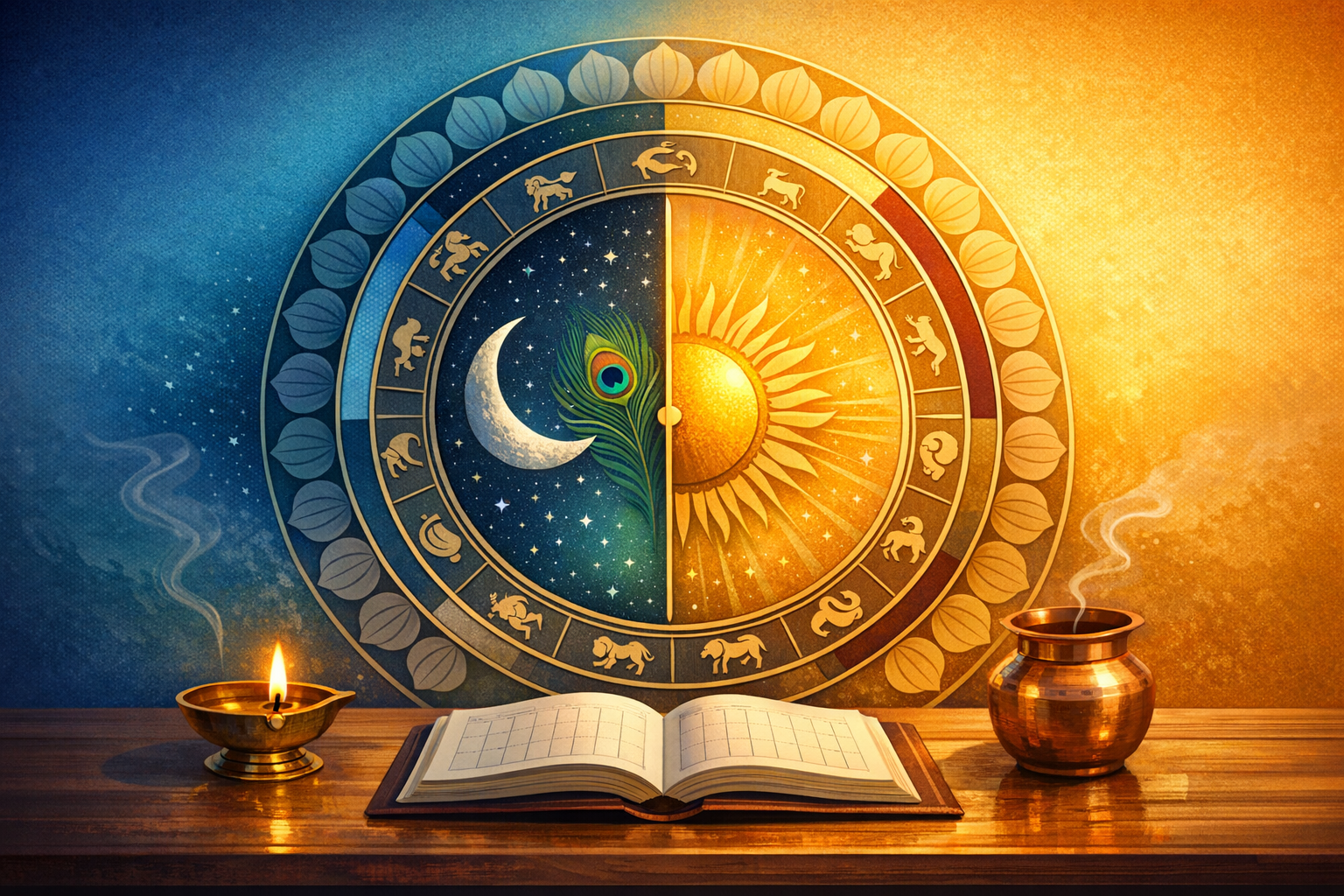
Friday, May 22, 2026, in the Hindu Calendar (Panchang) observes Shukla Paksha Sashti tithithe sixth lunar day of the waxing phaseprevailing until 11:46 AM (IST) in most regions, after which Shukla Paksha Saptami tithi begins. This day’s observances therefore straddle two distinct tithis, offering a pragmatic two-part spiritual and ritual planning window within a single civil date.
In the Panchang framework, a tithi is determined by the angular distance between the Sun and the Moon, and it does not align neatly with the 24-hour civil day. Thus, the Sashti-to-Saptami transition at 11:46 AM (IST) is a precise astronomical marker with immediate implications for daily puja, vrata, and Shubh Muhurat 2026 planning. Friday (Shukravar) additionally colors the day with auspiciousness associated with Shukra, traditionally linked to harmony, aesthetics, and prosperity.
Shukla Paksha Sashti is widely associated with devotion to Subrahmanya (Skanda), as well as with Shashthi Devi who is revered as a guardian of children and family welfare. In many households, the early hours under Sashti tithi are reserved for simple yet focused practiceslighting a lamp, reciting brief stotras, or performing a home abhishekamreflecting a heartfelt intent to nurture courage, discipline, and collective well-being.
With the onset of Shukla Paksha Saptami after 11:46 AM (IST), attention traditionally pivots toward the Surya principle, symbolizing vitality, insight, and steadfast clarity. While the most celebrated Saptami (Ratha Saptami) occurs in a different month, routine Saptami days are still well-regarded for Surya arghya (water oblation at sunrise when feasible) and focused contemplation on right action, study, and service. This shift from Sashti to Saptami within the same day offers an opportunity to align intention: strength and protection in the morning hours, and clarity and illumination thereafter.
Good time (muhurta) selection on this date can be approached with foundational Panchang principles. Abhijit Muhurtacentered on local solar noon and spanning roughly 24 minutes before and afterremains a classical choice for initiating works that require balanced, stable outcomes. Brahma Muhurtaapproximately 1 hour 36 minutes to 48 minutes before local sunriseis traditionally prized for meditation, japa, and scriptural study. Because these windows depend on local sunrise and the observer’s longitude and latitude, they should be computed for the specific location to maintain accuracy.
Avoidance windows are equally important in day planning. Rahu Kalam, Yamagandam, and Gulika/Kuligai during daytime are derived by dividing the sunrise-to-sunset period into eight equal segments. For Fridays, Rahu Kalam falls in the fourth segment after sunrise; it is traditionally avoided for initiating significant undertakings. Yamagandam and Gulika for the day can be located using the same segment-based method. Since segment durations vary with the season and location, computing them from the local sunrise and sunset ensures reliability.
The Nakshatra and the Moon’s Rashi (Chandra Rashi) for May 22, 2026, are location-sensitive and can change within the day much like tithi. For precise Nakshatra and Rashi readingsespecially for tasks such as naming ceremonies, travel choices, or remedial measuresreference to a local Panchang or a well-calculated ephemeris adjusted to the observer’s city is recommended. In practice, Nakshatra supports finer-grained muhurta choices (via Tarabalam and Chandrabalam), while the Moon’s Rashi contextualizes emotional tone and receptivity.
Technically, the tithi index is governed by the Sun–Moon elongation: Tithi = ⌊(elongation ÷ 12°)⌋ + 1. A nominal tithi spans an average of 0.8 of a civil day (≈ 23 hours 37 minutes), but can be shorter or longer due to orbital variations. Karanashalf-tithi segmentsiterate in a known sequence (Bava, Balava, Kaulava, Taitila, Garaja, Vanija, Vishti/Bhadra), and Yoga arises from the sum of the Sun’s and Moon’s ecliptic longitudes. While this post centers on the Sashti-to-Saptami switch at 11:46 AM (IST), those requiring full muhurta specificity for marriage, griha-pravesh, or samskaras should compute the Karana and Yoga for their exact locale and time.
Regional practice nuances should be noted. Festivals and vratas may observe Udaya tithi (tithi at sunrise) or stipulate tithi presence at a specific canonical span (e.g., pradosha, nishita). Northern calendars often follow the Purnimanta system, while Southern regions commonly employ the Amanta system; both are aligned to the same astronomical reality yet differ in month naming conventions. The Panchang, therefore, balances precision with paramparā (living tradition), guiding families to follow the rule-set received from their lineage or community while keeping core astronomical markers intact.
The shared lunisolar sensibility across the dharmic traditions reinforces a spirit of unity. Hindu families consult the Panchang for daily tithi-guided sādhanā; many Buddhist communities observe lunar uposatha rhythms; Jains schedule vratas and paryushana-linked reflections by tithis; and numerous Sikh households, while primarily guided by the Nanakshahi or Bikrami frameworks, engage with tithi-based familial customs within extended communities. This convergence around celestial timekeeping nurtures mutual respect, shared festivals, and intergenerational continuity, aligning with a broad vision of harmony across dharmic paths.
Practical planning for May 22, 2026, can therefore be staged in two parts. During Shukla Paksha Sashti (until 11:46 AM, IST), families inclined toward Skanda worship may undertake brief puja, japa, or sankalpa for protection and valor. After the transition to Shukla Paksha Saptami, Surya-focused actsmindful study, a short arghya at a suitable time, or charitable intentcan structure the remainder of the day. Choosing a start time within an auspicious muhurta (e.g., Abhijit or a favorable Choghadiya such as Amrit, Shubh, or Labh) while avoiding Rahu Kalam completes a balanced, tradition-consistent approach.
Because Panchang elements are inherently local, one final methodological note ensures accuracy and confidence: determine the observer’s sunrise and sunset for May 22, 2026; compute daytime into eight equal parts for Rahu Kalam/Yamagandam/Gulika; identify local solar noon for Abhijit Muhurta; and verify the live Nakshatra and Chandra Rashi around the 11:46 AM (IST) tithi change. This disciplined, location-aware process yields a dependable Daily Hindu Calendar practice that honors both astronomical exactitude and the inclusive, unifying ethos of the dharmic traditions.
Inspired by this post on Hindu Blog.