Kalachakra, the Wheel of Time, occupies a central place in Hindu Tantra as a precise metaphysical and practical map for realizing the unity of consciousness. It frames time not as a linear arrow but as a living cycle that binds and simultaneously reveals the correspondence between the individual (pinda) and the cosmos (brahmāṇḍa). Read as both doctrine and discipline, Kalachakra illuminates how human awareness can synchronize with cosmic rhythm to access states of freedom beyond temporality.
Etymologically, kāla signifies time and chakra denotes a revolving wheel or cycle, together indicating the patterned, recursive flow of manifestation. Within Hindu Tantraespecially Śaiva and Śākta currentsKalachakra functions as a unifying idea that integrates cosmology, ritual timing, yogic physiology, and contemplative insight. Although the term also names a distinct Buddhist corpus, in the Hindu Tantric milieu it is better read as a cross-cutting principle that renders time a practice-oriented gateway to supreme consciousness rather than a merely abstract category.
Upaniṣadic reflections establish the philosophical ground. The Maitri Upaniṣad distinguishes time as twofoldmeasurable (mūrta) through days, nights, and seasons, and immeasurable (amūrta), the timeless reality toward which practice aims. The Bhagavad Gītā’s theophany further declares, “kālo ’smi” (I am Time), identifying time both as a dissolving force and as a facet of the Absolute. Kalachakra in Tantra draws on these insights to train attention toward the Akāla, the unconditioned awareness in which cyclical time arises and subsides.
Kashmir Śaivism articulates this trajectory with technical precision. Kāla (time) appears among the kañcukaslimiting veils that constrain infinite consciousnesswhile spanda, the primordial throb, describes how the Absolute vibrates as cycles. Sādhana becomes a calibrated effort to notice limitation as pattern, then to relax the grasp that confers reality upon patterning, revealing the background luminosity of awareness.
Hindu cosmology provides the grand outer dial of the Wheel of Time. The four yugasSatya, Tretā, Dvāpara, and Kalicompose a mahāyuga of 4.32 million years. Seventy-one mahāyugas make a manvantara, fourteen manvantaras make a kalpa (a day of Brahmā, 4.32 billion years), and an equally long night follows. Such scale does not merely quantify antiquity; it contextualizes human life as a meaningful micro-interval nested within unimaginably vast cycles.
The pañcāṅgatithi (lunar day), vara (weekday), nakṣatra (lunar mansion), yoga, and karaṇaserves as the ritual chronometer of Kalachakra. Tantric practitioners employ this calendar not for fatalism but for resonance, aligning sādhana with auspicious windows so that mantra, nyāsa, and meditation ride the crest of natural rhythms. Muhūrta selection thus becomes an applied science of temporal entrainment.
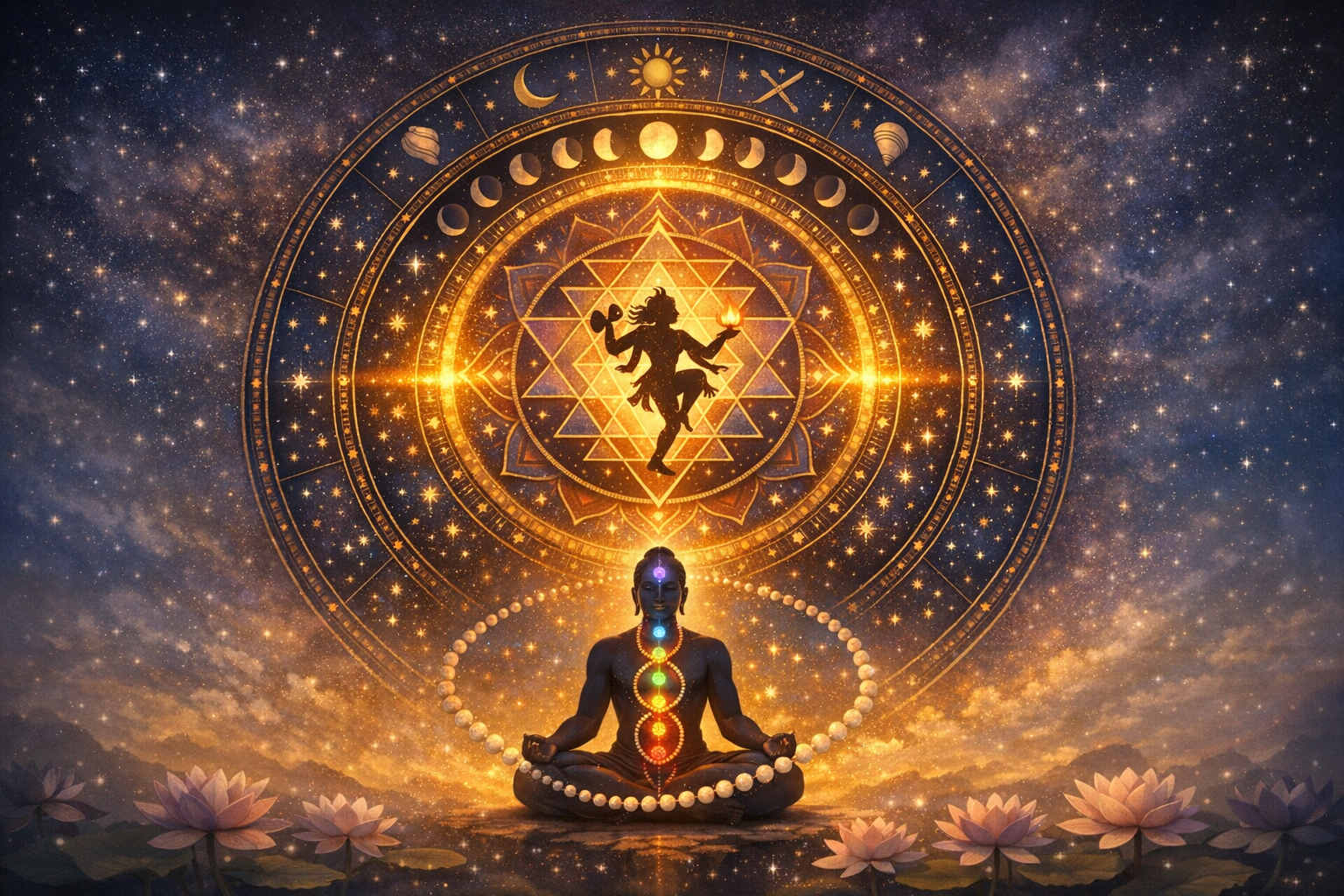
The inner wheel turns within the subtle body. Classical mapping of the chakrasmūlādhāra through sahasrārapresents psychophysical stations where prāṇa and attention cyclically stabilize, intensify, and transcend. Kalachakra here implies that physiological cyclessleep–wake, hormonal tides, and breath oscillationscan be harnessed to refine attention, stabilize affect, and deepen insight into the continuity of awareness across change.
Svara-yoga operationalizes this by reading the alternation of nostril dominance (ida–piṅgalā) as a living clock that modulates cognition and action. When suṣumṇā activates, meditative absorption is reportedly facilitated, making these ultradian breath rhythms a practical compass for timing practice. Observant householders and renunciants alike note that synchronizing contemplative work with these cycles improves consistency and depth without strain.
Deity symbolism encodes temporal mastery. Śiva as Mahākāla is lord of time, while Kālī, the devouring power, exposes the perishability of forms. The icon of Śiva Naṭarāja choreographs Kalachakra in bronze: the damaru beats cyclical time, the flame dissolves obsolescence, the raised foot grants refuge, and Apasmāra, the dwarf of forgetfulness, is subdued. The message is cleardance with the cycle, recognize its source, and the wheel liberates rather than binds.
Yantra science visualizes these principles. The Śrīcakra’s nine interpenetrating triangles and the navāvaraṇa enclosures function as a cartography of ascent and return, mapping consciousness from gross to subtle and back to the world, now sacralized. Lunar kalā (phases) and the Nityā Devīs in Śrīvidyā practice link the month’s cycle to mantric unfoldment, converting calendrical time into an engine of interiorization.
Mantra-japa integrates number with sky. The 108-bead mālā encodes cosmology27 nakṣatras × 4 pādasand mirrors elegant solar–lunar ratios recognized in traditional astronomy. Repetition becomes entrainment; the mind learns the beat of the heavens, and attention gradually stabilizes in the witness that outlasts each cycle of sound and silence.
A Kalachakra-informed daily architecture privileges the sandhyādawn, noon, and duskas liminal thresholds. Practice during brahma muhūrta, roughly the 96 minutes before sunrise, often yields heightened clarity with minimal mental turbulence. Śākta lineages may emphasize new-moon practices for Kālī, while Śrīvidyā traditions privilege full-moon worship; both approaches translate lunar dynamics into contemplative advantage.
Prāṇāyāma refines temporal perception by modulating the felt tempo of cognition. Nādi-śodhana harmonizes ida and piṅgalā, bhastrikā energizes, and kumbhaka (retention) reveals the “gap” in which time seems to fall away. Practiced judiciously and ethically, these methods quiet reactivity, making it easier to observe the rise and fall of thoughts as rhythmic expressions of prāṇa rather than ultimate facts.
Tantra anchors these methods in ethical substrate. Yama–niyamaahimsā, satya, tapas, svādhyāya, and īśvara-praṇidhānastabilize attention and protect momentum by reducing the karmic “noise” that distorts perception. In this sense, virtue is not moral ornament but a temporal technology that cleans the signal of awareness.
Kalachakra also reframes karma. Time is the visible theater in which saṃskāras mature as prārabdha, while intention (sankalpa) seeds āgāmi. Through discernment and disciplined practice, sanchita’s latent store can be rendered inert, and prārabdha can be met with equanimity. The present moment thus becomes the axle of the wheel where freedom is exercised, not a passive point carried by fate.
Cross-Dharmic resonances deepen this vision of unity. In Buddhism, the Kalachakra system frames time, cosmology, and practice within the insight of śūnyatā and bodhicitta, emphasizing compassionate action synchronized with wisdom beyond fixation. Differences in metaphysical language aside, both streams cultivate precision timing, ethical rigor, and stabilized attention to access the timeless.
Jain cosmology presents Utsarpiṇī and Avasarpiṇī, ascending and descending half-cycles of the cosmic wheel, often depicted as the Kālacakra diagram. Its ethic of ahiṃsā and the doctrine of Anekāntavāda affirm that reality is many-sided and that humility in knowledge is essential. The convergence with a Kalachakra sensibility lies in honoring cyclical law while orienting practice toward liberation beyond becoming.
Sikh thought adds a complementary vocabulary of transcendence: Ik Onkar and Akaal Purakh foreground the Timeless One before whom all cycles unfold. The praxis of simran and seva harmonizes daily life with Hukam, making each temporal act a vessel for timeless remembrance. This emphasis on the Timeless nurtures the same liberation Kalachakra seeksfreedom through rhythmic, ethical living that points beyond time.
Common misconceptions warrant clarification. Kalachakra is not fatalism or astrology-as-destiny; it is a disciplined approach to entrainment that respects cosmic regularities without surrendering agency. Nor is it sectarian property; the Wheel of Time is a shared Dharmic intuition that invites dialogue across Hinduism, Buddhism, Jainism, and Sikhism while honoring each tradition’s integrity.
A practical on-ramp can be designed without esotericism. Over twenty-eight days, practitioners may track breath dominance morning and evening, sit daily in brahma muhūrta when feasible, align a chosen mantra with tithi-suitable sessions, and maintain a concise yama–niyama journal. Many report that such modest, regular calibrations yield disproportionate clarity, emotional steadiness, and a felt continuity of awareness across changing moods and demands.
Interdisciplinary dialogue reinforces these observations. Chronobiology’s circadian and ultradian findings, heart-rate variability research, and vagal tone modulation correlate with classical guidance about practice timing, breath balance, and affect regulation. Rather than reducing Tantra to physiology, this complementarity invites refined experimentation anchored in ethics and discernment.
Textual anchors for this synthesis include the Maitri Upaniṣad’s twofold time, Bhagavad Gītā 11.32 on Time as the Absolute’s power, Tantric manuals on nyāsa and muhūrta selection, Svara-yoga teachings on ida–piṅgalā–suṣumṇā, Śrīvidyā literature on lunar kalā and the Nityā Devīs, and Kashmir Śaiva sources on spanda and the kañcukas. Together, they frame Kalachakra as both ontology and method.
Kalachakra in Hindu Tantra ultimately discloses a practical metaphysics: live attuned to the Wheel of Time to remember what stands beyond it. When cycles are recognized as rhythms of Śakti rather than prisons of fate, agency is restored, compassion matures, and insight stabilizes. In this spirit, the Wheel becomes a bridgeuniting microcosm and macrocosm, and harmonizing the Dharmic family in the shared pursuit of liberation. Vasudhaiva Kutumbakam.
Inspired by this post on Hindu Blog.