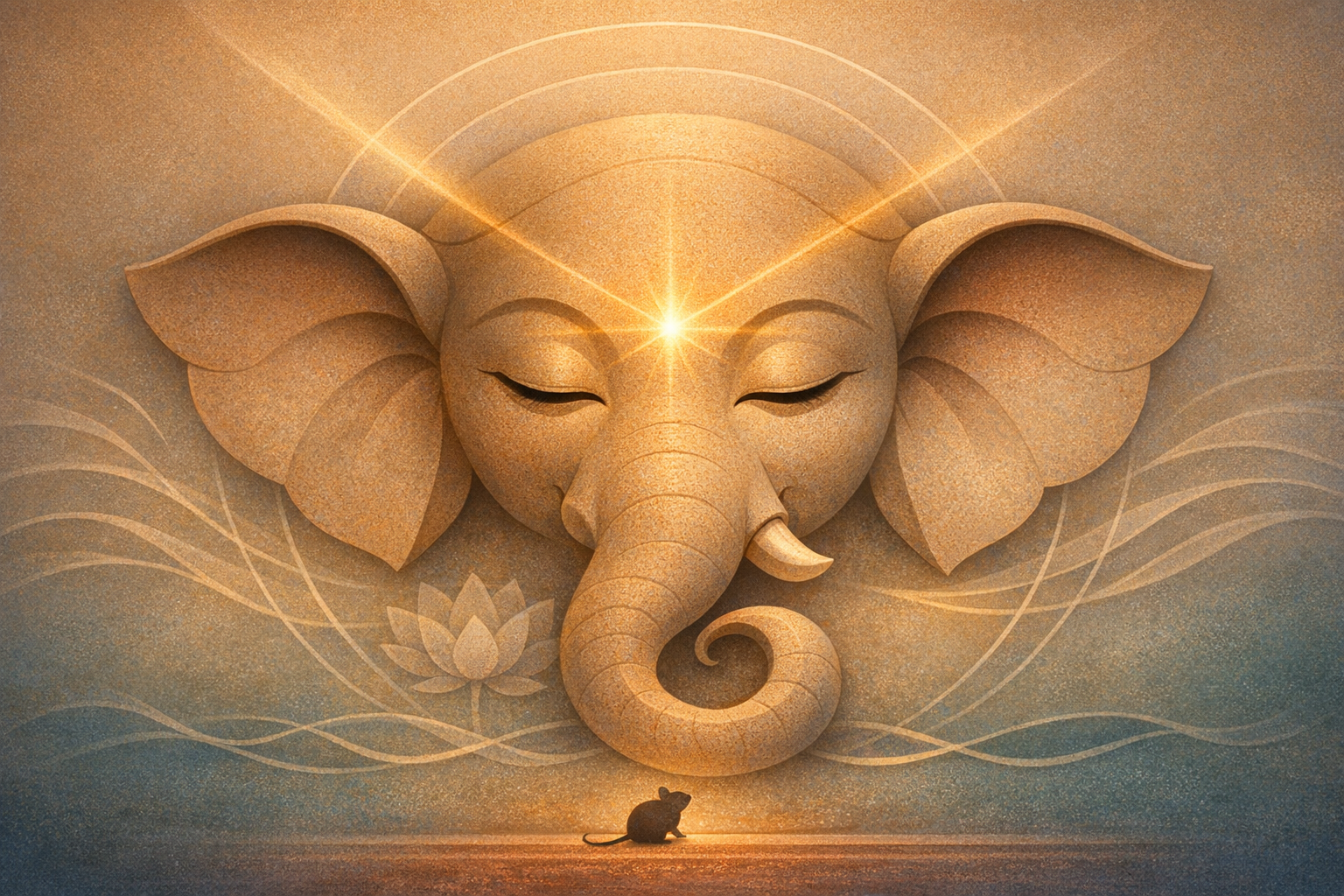
The motif of Ganesha’s small, concentrated eyes distills a far-reaching spiritual teaching: expansive wisdom is born from focused perception. In Hindu iconography, the elephant-headed deity embodies intellect, discernment, and the removal of obstacles; his comparatively small eyes signal a deliberate narrowing of attention that opens a wider internal horizon. This symbolism has resonated across centuries because it links the natural world’s cuesthe keen, observant gaze of an elephantto a universal contemplative principle: sustained, calm attention clarifies reality and guides wise action.
Traditional artisans and āgamic-śilpa canons often present deities with netra-bhāva (the “mood of the eyes”) suited to their essential quality. For Ganesha, eyes are typically rendered small or gently half-closed, suggesting dhyāna (meditative absorption) and apramatta (careful mindfulness). This is not a physiological claim but an iconographic language: subtle eyes communicate interiority. The image thus instructs the devotee even before a single verse is read, condensing philosophy into form.
Placed within Hindu philosophy and Yoga, the symbol aligns with the graded inward-turning of attentionpratyāhāra (withdrawal of the senses), dhāraṇā (one-pointed attention), and dhyāna (sustained meditation). When the senses (indriyas) no longer scatter awareness toward distractions, the mind’s lens tightens, and insight (prajñā) becomes possible. Ganesha’s small eyes, then, become a mnemonic for ekāgratāone-pointed steadinesswithout which clarity, ethical discernment, and purposeful action falter.
The Bhagavad Gītā (6.13) reinforces the same discipline through nasikāgra-dṛṣṭiresting the gaze near the tip of the nose while seated with a balanced posture. This gentle convergence cultivates interior steadiness and pacifies mental wavering. Iconography and practice thus reinforce each other: what is seen in the mūrti is enacted in sādhanā. The devotee learns to look as Ganesha lookscalmly, precisely, compassionately.
Contemporary attention science adds a complementary perspective. Narrow, stable focus reduces cognitive load, lowers task switching, and recruits attentional networks more efficiently. Many contemplative protocols also show shifts in autonomic balance toward parasympathetic tone; soft, sustained gaze translates into calmer breath and steadier heart rate variability. Practitioners commonly report a palpable “settling” as micro-saccades reduce and awareness coheresmirroring the still, intent eyes sculpted in stone and cast in bronze.
This symbolism is not an isolated Hindu teaching; it harmonizes with contemplative insights across the dharmic spectrum. In Buddhism, the taming of the mind is famously depicted through the elephant metaphor in meditation manuals, where a once-unruly elephant becomes steady and white as śamatha (calm abiding) matures. Half-closed eyes in Buddha images, neither fully outward nor fully inward, mirror the balanced vigilance that Ganesha’s gaze conveysalert, compassionate, and undistracted.
Jain traditions emphasize apramatta (carefulness) and samayik (equanimity practice), both requiring refined attention and disciplined restraint of the indriyas. The serene, downcast eyes of Tīrthaṅkaras signify inward luminosity and non-reactivity, paralleling Ganesha’s concentrated look. In lived practice, Jain householders often describe how brief, focused recollection stabilizes conduct throughout the dayprecisely the ethical fruit that small, steadfast eyes signify.
Sikh praxis, while iconographically distinct, converges in principle. Simran (remembrance of the Divine Name) trains one-pointedness and inner poise, reducing mental dispersion. The disciplined, compassionate focus cultivated in simran finds a conceptual kinship with Ganesha’s attentive gaze. Across Hinduism, Buddhism, Jainism, and Sikhism, a single throughline emerges: the mind, when focused and ethically aligned, becomes an instrument of clarity, service, and unity.
Devotional experience offers a practical bridge from icon to insight. In darśan (sacred seeing), practitioners commonly attune their gaze to the deity’s eyes; the exchange is not merely aesthetic but pedagogical. Ganesha’s small eyes teach a “how” of lookingwithout craving, without aversion, without haste. Those who adopt a similar gaze in daily tasksreading, listening, caregiving, or decision-makingoften report improved comprehension, emotional balance, and fewer impulsive errors.
Several accessible practices map the symbol into daily life. A short nasikāgra-dṛṣṭi session (2–5 minutes) with even breathing steadies scattered attention. Trāṭaka (steady gazing) on a small, safe focal point (a dot or gentle light) can sharpen concentration; eyes are then closed to observe the afterimage, directing awareness inward. Mindful micro-pauses60 seconds of soft gaze before meetings or studyinstall the habit of precise, quiet observation. These are not ends in themselves; they serve ethical clarity and compassionate action.
In the broader hermeneutic of Ganesha’s form, small eyes interlock with other attributes to form an ethical curriculum. Large ears counsel deep listening; the single tusk (ekadanta) symbolizes resolve and sacrifice; the flexible trunk models adaptive intelligence; the ample belly expresses forbearance and the capacity to “digest” opposites; the mouse (mūṣaka) as vāhana represents desire disciplined and made serviceable. The eye motif is thus one jewel in a coherent garland: attention in service of wisdom and balance.
Textual traditions reinforce these readings. The Ganesha Purāṇa and Mudgala Purāṇa (notably the eight incarnations theme) repeatedly return to themes of obstacle-removal through discernment, vow-keeping, and concentrated effort. Agamic and śilpa sources, while diverse, broadly align in treating netra-bhāva as a carrier of theological meaningsmall or half-closed eyes for inwardness, wide or elongated eyes for alert protection, and so on. The consistency of practice, text, and image across regionsfrom Maharashtra to Tamil Nadu to Odishasuggests a durable interpretive consensus.
Importantly, concentrated seeing is not narrow-mindedness; it is the opposite. By quieting reactivity, focused attention widens empathy and refines judgment. In a plural, multicultural world, Ganesha’s gaze invites engagement without agitation, conviction without contempt. The symbol affirms unity in spiritual diversity: multiple paths across Hinduism, Buddhism, Jainism, and Sikhism converge on the same inner discipline of compassionate, steady attention.
Applied to contemporary lifestudy, craft, leadership, caregivingthe lesson is precise. Choose a worthy object; attend with gentleness; return when distracted; act from calm clarity. Just as artisans carve small, intent eyes to speak volumes, practitioners can “carve” the quality of their day through moments of steady sight. Over time, attention matures into wisdom, and wisdom into servicea sequence encoded quietly in Ganesha’s face.
In sum, the small eyes of Ganesha are a compact theology of attention. They align with Yoga’s pratyāhāra–dhāraṇā–dhyāna, echo Buddhist śamatha’s stabilization, reflect Jain samayik’s carefulness, and resonate with Sikh simran’s one-pointed remembrance. The image instructs: look carefully, feel deeply, choose wisely. From that discipline arises the broader vision needed to remove obstacleswithin oneself and in the shared work of sustaining a just, compassionate, and dharmically unified society.
Inspired by this post on Hindu Blog.