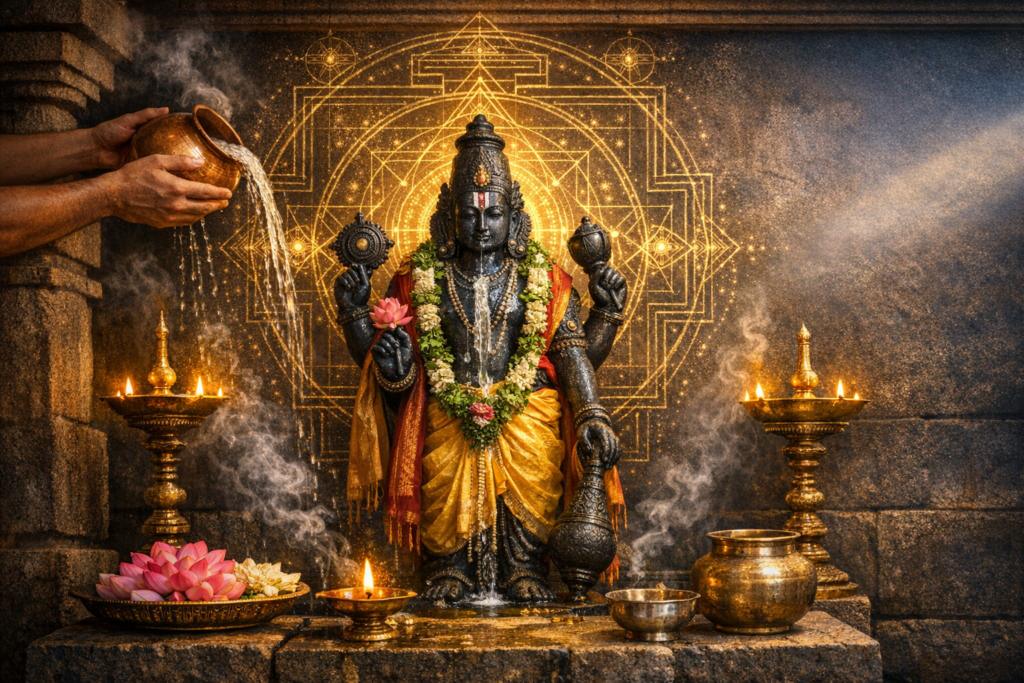
Hindu philosophy approaches ethics as a living inquiry, not a fixed code. Instead of absolute moral laws, it foregrounds dharma as a dynamic principle that must be discerned in context. This view sees moral judgment as sensitive to time, place, and circumstance, and it resists the temptation to reduce right and wrong to rigid formulas. The result is an ethics that is both intellectually rigorous and deeply humane.
Classical sources describe this contextual discernment through the idea of deśa–kāla–pātra: place, time, and person. What is appropriate in one situation may not be in another, and the Dharmashastras explicitly acknowledge apad-dharma, the altered duties that apply in emergencies. This does not mean that anything goes; rather, it means that moral clarity requires careful attention to changing conditions and human limitations.
Hindu philosophy weaves together three interdependent factors: intention (bhāva), action (karma), and consequence (phala). Foundational values such as ahimsa and satya guide decision-making, while the demands of svadharma (role-specific duty) and lokasaṅgraha (the welfare and stability of society) refine how those values are applied. The interplay of these elements invites humility and discernment rather than moral arrogance.
Epic narratives offer concrete illustrations of this fluidity. In the Mahabharata, dilemmas are rarely simple, and the same action can bear different moral weights depending on motive and outcome. The Bhagavad Gita anchors this complexity: Arjuna is urged to act in alignment with svadharma and with an eye to lokasaṅgraha, yet to do so without attachment to personal gain. This synthesis avoids both rigid deontology and blind consequentialism, cultivating responsibility with inward freedom.
Contextual ethics is not unique to Hinduism; it resonates across dharmic traditions. Jainism’s Anekantavada warns against one-sided certainties and affirms that truth has many facets. Buddhism’s Middle Way and the doctrine of upāya (skillful means) encourage compassionate, situational responses that relieve suffering. Sikh teachings on hukam and seva align action with divine order and the common good. Together, these perspectives enrich a shared dharmic ethos that values pluralism, dialogue, and moral humility.
Practical discernment benefits from a clear method. A useful set of questions includes: (1) Does this action minimize harm (ahimsa) while honoring truth (satya)? (2) Does it uphold svadharma—duties arising from one’s roles and capacities? (3) Will it contribute to lokasaṅgraha, sustaining social trust and welfare? (4) Is it suited to deśa–kāla–pātra—this specific place, time, and person? (5) Does it foster inner clarity and chitta-shuddhi rather than agitation or vanity? (6) Can it be undertaken without attachment to outcomes, as taught in the Bhagavad Gita?
Consider nonviolence in contexts of protection. While ahimsa is a luminous ideal, the tradition also recognizes kshatra-dharma—the responsibility to safeguard the vulnerable and preserve order. The balance lies in intention and proportion: use the minimum force necessary, seek reconciliation where possible, and prioritize the restoration of peace over retribution. Such nuance prevents ethics from becoming either naive or cruel.
These principles scale naturally to contemporary life. In public discourse, deśa–kāla–pātra encourages restraint amid social media outrage, favoring fact-based dialogue over impulsive judgment. In policy and leadership, the aim of lokasaṅgraha highlights long-term social cohesion and ecological responsibility. In personal decision-making, attention to svadharma helps align career choices, family roles, and civic duties with inner purpose and community needs.
Dharmic ethics also cultivates intellectual humility. Anekantavada reminds that partial truths improve through conversation with other perspectives; the Gita counsels acting without clinging; Buddhist insights emphasize reducing suffering; Sikh seva keeps service at the center. Taken together, these threads support unity across Hinduism, Buddhism, Jainism, and Sikhism, and they promote an ethical culture that is principled yet adaptable.
Moral certainty can be comforting, but living truth requires deeper courage. Hindu philosophy proposes that dharma unfolds through attentive inquiry, disciplined action, and compassionate regard for others. By honoring context without abandoning principles, it offers a reliable compass for complex times—and a shared language through which the dharmic traditions can stand together for the common good.
Inspired by this post on Hindu Blog.