Panchamukhi GanapatiGanesha with five facesencapsulates one of Hindu iconography’s most profound syntheses: the living convergence of the five senses (indriyas) and the five great elements (pancha mahabhuta). Approached through Vedic philosophy and yogic practices, this form teaches how sensory experience can be refined into awake, steady awareness.
Etymologically, Panchamukhi means five-faced, while Ganapati signifies the lord of the ganas, the manifold categories of existence. Across Agamic, Puranic, and regional traditions, the fivefold schema is read through multiple, complementary lenses: elements and senses, the five vital winds (pancha prana), the five sheaths (Pancha Kosha Viveka), and the fivefold articulation of Om (A-U-M with bindu and nada). Such layered meaning is characteristic of the dharmic approach to symbolismplural, integrative, and practice-oriented.
Classical Indian thought (Sankhya–Yoga and allied schools) relates each sense to an elemental quality: hearing to ether (akasha) through sound; touch to air (vayu) through movement; sight to fire (agni) through form and luminosity; taste to water (apas) through liquidity; and smell to earth (prithvi) through solidity and fragrance. Panchamukhi Ganapati becomes the integrator of these pairings, guiding the shift from scattered attention to discerning awareness (viveka) and balanced embodiment.
Beyond sensory cognition, many lineages extend the reading to the pancha pranaprana, apana, vyana, udana, and samanaimplying that the five faces safeguard the vital flows that animate attention, speech, digestion, locomotion, and subtle cognition. This interpretation aligns with yogic practices such as pratyahara, where sense-restraint is understood not as repression but as intelligent regulation, and with the refinement of breath that steadies perception.
A Vedantic strand relates the five faces to the five sheaths taught in the Taittiriya Upanishad: annamaya (physical), pranamaya (vital), manomaya (mental), vijnanamaya (intellective), and anandamaya (bliss). Read in this way, Panchamukhi Ganapati signals sovereignty across all layers of embodiment, from gross to subtle, culminating in a natural ease that Upanishadic literature associates with abiding joy.
Mantric theology further deepens the picture. The Ganapati Atharvashirsha venerates Ganesha as identical with Om (pranava) and places his abiding presence at the muladhara, the foundational support at the base of the spine. In traditional yoga, Ganesha is often honored as the guardian of energetic ascent through sushumna. When the five faces are contemplated as the fivefold structure of OmA, U, M, bindu, and nadathe image becomes a meditation on sound, silence, and the genesis of consciousness.
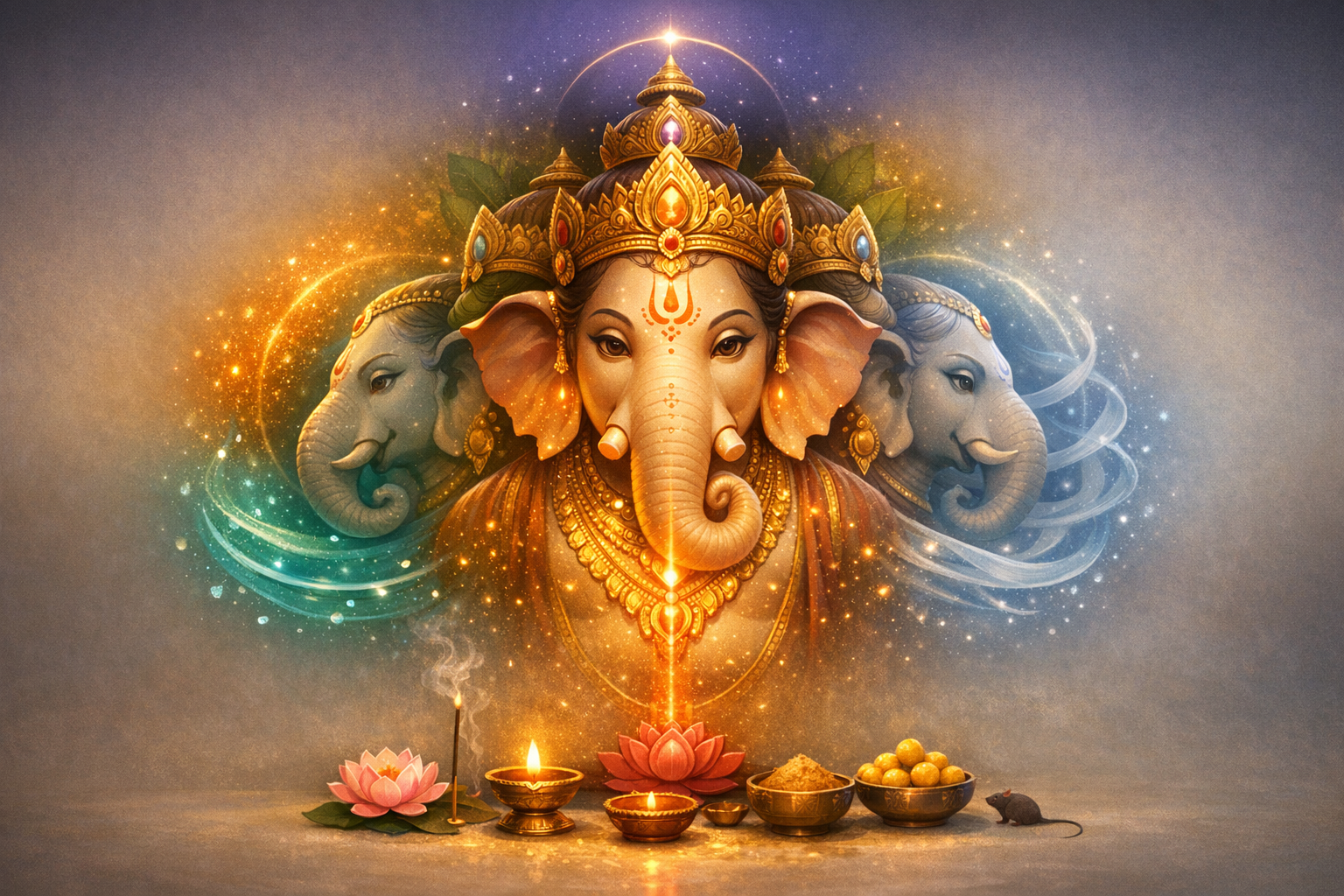
Iconographically, Panchamukhi Ganapati is frequently envisioned with four faces oriented to the cardinal directions and a fifth rising upward, suggesting an axis that joins earth and sky. The upward face intimates transcendenceawareness that outlives space-timewhile the horizontal faces honor immanence within the lived world of elements and senses. Regional ateliers vary color, crown, and expression, yet the underlying principle of harmonious integration remains constant.
Ritual practice preserves this fivefold grammar. In Panchopachara five offeringsgandha, pushpa, dhoopa, deepa, and naivedyadevotees symbolically honor the elemental matrix through fragrance, flower, incense, flame, and nourishment, returning what is received from nature to its divine source. The worship of Panchamukhi Ganapati makes this restitution explicit, turning daily puja into contemplative ecology.
Contemplative engagement can be structured methodically. A practitioner may begin with steady breath at the muladhara, invoke Om Gam Ganapataye Namah, and then, in sequence, place attention on hearing, touch, sight, taste, and smell, acknowledging the allied element and gently reclaiming awareness from each sense. The cycle concludes by resting in the quiet center that the image’s upward face intimates. Such pratyahara-centered yogic practices complement, rather than replace, temple worship and festive observances like Ganesh Chaturthi.
Multiple interpretive matrices coexist without friction in the dharmic world because symbol and practice are purposefully polyvalent. Some teaching lineages present the five faces as values such as compassion, discernment, strength, prosperity, and wisdom; others align them with guardianship of the directions and the zenith. The unifying intent remains identical: the removal of inner obstacles and the alignment of human faculties with dharma.
The motif of five is shared widely across the dharmic family, underscoring civilizational unity while honoring diversity. Hindu philosophy speaks of pancha mahabhuta and pancha kosha; Buddhism reflects on the five great elements and the five skandhas that structure experience; Jainism articulates five senses alongside the broader panchastikaya ontology; Sikh teachings in Gurbani invoke panch tattva to denote the elemental ground of the body. Panchamukhi Ganapati thus serves as a bridge-image resonant with the contemplative sciences of Hinduism, Buddhism, Jainism, and Sikhism.
In lived life, the five-faced symbol provides a practical checklist. When decisions are noisy or hurried, pausing to notice what is heard, touched, seen, tasted, and smelled grounds discernment; recalling the elemental correspondences introduces spaciousness; and returning to the breath stabilizes intention. In this sense, Panchamukhi Ganapati functions as a cognitive framework as much as a sacred icon.
From a pedagogical perspective, the image encodes a curriculum: sensory literacy (indriya-jñana), energetic hygiene (prana-samskara), ethical clarity (dharma), contemplative skill (dhyana and pratyahara), and the insight that awareness is fundamentally unfragmented despite the mind’s fivefold dispersal. Each face becomes a classroom for cultivating steadiness and joy.
Scholars of Hindu iconography often note resonances among five-faced forms, especially the Panchamukha Shiva schema of Sadyojata, Vamadeva, Aghora, Tatpurusha, and Ishana. While Ganesha’s theology is distinct, artists may borrow spatial logic to communicate transcendence above and immanence around. Such cross-pollination is organic to South Asian temple arts and invites interpretive humility.
It is equally valuable to acknowledge historical texture. Panchamukhi Ganesha images appear across centuries and regions, from medieval bronzes to contemporary murtis in Maharashtra and Tamil Nadu. Differences in mudra, vahana placement, and facial ornamentation reflect local pedagogy rather than doctrinal discord, keeping the core messageharmonize the senses and elementsintact.
Meaningfully approached, Panchamukhi Ganapati is less an esoteric rarity and more a contemplative map. The five faces orient those who seek to transform the sensory world into a vehicle for wisdom, to honor the elements as sacred, and to remember that the remover of obstacles ultimately points beyond obstaclesto a self that is whole, alert, and compassionate.
Inspired by this post on Hindu Pad.