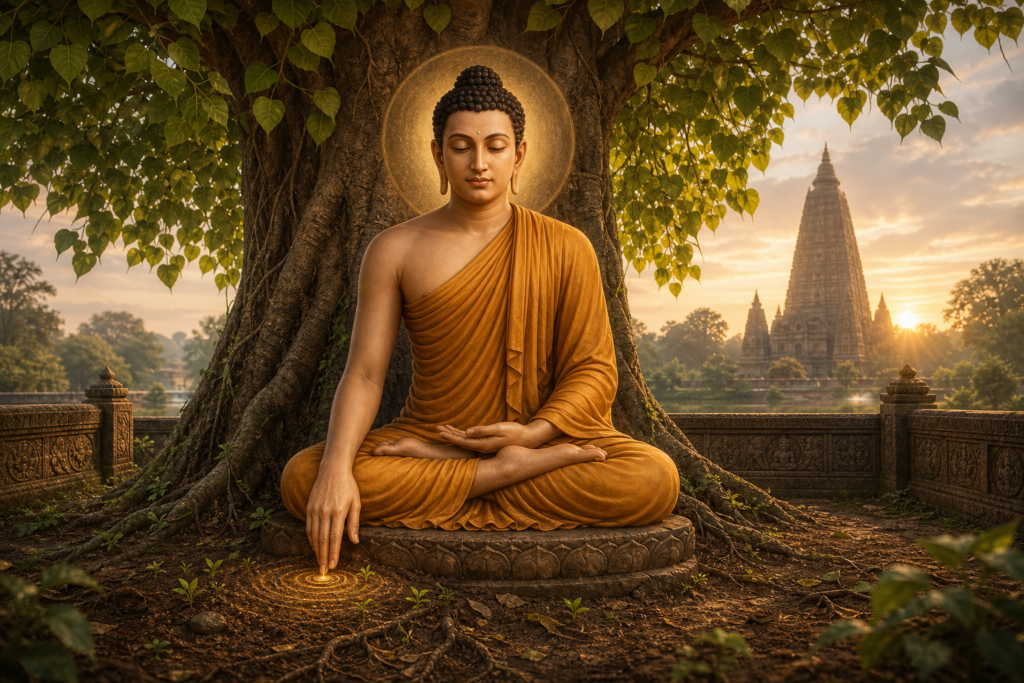
The teaching that “you are free anywhere or bound anywhere” encapsulates a central insight of Hindu philosophy: true freedom does not depend on external conditions but on the recognition of the ever-free Self (atman). Classical sources such as the Upanishads and the Bhagavad Gita affirm that the Self is uncreated, undying, and intrinsically whole; consequently, liberation (moksha) is a matter of realizing what already is, rather than acquiring something new. This perspective challenges common assumptions that freedom follows from wealth, status, location, or favorable circumstances, and reframes bondage as a function of ignorance (avidya) and misidentification with transient phenomena.
In this view, bondage arises when consciousness is confined to the body, senses (indriyas), and fluctuating mind, generating clinging, fear, and suffering. Freedom emerges as that misidentification dissolves through discriminative understanding (viveka), steady practice (abhyasa), and ethical living aligned with dharma. Advaita Vedanta articulates this as knowledge of the non-dual Self, while Samkhya-Yoga illuminates the distinction between purusha (seer) and prakriti (seen), enabling dispassion (vairagya). Though their analyses differ, both affirm an inner liberation that is not contingent on circumstance.
Hindu traditions offer multiple complementary paths toward this realization. Karma Yoga refines action into selfless service, Bhakti channels emotion into devotion to the Divine, Jnana pursues insight through inquiry into the nature of reality, and Raja Yoga stabilizes attention through meditation and pranayama. The Bhagavad Gita integrates these yogas, showing how disciplined action, devotion, and contemplative knowledge converge in inner peace. When practiced consistently, these methods transform daily lifework, family responsibilities, and social engagementinto a training ground for freedom rather than sources of bondage.
Lived experience reflects this philosophy in relatable ways. A commuter navigating crowded streets, a caregiver balancing duties, or a student facing uncertainty can notice that calm and clarity do not always track external ease. Reports from practitioners across traditions indicate that brief yet regular meditation, reflective study of texts like the Bhagavad Gita and upanishad, and mindful action grounded in dharma steadily reduce reactivity and expand equanimity. Over time, individuals describe a shift from seeking control over circumstances to cultivating mastery of attention and intention, resulting in resilience and inner stability.
This understanding resonates across the dharmic family. Buddhism’s nirvana, Jainism’s kevala jnana, and Sikhism’s mukti through remembrance of the Divine Name (Naam) all affirm that genuine freedom is realized through inner transformation rather than external conquest. While doctrinal nuances differ, these paths converge on the insight that clarity, compassion, and disciplined practice reveal an already-present freedom. Emphasizing this shared ground strengthens unity among Hinduism, Buddhism, Jainism, and Sikhism, and enriches an inclusive vision of spiritual growth.
Ethically, inner freedom expresses itself as ahimsa, seva, and responsibility to the common good. When freedom is understood as clarity of awareness rather than license, it naturally aligns with benevolence, justice, and humility. Communities shaped by such understanding are less prone to polarization because individuals no longer treat identity, opinion, or circumstance as absolute. Inner peace thus becomes a cultural asset, encouraging social harmony without suppressing diversity.
In summary, Hindu philosophy presents spiritual freedom as the recognition of the ever-free Self, available here and now. Practices across Karma, Bhakti, Jnana, and Raja Yoga make this insight experiential and durable, even amid challenges. Parallels within Buddhism, Jainism, and Sikhism underscore a shared dharmic commitment to inner liberation and compassionate living. By grounding daily choices in discernment and devotion, individuals discover that freedom is not elsewhere: it is the stable center from which wise action and enduring peace arise.
Inspired by this post on Hindu Blog.