
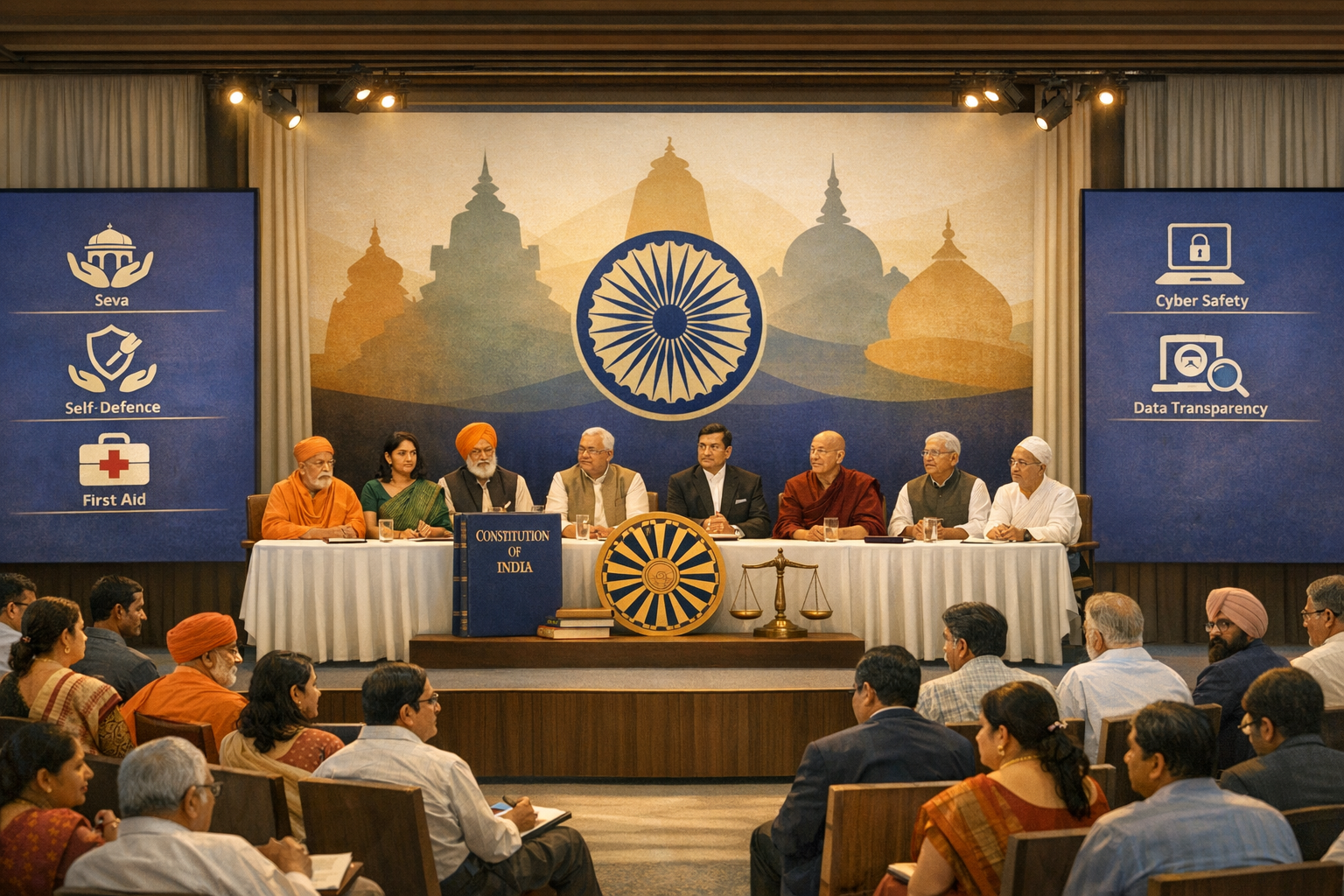
At the Hindu Rashtra Adhiveshan in Gorakhpur (Uttar Pradesh), representatives from more than 160 Hindu organisations converged to deliberate on community safety, social cohesion, and policy development. Participants resolved to enhance Hindu unity across sampradāyas and regions, expand temple-based outreach (seva), and build lawful self-defence capacity at the grassroots. They also called for national legislation to address what many attendees described, in their words, as “love jihad” and “corporate jihad,” terms used to denote predatory deception in intimate relationships and organised economic coercion. The meeting’s overarching frame emphasised a dharmic civil society agenda rooted in Sanatana Dharma, while affirming the need to operate squarely within India’s constitutional order and the rule of law.
Viewed through an academic lens, the Adhiveshan functioned as a large-scale civil society consultation aimed at translating community concerns into actionable, lawful proposals. The phrase “Hindu Rashtra” in this context was articulated as a cultural-civilizational ethos of Dharma in Hinduism rather than a theocratic project—namely, the aspiration to strengthen ethical life, social responsibility, and institutional integrity while respecting constitutional rights and pluralism. That framing supported a practical agenda: protect families from coercion, reinforce community resilience, and expand temple-linked CommunityEngagement with measurable impact.
Because the terms “love jihad” and “corporate jihad” are contested in public discourse, the debate benefits from precise, neutral legal language. From a policy standpoint, the concerns raised correspond to two testable problem statements: (1) targeted deception, coercion, or trafficking linked to intimate relationships for unlawful conversion or exploitation; and (2) organised economic intimidation or inducement that undermines individual autonomy and public order. Reframing these claims in religion-neutral, behaviour-specific terms is essential for any potential national framework to withstand judicial scrutiny and to align with India’s commitments to equality before the law.
A constitutional pathway exists for carefully drafted, rights-compatible legislation. Article 25 protects freedom of conscience and free profession, practice, and propagation of religion, subject to public order, morality, and health. The Supreme Court’s decision in Rev. Stanislaus (1977) upheld state Freedom of Religion Acts by clarifying that the right to “propagate” does not include a right to convert another person by force, fraud, or allurement. With “Criminal law” in the Concurrent List, Parliament can legislate on behaviour-based harms nationwide; States retain primacy over “public order” and “police,” which underscores the need for Centre–State coordination in any counterextremism or victim-protection framework.
Translating the Adhiveshan’s intent into a legally robust model would require a religion-neutral statute addressing coercion, deception, trafficking, and undue influence, irrespective of the faith identity of any party. Core design features should include: (a) narrow, precise definitions of prohibited conduct; (b) strong due-process protections, including burdens of proof and safeguards against misuse; (c) age- and consent-sensitive standards aligned with existing criminal law; (d) victim-centric remedies such as shelter, counselling, and legal aid; (e) protection of privacy and data security; and (f) independent oversight and transparent reporting to deter selective enforcement. Such an approach protects vulnerable individuals without stigmatising consensual interfaith relationships.
Institutional architecture would benefit from a three-tier model. At the national level, standard-setting, training modules, and inter-operable data definitions would promote uniformity. At the State level, specialised units could ensure prompt investigation, witness protection, and coordination with prosecution, while remaining alert to the risks of overreach. At the district level, integrated victim-support cells linked to One-Stop Centres, legal services authorities, and civil-society partners could provide immediate assistance. Periodic audits, ombuds oversight, and public dashboards would advance accountability and policy learning.
The Adhiveshan’s emphasis on self-defence initiatives was framed within the bounds of Indian law. The Indian Penal Code (Sections 96–106) recognises a right of private defence under narrowly defined circumstances; any training must be strictly preventive and compliant with the rule of law. In practice, community programmes can integrate lawful self-defence techniques with first aid, disaster response, cyber-safety, legal literacy, and bystander-intervention skills—capacities that improve household resilience and reduce reliance on vigilantism. Liaison protocols with local police and district administration help ensure alignment with public order mandates.
Temple-based outreach emerged as a prominent solution vector. Historically, Hindu temples have served as community institutions for education, health, and social protection. Contemporary “temple outreach” can include youth mentorship, skill development, women’s safety workshops, counselling services, and scholarships administered with transparent eligibility criteria. In line with the blog’s objective of unity among Dharmic traditions, the programmes discussed at the Adhiveshan were described as open to communities of Hinduism, Buddhism, Jainism, and Sikhism, reinforcing shared values while respecting each tradition’s autonomy.
Strengthening Hindu unity, as articulated in Gorakhpur, was presented not as uniformity but as cooperative federalism within the Dharmic sphere—Sampradāya diversity under a Sanatana Dharma umbrella. Practical steps include joint calendars for sevas and festivals, inter-sampradāya dialogues to manage disagreements constructively, and pooled resources for education and health initiatives. This culturally anchored approach to Hindu society seeks to translate spiritual principles into measurable social goods without diluting doctrinal distinctiveness.
Evidence-based policy will be crucial to move beyond rhetoric. Standardised reporting of complaints (with rigorous verification), district-wise victim-support statistics, conviction/acquittal ratios, and independent evaluations can help separate anecdote from trend. Auditable data reduce polarisation, improve Policy Development, and protect fundamental rights. Research tie-ups with universities can further enrich the knowledge base, ensuring that legal reforms remain anchored to facts and that unintended consequences are swiftly identified.
Accounts shared at the Adhiveshan underscored the human stakes behind the policy agenda. Attendees described parental anxieties about online grooming, students seeking guidance on safe digital practices, and volunteers using temple networks to coordinate blood-donation drives and flood relief. Such lived experiences—while diverse—converge on a common aspiration: to make neighbourhoods safer, nurture trust across communities, and ensure that young people flourish with dignity and opportunity.
To sustain impact, participants recommended metrics that communities can track locally: number of lawful self-defence and first-aid trainings delivered; women and youth reached through safety workshops; scholarships disbursed and programme completion rates; victim-support cases closed with satisfaction surveys; and inter-sampradāya events successfully hosted. Publishing these indicators through temple noticeboards and community websites enhances transparency and fosters a culture of continuous improvement.
Ethical guardrails formed a recurring theme. The Adhiveshan affirmed that adults have a fundamental right to choose their partners and faiths freely; the target of any intervention is coercion, fraud, trafficking, and intimidation—not voluntary interfaith relationships or legitimate religious activity. Clear community norms against vigilantism, proactive police liaison, and grievance-redress mechanisms can prevent misuse and uphold both public order and civil liberties.
In sum, the Hindu Rashtra Adhiveshan in Gorakhpur functioned as a high-energy forum that channelled community concerns into an agenda emphasising Hindu unity, temple outreach, and lawful protection against coercion. Its enduring value will depend on how effectively aspirations are translated into religion-neutral, constitutionally sound policy and into local programmes that demonstrably improve safety, dignity, and social trust. When rooted in Sanatana Dharma’s ethic of seva and guided by India’s constitutional framework, this model of CommunityEngagement can strengthen Dharmic unity and contribute to a more secure and harmonious public sphere.
Inspired by this post on Hindu Jagruti Samiti.









Leave a Reply
You must be logged in to post a comment.