
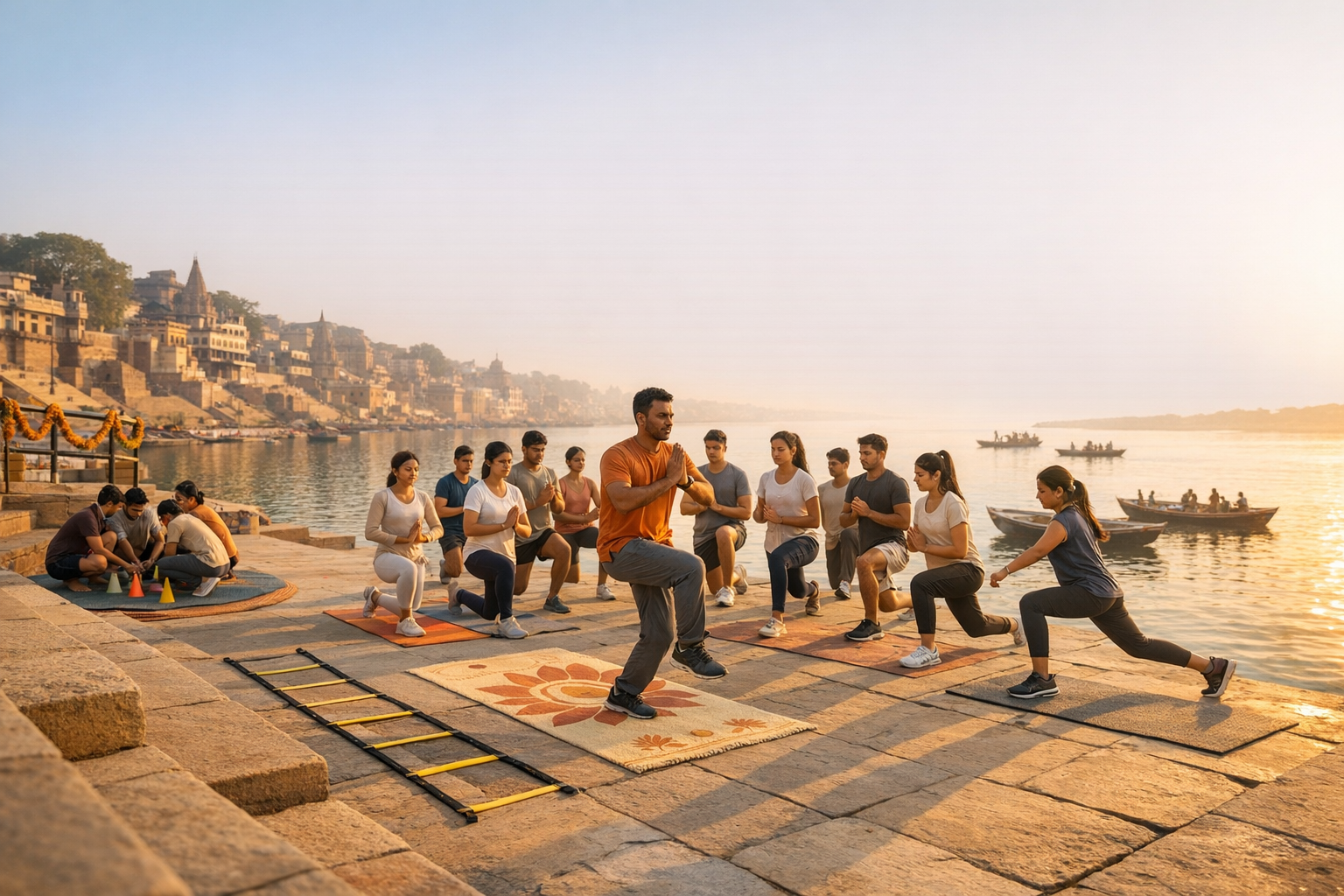
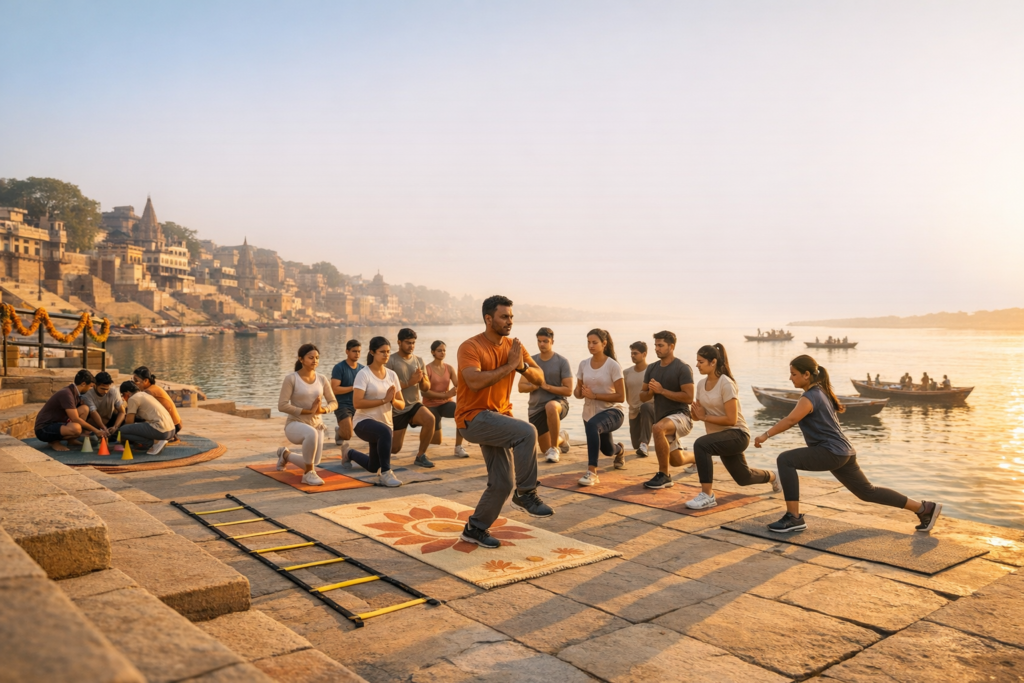
More than 325 young men and women participated in the ‘Shaurya Training Camps’ conducted in Varanasi and Ghazipur under the ‘Har Ghar Yoddha Campaign’ of the Hindu Janajagruti Samiti. Designed as an integrated body–mind–spirit immersion, the program focused on building physical fitness, mental resilience, and spiritual discipline, while reinforcing civic responsibility and service. Set against the cultural landscape of Uttar Pradesh, the initiative aligned youth development with shared dharmic values that resonate across Hinduism, Buddhism, Jainism, and Sikhism.
Such community-based youth development models are increasingly recognized for their multidimensional benefits: improved physical health indicators, stronger self-regulation, and enhanced prosocial behavior. Empirical research consistently shows that combined aerobic training and mindfulness-based practices can improve attention, reduce stress reactivity, and boost overall well-being. The ‘Shaurya Training Camps’ reflect this evidence-informed approach by coupling structured physical conditioning with cognitive skills training and contemplative practices.
Program design emphasized three reinforcing pillars. First, physical conditioning cultivated stamina, agility, and coordination through progressive drills suited to mixed-age cohorts. Second, mental resilience was strengthened through attention training, goal-setting, and team problem-solving tasks that promote focus and interpersonal trust. Third, spiritual discipline was deepened through reflective practices—breathwork, meditation, and ethics-centered dialogues—encouraging participants to translate inner clarity into constructive action in family and community life.
Physical readiness was addressed through functional movement patterns, joint-mobility routines, and endurance-building activities that emphasize safety and scalability. Warm-ups and cool-downs reduced injury risk, while interval formats allowed different fitness levels to progress together. The approach mirrors best practices in youth athletics by combining skill acquisition with progressively challenging workloads and adequate recovery.
Foundational self-protection principles were introduced to build confidence and awareness without encouraging aggression. Core elements included situational assessment, boundary-setting, safe distancing, voice assertion, and simple escape-oriented techniques appropriate for beginners. Emphasis remained on de-escalation, lawful conduct, and bystander safety—framing self-defence as an ethical responsibility grounded in ahimsa, not as an outlet for confrontation.
Mental resilience training complemented the physical modules. Short, repeatable attention drills (eyes–breath–body alignment), memory games, and time-bounded challenges encouraged sustained focus under mild pressure. Group reflections following each activity made tacit skills explicit: What helped in maintaining composure? How did the team recover from errors? These practices, adapted from cognitive-behavioral micro-skills, strengthen executive function and reduce impulsivity—competencies essential for academic success and leadership.
Spiritual practice was framed through universal dharmic values—satya (truthfulness), ahimsa (non-harm), tapas (discipline), and seva (service). Breath-led meditation and silent contemplation fostered inner steadiness, while devotional or reflective components were kept flexible to respect individual traditions. Participants were encouraged to adopt a daily micro-routine (for example, five minutes of breath awareness plus a short reflection) to anchor learning beyond the camp setting.
Throughout, facilitators highlighted the shared ethical core of dharmic paths. Whether one identifies with Hinduism, Buddhism, Jainism, or Sikhism, the cultivation of self-mastery, compassion, and service offers common ground. The camps’ language and activities underscored pluralism and mutual respect, aiming to strengthen social cohesion without privileging a single mode of practice.
Safeguarding and inclusion were treated as non-negotiable. Age-appropriate progression, gender-sensitive facilitation, clear codes of conduct, hydration breaks, and first-aid readiness provided a secure learning environment. Mentors monitored workload and recovery, while group check-ins normalized help-seeking and peer support, thereby reducing stigma around physical or mental fatigue.
Community-building remained a defining outcome. Mixed teams from Varanasi and Ghazipur worked together on tasks that required communication, role rotation, and collective decision-making. This peer-to-peer learning structure nurtured leadership, empathy, and accountability—competencies that translate to school, workplaces, and neighborhood initiatives. Alumni connections and local volunteer networks can extend these benefits through ongoing practice circles and seva projects.
The regional context added distinctive depth. Varanasi—Kashi—embodies a long-standing tradition of spiritual inquiry and disciplined practice along the Ganga’s ghats, while Ghazipur’s vibrant social fabric reflects the resilience of eastern Uttar Pradesh. Conducting ‘Shaurya Training Camps’ in these districts connected contemporary youth aspirations with a living heritage of sadhana, scholarship, and community responsibility.
Early indicators from the camps were encouraging: participants commonly reported improved confidence, better posture and breath control, greater attentional steadiness, and a clearer sense of purpose. In academic and sporting contexts, such gains often correlate with enhanced task persistence and collaborative performance. Moreover, families observed that structured routines—light morning movement, mindful breathing, and short evening reflection—helped stabilize daily habits.
From a systems perspective, the ‘Har Ghar Yoddha Campaign’ advances a scalable, household-centered model: each home becomes a locus of well-being, preparedness, and ethical action. When multiplied across neighborhoods, these micro-habits can improve public health, reduce friction in community spaces, and strengthen collective capacity for disaster response and civic duties. The model is practical, evidence-aligned, and culturally rooted.
Methodologically, the camps exemplify good practice in youth empowerment: clear goals, structured progression, high mentor–participant ratio, culturally consonant content, and explicit transfer of learning to daily life. Future cycles can further enhance impact through simple tracking—attendance consistency, fitness markers (e.g., resting heart rate trends), self-reported stress, and community service hours—while maintaining privacy and consent.
In summary, the ‘Shaurya Training Camps’ in Varanasi and Ghazipur offered a rigorous, inclusive, and values-based pathway for youth to integrate physical vitality, mental clarity, and spiritual steadiness. Anchored in the dharmic ethic of service and self-mastery, and aligned with evidence from youth development science, the initiative under the ‘Har Ghar Yoddha Campaign’ illustrates how culturally grounded training can translate into tangible personal and civic benefits for Uttar Pradesh and beyond.
Inspired by this post on Hindu Jagruti Samiti.






Leave a Reply
You must be logged in to post a comment.