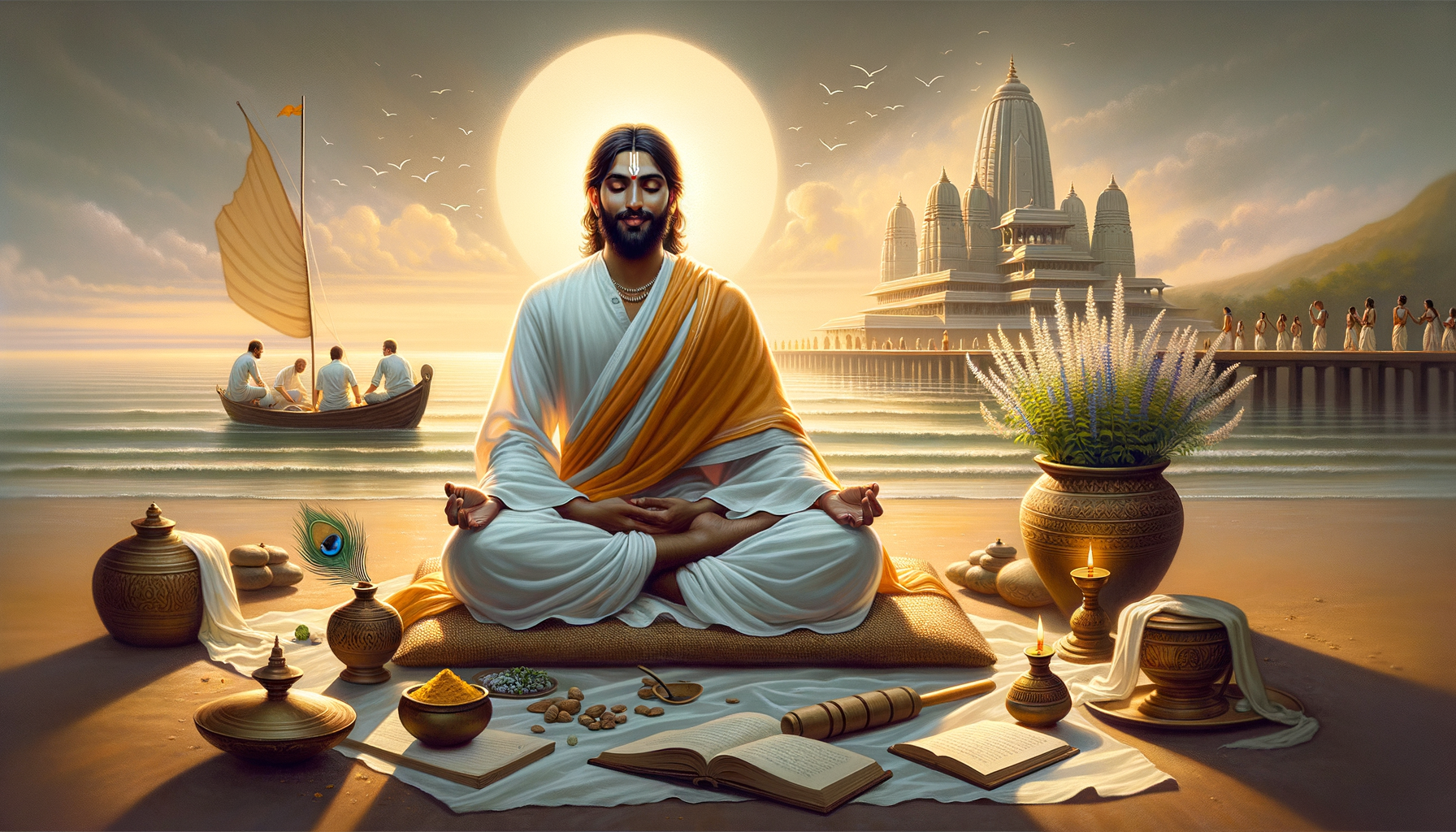
Sant Rishidas is remembered as a 14th-century Gujarati saint whose life embodied steadfast devotion to Krishna and the values of the Bhakti Tradition. Born into a pious Brahmin family in Gujarat, he was closely connected to the sacred city of Dwaraka through his father, who served as a priest at the renowned Shree Dwarkadhish Temple. Within this milieu of temple service and Vaishnavism, Rishidas is regarded as a figure whose quiet spiritual influence shaped devotional life in his village and beyond.
Placing Sant Rishidas in historical context highlights the flourishing of Bhakti across India during the late medieval period. Gujarat, anchored by Dwaraka’s enduring presence in Hindu spirituality, nurtured devotional currents that emphasized personal piety, seva (selfless service), and remembrance of the divine name. While detailed archival records of Rishidas are scarce, the broad contours of regional practicecentering on Krishna-bhakti, congregational worship, and scriptural reverenceoffer a reliable frame for understanding his legacy.
Available accounts associate Rishidas’s formative years with the rhythms of temple life, where ritual precision and humility were guiding principles. Being raised in a priestly household would have exposed him to daily worship, sacred recitation, and the ethical discipline that underpins Hindu temples. In this environment, devotion was not merely belief but a lived disciplineone that integrated reverence, community responsibility, and service to the divine through care for people and place.
Rishidas’s memory thus functions as a testament to how village-centered devotion can carry timeless relevance. The practices associated with Krishna-bhaktisinging kirtans, contemplating the leelas of Sri Krishna, and practicing sevacultivate an interior steadiness that is equally meaningful to contemporary seekers. For pilgrims visiting Dwaraka or families maintaining home altars, the example attributed to Rishidas underscores the enduring power of simple, sincere worship grounded in daily ethics.
Beyond its regional significance, the legacy of Sant Rishidas illuminates a broader dharmic consonance. The qualities often linked with his lifekaruṇā (compassion), ahiṁsā (non-violence), satya (truthfulness), and dharma (righteous conduct)resonate deeply across Hinduism, Buddhism, Jainism, and Sikhism. In this shared ethical landscape, Krishna-bhakti stands alongside other paths as a complementary way to cultivate inner transformation, community harmony, and unity in spiritual diversity.
For students of Indian history and culture, the case of Sant Rishidas also illustrates how local saints reinforce civilizational continuity. Even when textual documentation is limited, oral traditions, temple histories, and regional memory preserve the essence of devotional lineages. This continuityvisible in places like the Shree Dwarkadhish Templeanchors communities in values that are both spiritually elevating and socially cohesive.
In the present day, the example associated with Rishidas invites practical reflection: devotion can be expressed through attentive work, kind speech, and service to those in need. Such expressions of bhakti align with the shared dharmic goal of lokasangrahasustaining the welfare of societywhile nurturing personal equilibrium. In this way, a 14th-century Gujarati saint continues to speak to modern life, encouraging seekers to integrate faith, ethics, and compassion in a manner that strengthens families, communities, and the wider spiritual commons.
While definitive biographical details of Sant Rishidas remain limited, the consistent portrayal of his Krishna-centered devotion positions him within Gujarat’s rich spiritual heritage. His remembered life offers a credible and inspiring model of Hindu spiritualityrooted in daily practice, informed by temple tradition, and open to the broader unity that binds the dharmic family of traditions.
Inspired by this post on Hindu Pad.