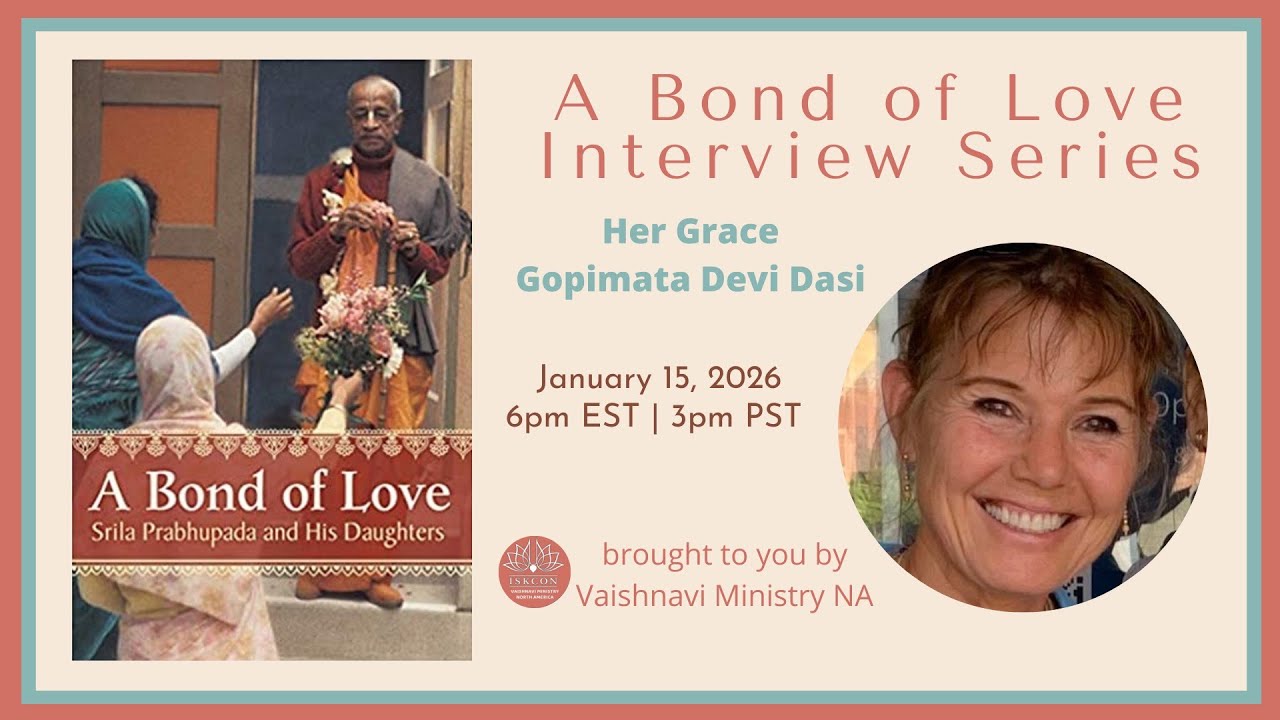
Her Grace Gopimata dasi emerged from the midwestern United States and, in 1977, encountered Srila Prabhupada in London. That meeting oriented the next decade of life toward the ashrams there, with a primary commitment to sankirtan. Alongside daily outreach, responsibilities included service as a pujari and cook, as well as devotional theatre with the Vaikuntha Players. Later, the journey continued in household life through marriage to His Grace Ankottha, maintaining continuity in seva and devotion.
Situated within the historical context of ISKCON’s London community in the late 1970s, this trajectory illustrates how meeting a spiritual teacher can catalyze disciplined practice and public engagement. Sankirtanjoyful, collective remembrance of the Divinefunctioned as both sadhana and social bridge, echoing the shared dharmic ethos of communal song, contemplation, and service found across Hinduism, Buddhism, Jainism, and Sikhism. The emphasis on unity, compassion (karuna), and nonviolence (ahimsa) underscores how devotional practice can contribute to cohesion among diverse spiritual communities.
Pujari service and cooking are noted as forms of embodied bhakti, where ritual precision, hospitality, and care become pathways of spiritual realization. The Vaikuntha Players added an aesthetic dimension to practice, using narrative and performance to transmit teachings with clarity and warmth. In these roles, HG Gopimata dasi’s experience exemplifies how ISKCON (International Society For Krishna Consciousness) integrates scripture, seva, and the arts to support personal transformation and community uplift.
Marriage to His Grace Ankottha highlights the dharmic principle that household life can be a site of continued practice and responsibility. Such transitions mirror a broader pattern within Gaudiya Vaishnavism and the wider dharmic world: devotion is sustained not only in monastic settings but also through ethical action, shared duties, and steady remembrance in family life. This balance between public outreach and intimate care demonstrates a holistic approach to Hindu spirituality.
Overall, the journey from Midwestern roots to London ashrams reflects a cross-cultural, service-centered life shaped by Srila Prabhupada’s guidance, sankirtan, and devotional arts. Readers may recognize in this account a succinct template for meaningful practice: consistent seva, community participation, and reverence for tradition. Such a path resonates across dharmic traditions, where shared valuesdevotion, compassion, discipline, and unitycreate living bridges among Hindu, Buddhist, Jain, and Sikh communities.
Inspired by this post on Dandavats.