
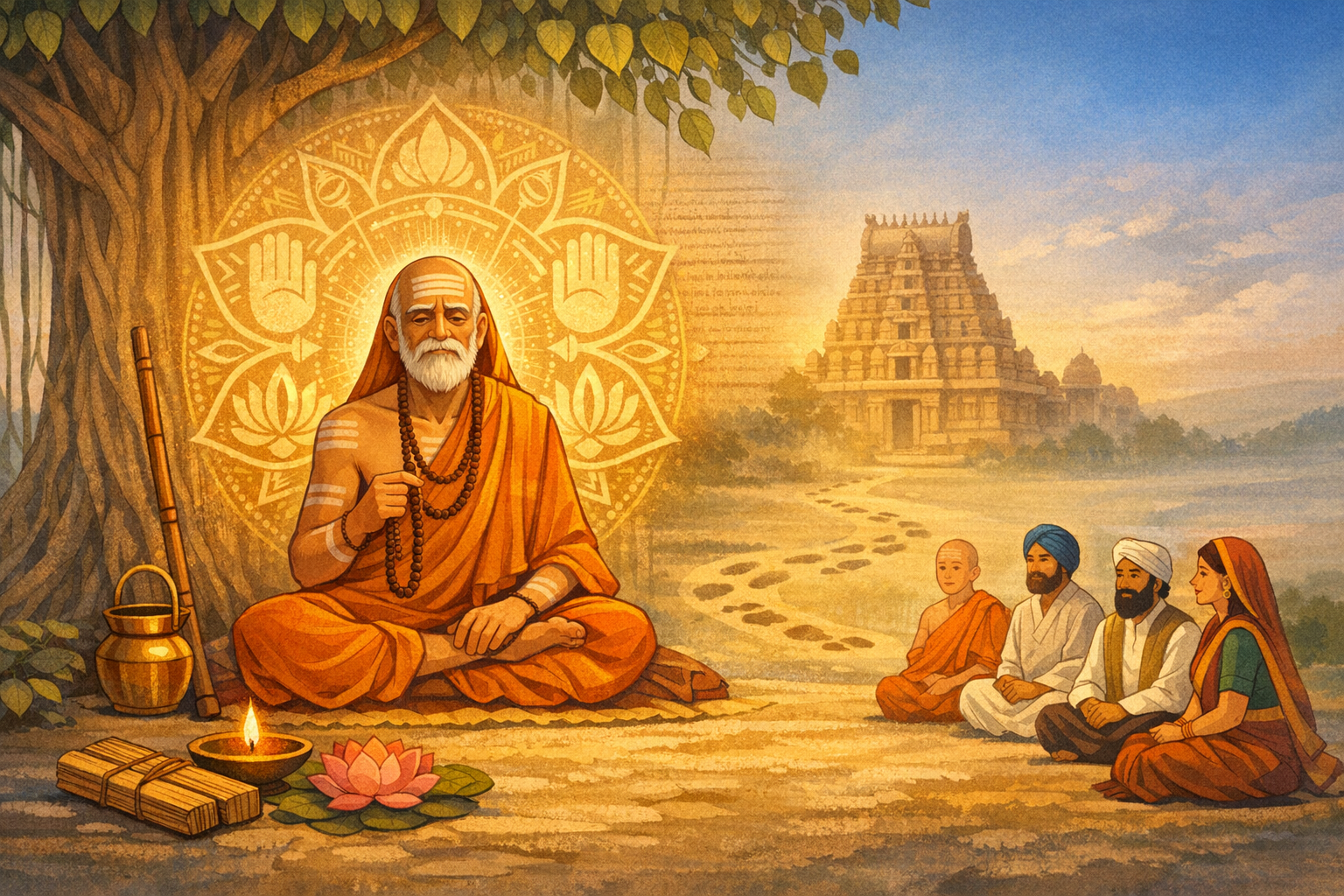
Shri Chandrashekarendra Saraswati Swamigal (1894–1994), revered as Mahaperiyava and the Sage of Kanchi, served as the 68th Jagadguru of the Kanchi Kamakoti Peetam. His life embodied Advaita Vedanta in action—uncompromising in discipline, expansive in compassion, and inclusive in vision. Across decades of padayatra and dialogue, his presence drew seekers from diverse communities, including Hindus, Buddhists, Jains, Sikhs, and people from other faith traditions who recognized in him an unwavering commitment to truth, humility, and service.
Situated in Kanchipuram, the Kanchi Kamakoti Peetam stands within the Shankaracharya Parampara that traces its lineage to Adi Sankara. This parampara safeguards Vedic Tradition through the Guru-Shishya Tradition, not as a static inheritance but as a living stream of learning and practice. Within this lineage, Mahaperiyava’s spiritual leadership exemplified fidelity to śruti and smṛti alongside a sensitive engagement with the challenges of modern life.
Born as Swaminathan in Tamil Nadu, he assumed sannyasa at a young age and was installed as Jagadguru during adolescence, a transition that set the course for a lifetime of tapas, study, and guidance. Accounts from ashram records and devotees’ recollections describe a daily rhythm steeped in austerity—long hours of japa, scriptural recitation, and attentive reception of visitors seeking counsel. His stewardship spanned much of the 20th century, a period of unprecedented social change, during which his counsel emphasized steadiness in dharma and adaptability in circumstance.
Mahaperiyava’s padayatra—long journeys on foot through towns and remote hamlets—became a mobile university of dharma. The Jagadguru engaged farmers, artisans, scholars, and householders with equal attention, encouraging Vedic learning, revitalization of local temples within Agama frameworks, and strengthening of community bonds through seva. This peripatetic outreach made the Peetham’s guidance accessible to those far from urban centers, thereby knitting together a broad, interregional network of practice and trust.
His discourses, preserved and popularized in collections such as Deivathin Kural and synthesized in texts like Hindu Dharma: The Universal Way of Life, articulate a comprehensive vision of Sanatana Dharma as both a metaphysical framework and a practical ethics for daily living. These teachings conveyed that the “Hindu way of life” is not reducible to ritual performance alone but integrates thought, conduct, and contemplative insight.
At the philosophical core, Mahaperiyava taught Advaita Vedanta in clear, graduated terms. The sadhana-chatuṣṭaya—viveka (discernment), vairagya (dispassion), śamādi-ṣaṭka (ethical and mental disciplines), and mumukṣutva (longing for liberation)—frames the aspirant’s foundations. The pathway of śravaṇa (listening to śāstra under a guru), manana (reflective inquiry), and nididhyāsana (deep contemplation) consolidates knowledge into lived realization. This Advaitic trajectory harmonizes with bhakti and karma—devotion softens the heart, and selfless action purifies intention—offering a complete method that is both rigorous and compassionate.
Temple practice and Vedic recitation remained central to his guidance. He affirmed the complementary authority of Veda and Agama, emphasizing proper kumbhābhiṣeka, iconography aligned with śāstra, and the continuity of local sampradāyas. In parallel, he underscored the indispensability of satya (truthfulness), ahimsa (non-violence), and dāna (generosity), locating sacrality not only in shrines but also in ethical conduct, inter-personal kindness, and societal responsibility.
Mahaperiyava’s vision of spiritual coexistence in India drew upon shared dharmic values found across Hinduism, Buddhism, Jainism, and Sikhism—non-violence, self-discipline, compassion, and selfless service. He encouraged interfaith dialogue anchored in dignity and mutual recognition. In this approach, unity in spiritual diversity is not political expedience; it is a metaphysical and ethical imperative consistent with Vasudhaiva Kutumbakam, the understanding that humanity forms a single family bound by deeper truths.
Accounts from multiple regions note how individuals from non-Hindu backgrounds sought blessings and received counsel tailored to their contexts, without any erosion of their traditions or conscience. This inclusive posture, rooted in Advaita’s recognition of the one Self appearing as many, transformed the Peetham’s presence into a beacon of trust for plural communities.
Within the Guru-Shishya Tradition, he prioritized transmission through lived example over rhetorical flourish. Devotees widely observed that a brief darshan often induced a palpable quietude—an outcome, they felt, of the Jagadguru’s tapas and one-pointedness cultivated over decades. Guidance rarely appeared formulaic; it reflected precise reading of a seeker’s capacities, responsibilities, and constraints, whether the visitor was a householder, scholar, artisan, scientist, or public servant.
Many testimonies converge on a characteristic pattern: the initial experience of serenity in his presence; concise questions that revealed the crux of a problem; and practical instructions that were simultaneously simple and exacting. Individuals recount being advised to reorient daily routines—establishing steady japa, committing to svādhyāya of Bhagavad-Gita or Upanishads, and advancing small, consistent acts of seva—changes that cumulatively altered outlook and outcomes.
Mahaperiyava’s institutional legacy—nurturing Vedic pathashalas, supporting traditional arts, and encouraging education and healthcare initiatives—reflects a comprehensive model of dharma that cultivates minds, sustains communities, and preserves heritage. The emphasis remained consistent: excellence in study, rigor in practice, integrity in administration, and compassion in service.
Engaging modernity without surrendering first principles, he articulated a pragmatic hermeneutic: retain the kernel of śāstra; adapt the husk to time and place. This helped householders integrate the pressures of contemporary work with the mandates of sandhyāvandana, vrata, and compassion-driven action, thereby preventing fragmentation between the sacred and the civic.
For spiritual practitioners, a clear method emerges from his teaching corpus: begin with disciplined timekeeping (niyama) for prayer and study; stabilize attention through japa and pranayama as appropriate to one’s tradition; adopt nishkāma karma to purify motive; cultivate svādhyāya to refine understanding; and undertake regular satsanga to align with a living stream of wisdom. This scaffold supports both beginners and advanced aspirants, enabling steady internalization of Vedantic insight.
A noteworthy aspect of his pedagogy was the respect for adhikāra-bheda—the recognition that seekers differ in temperament, capacity, and circumstance. Rather than promoting a singular method, he recommended paths consonant with one’s swabhāva: contemplative inquiry for the reflective, devotional liturgy for the affective, and selfless service for the action-oriented—all harmonized within Vedanta’s non-dual ground.
In an era of accelerated change, Mahaperiyava’s counsel on ethical clarity remains instructive. He urged transparent livelihoods, restraint in consumption, reverence for nature, and responsibility toward local communities. These principles align naturally with the dharmic emphasis found across Jain ahimsa, Buddhist karuna, Sikh seva, and the Hindu synthesis of jnana-bhakti-karma, offering a shared civilizational grammar for peaceful coexistence and collective flourishing.
The Jagadguru’s approach to scholarship coupled precision with accessibility. Technical exposition of Advaita never came at the cost of pastoral sensitivity. Listeners were encouraged to verify teachings through experience, to question with humility, and to refine understanding through repetition—śravaṇa, manana, and nididhyāsana as iterative deepening rather than a one-time sequence.
Mahaperiyava’s own life furnished a template for serenity under constraint. His simplicity of living—minimal needs, measured speech, and unbroken attention—demonstrated that inner freedom does not await perfect external conditions; it emerges from discipline directed by discernment. This inner equipoise was not retreat from the world but a resource for courageous engagement with it.
Contemporary readers may draw several practical takeaways. First, schedule sanctifies intention: fixed times for prayer, study, and reflection anchor the day. Second, community strengthens perseverance: shared recitation, collective seva, and participation in local temples or sanghas reinforce commitment. Third, learning must ripen into character: ethical action is the natural fragrance of realized understanding.
In the broader arc of India’s spiritual traditions, Mahaperiyava stands as a unifying presence—rooted in the Shankaracharya Parampara, articulating Vedanta with clarity, and radiating compassion that crossed sectarian boundaries. His legacy continues to inspire a dharmic renaissance that honors plurality while returning, again and again, to the insight at the heart of Advaita: the One without a second, apprehended through steadfast practice and expressed as love-in-action.
As communities across India and the world seek pathways to peace, dignity, and sustainability, the Sage of Kanchi’s life offers a reliable compass. Fidelity to śāstra, humility in learning, courage in service, and gentleness in speech—these together constitute a practical sadhana that advances inner peace and social harmony. In this sense, Mahaperiyava’s living grace remains available: in disciplined practice, in compassionate regard for all beings, and in the shared pursuit of truth that binds Hinduism, Buddhism, Jainism, and Sikhism within a single civilizational family.
Inspired by this post on Hindu Pad.











Leave a Reply
You must be logged in to post a comment.