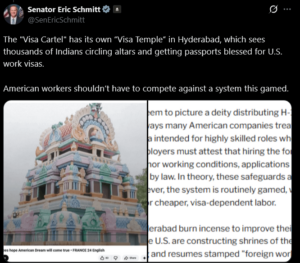
Senator Eric Schmitt’s recent posts on X alleging a so‑called “Visa Cartel” linked to a “Visa Temple” in Hyderabad have sparked an intense debate about immigration policy, cultural practices, and the portrayal of Indian professionals in the United States. The discussion has quickly moved beyond a single tweet to broader questions about how to evaluate the H‑1B program, how to discuss religious traditions with accuracy and respect, and how to protect both American workers and high‑skilled immigrants from mischaracterization.
As posted on X: "The 'Visa Cartel' has its own 'Visa Temple' in Hyderabad, which sees thousands of Indians circling altars and getting passports blessed for U.S. work visas. American workers shouldn’t have to compete against a system this gamed." The statement, widely shared, was read by many as an indictment not only of the H‑1B system but also of a distinct devotional practice at the Chilkur Balaji Temple.
The reference is to the Chilkur Balaji Temple, colloquially known as the “Visa Temple” because some devotees offer prayers when applying for overseas travel, study, or work, and return to give thanks when goals are achieved. This custom, rooted in expressions of gratitude and hope, has no procedural or institutional connection to U.S. immigration adjudications. No credible evidence links the temple to organized immigration fraud or any “cartel.” Conflating a devotional tradition with unlawful behavior misrepresents both religious life and the legal architecture of U.S. visas.
Understanding the H‑1B program in policy terms is essential. The H‑1B is a nonimmigrant classification that allows U.S. employers to hire foreign professionals in “specialty occupations” requiring at least a bachelor’s degree (or equivalent) in a specific field. Congress set an annual cap of 65,000 visas, with an additional 20,000 for holders of advanced U.S. degrees. Universities, affiliated nonprofits, and certain research organizations are cap‑exempt, and the petition process is employer‑driven and highly regulated.
Before filing, employers must obtain a Labor Condition Application (LCA) from the Department of Labor attesting to wage and working conditions. The LCA requires that the employee be paid at least the prevailing wage for the role and location, and that hiring will not adversely affect similarly employed U.S. workers. Only after LCA certification may the employer submit Form I‑129 to U.S. Citizenship and Immigration Services (USCIS). Site visits, anti‑fraud fees, and documentary evidence requirements create multiple layers of compliance checks.
Because demand for H‑1B visas routinely exceeds supply, USCIS uses a registration and lottery system for cap‑subject petitions. After a surge in multiple registrations for the same beneficiaries, USCIS moved to a beneficiary‑centric selection process, a reform designed to curb gaming by prioritizing unique individuals rather than the number of registrations. This change, along with stricter guidance on third‑party placements, reflects ongoing efforts to improve program integrity without discarding the skilled‑worker pipeline U.S. employers rely upon.
Data routinely show that Indian nationals constitute the majority of H‑1B approvalsoften around 70 percent in recent years. Several structural factors explain this concentration: India’s large STEM graduate pipeline; English proficiency; deep integration of Indian IT and consulting firms in global value chains; and decades‑long U.S.–India educational and business linkages. These are market and educational dynamics, not hallmarks of a “cartel.”
Indian‑origin professionals help power core sectors of the U.S. economy, including software, semiconductors, healthcare, finance, and higher education. Indian Americans rank among the highest median household income groups in the United States and contribute significantly through taxes, innovation, patents, entrepreneurship, and patient care. These contributions coexist with legitimate concerns about labor standards and fair competition that should be addressed through rules and enforcement rather than rhetoric.
Concerns about displacement in specific labor markets warrant empirical scrutiny, and researchers have produced mixed findings depending on sector, region, and time period. A measured policy approach distinguishes isolated noncompliance from program design issues and avoids blanket attributions to a nationality or faith community. When abuses occursuch as benching without pay, sham positions, or opaque vendor chainsDOL and USCIS enforcement is the proper remedy.
Religious freedom is a bedrock principle in both India and the United States. The devotional practices at Chilkur Balaji Temple, like milestone prayers in other faiths, are matters of conscience and culture. Treating prayerful thanksgiving as evidence of institutional malfeasance collapses the distinction between private belief and public policy. It also risks stigmatizing millions who observe similar traditions across Hindu, Buddhist, Jain, and Sikh householdstraditions that celebrate perseverance, ethical conduct, and lawful accomplishment.
In many families across the Indian and broader South Asian diaspora, milestonesadmission letters, job offers, or professional licensesare marked with quiet gratitude, charitable giving, or a simple visit to a place of worship. These practices do not alter visa adjudications or employment eligibility; they reflect a human impulse to seek meaning and to express thanks. Equating such customs with “gaming” the system inadvertently casts suspicion on ordinary people who follow the rules and succeed within them.
A precise distinction is vital: the H‑1B program is a statutory, employer‑led process with defined criteria, audits, wage floors, and penalties for noncompliance. A temple, gurdwara, vihara, or jain derasarhowever belovedhas no legal standing in immigration adjudications. The former belongs to the domain of labor and administrative law; the latter belongs to civil society, community, and conscience.
Equally important is acknowledging the genuine anxieties of U.S. workers. Globalization, rapid technological change, and periodic layoffs in tech have created palpable insecurity. Sound policy addresses these realities without scapegoating immigrants or faith traditions. Expanded retraining funds, apprenticeships, and incentives for domestic STEM education can operate alongside targeted immigration reforms that prioritize wage competition on a level field.
Several reforms would move the conversation from controversy to constructive outcomes. First, wage‑based selection and enforcement that favor higher‑paid, harder‑to‑fill roles can dampen any incentive to replace domestic workers on cost alone. Second, continued beneficiary‑centric registration reduces multiple filings and enhances program integrity. Third, strengthening audits for labor standards and curbing abusive subcontracting chains protect both U.S. and H‑1B workers.
Fourth, modernizing the cap to respond to labor‑market signalswhile retaining guardrailscan better match supply to demand in critical sectors. Fifth, improving portability and whistleblower protections helps workers exit bad‑actor employers without falling out of status. Sixth, increased transparency in wage distributions, denial rates, and enforcement outcomes enables evidence‑based debate rather than speculation.
Finally, employment‑based green card reform merits attention. Long per‑country backlogsfelt acutely by Indian nationalscreate years‑long uncertainty that neither employers nor employees find optimal. More predictable permanent‑residence pathways diminish reliance on serial temporary visas and align immigration with long‑term human capital strategies.
It is also necessary to address language that can inadvertently fuel prejudice. Labeling a faith community’s ritual life as part of a “cartel” imports criminal connotations into a cultural space and obscures the real, documentable policy levers at hand. In a media environment primed for outrage, precision in termsand charity in interpretationare public virtues.
Across dharmic traditionsHinduism, Buddhism, Jainism, and Sikhismthere is a shared emphasis on right conduct (dharma), learning, and service. These values are broadly consonant with compliance‑oriented immigration pathways: study, expertise, licensure, ethical employment, and civic contribution. Reaffirming this common ground supports social cohesion and keeps the focus on institutional performance rather than identity.
Any balanced assessment must keep two propositions simultaneously true: abuses can and do occur and should be investigated and punished; at the same time, the overwhelming share of Indian professionals and employers operate within the law, meeting documented workforce needs in a highly regulated system. Policy should sift the former out without tarnishing the latter.
The episode surrounding the “Visa Temple” offers a teachable moment. It invites a careful separation of facts (how H‑1B works, where reforms bite) from symbols (how communities celebrate hope and express gratitude). It also reminds stakeholderslegislators, employers, and civil societythat language matters when discussing minorities and migrants who are readily stereotyped in public discourse.
In sum, robust compliance, smarter selection, and transparent enforcement are the best answers to concerns about the H‑1B program. Respect for devotional practices, whether at Chilkur Balaji or any house of worship, is not a barrier to reform; it is part of the pluralist framework within which reforms can be pursued. Moving past caricatures toward evidence‑based solutions will better serve American workers, high‑skilled immigrants, and the shared values that bind diverse communities together.
Framed this way, the controversy can catalyze productive change: protect labor standards, align visas with genuine scarcity, and honor the lawful aspirations of those who study, work, and build in the United States. Precision, fairness, and respectnot sensational labelsare the tools that will ultimately strengthen both immigration policy and social trust.
Inspired by this post on Hindu Human Rights Blog.