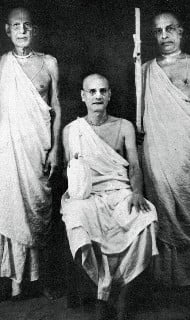
The global dissemination of Krishna-bhakti demanded an individual who could unite unwavering fidelity to the Bhakti Tradition with agile adaptation to a world increasingly organized by science and technology. In Abhayraised in disciplined Vaishnava practice and educated in chemistry and economicsthose competencies converged as practical realism aligned with whole-hearted surrender to the Divine.
Without cultivating any pretense of being divinely deputed, Abhay anchored his life in a simple conviction: strength sufficient to accomplish the impossible descends from above, provided one consents to become an instrument. That consent took a tangible form in a decisive stepaccepting sannyasa under Bhaktiprajnana Kesava Maharaja (often rendered Keshava Maharaj). Renunciation did not represent withdrawal from the world; it signified a reconfiguration of responsibility and focus, aligning all capacities with the instruction received in the Guru-Shishya Tradition.
Within the Vedic framework, sannyasa is a rigorous ashrama of vow-bound responsibility. In Gaudiya Vaishnavism, it serves as both spiritual intensification and missionary readiness, where teaching, kirtana, and scriptural exposition become the core obligations of a life centered on Krishna. Abhay’s acceptance of sannyasa thus functioned as an operational commitment: to embody the theological principles of bhakti while building pathways for transmission beyond India’s cultural and linguistic boundaries.
That choice was strategically consonant with the Gaudiya concept of yukta-vairagyaappropriating the tools of modernity without capitulating to materialism. Under this principle, reason, media, institutions, and even global logistics become value-neutral instruments that acquire sanctity when deployed for seva. The interplay between principled detachment and intelligent engagementyukta-vairagya in actionprovided a template for harmonizing tradition and innovation.
The mid-twentieth century was defined by accelerating globalization: expanding maritime and air travel, mass print and broadcast, nascent digital infrastructures, and academic networks shaping global discourse. A mission aspiring to carry Krishna’s teachings abroad could not ignore these technologies and institutions. Abhay’s background in chemistry and economics helped cultivate a methodological way of thinkinghypothesis, evidence, resource allocation, and systemic problem-solvingthat complemented the devotion-centered aims of Bhakti Tradition.
In a world confident in laboratories and ledgers, communication about dharma benefits from clarity, coherence, and intellectual integrity. Rather than opposing science and philosophy, Abhay demonstrated that sound reasoning can illuminate the Bhagavad Gita’s claims and Gaudiya Vaishnavism’s experiential insights. Framing spiritual assertions in disciplined language while preserving devotional intensity allowed the message of Krishna-bhakti to enter classrooms, living rooms, and public forums without diluting its essence.
Theologically, the conviction that empowerment arises “from above” is integral to the Gita’s teaching that divine energy enables one to transcend material constraints. Agency, in this view, is participatory: the devotee accepts the role of instrument while the efficacy derives from Krishna’s grace. Such an outlook cultivates humility, steadiness under adversity, and resiliencequalities indispensable to any long-range educational or cultural outreach in modern society.
This posture of instrumentality also rests on the authority and care transmitted through the Guru-Shishya Tradition. Abhay’s resolve was nourished by the instruction of Bhaktisiddhanta Sarasvati Thakura to present Krishna-bhakti in accessible language for global audiences. Under the guidance of Kesava Maharaj, sannyasa affirmed readiness to shoulder the austerity and discipline that sustained a lifelong vow of teaching, translation, and congregational kirtana.
Operationally, sannyasa freed attention and time for systematic writing, translation, and community-building. It encouraged a disciplined routine that supported publication projects, scriptural commentary, and public dialogue about Hindu Dharma across cultures. Here, “strength from above” did not negate human effort; it refined effortchanneling time, intellect, and organizational energy into outcomes aligned with bhakti’s ethical arc of compassion and service.
Abhay’s synthesis highlights common ground across the dharmic familyHinduism, Buddhism, Jainism, and Sikhismwhere disciplined practice, ethical vows, and service converge. The Vaishnava call to devotion resonates with the Yogic principle of īśvara-praṇidhāna (surrender to the Divine), the Sikh emphasis on seva and inner humility, the Jain commitment to ahiṁsā and aparigraha, and the Buddhist cultivation of disciplined sangha life and compassionate action. This unity in spiritual diversity underscores the blog’s objective: shared ethical and contemplative cores can flourish without erasing distinctive paths.
From a leadership perspective, Abhay’s path models three interlocking disciplines: (1) doctrinal fidelity that safeguards authenticity, (2) cultural adaptability that translates insights without distortion, and (3) instrumentality that keeps ego in check while catalyzing collective effort. In practice, this meant leveraging modern institutions, engaging academic discourse, and adopting evidence-aware methodsalways situated within the devotional telos of service to Krishna.
For contemporary practitioners and professionals across dharmic traditions, the narrative is relatable. Many confront junctures where purposes outgrow comfort zonescareer pivots toward meaningful service, commitments to community education, or vows that formalize ethical aspirations. Abhay’s example suggests that clarity increases as actions align with principle, and that sustainable progress often follows when one accepts to be an instrument of a cause larger than oneself.
Historically, the decision to accept sannyasa became a keystone for subsequent global outreach associated with ISKCON (International Society For Krishna Consciousness), systematic exposition of the Bhagavad Gita and Bhāgavata Purāṇa, and the spread of kirtana and prasada-centered community life. While the institutional expressions evolved over time, the original architecturedevotion anchored in scripture, guided by the Guru-Shishya Tradition, and expressed through culturally intelligent engagementremained constant.
In sum, Abhay’s balance of devotion and disciplined pragmatism offers a durable template for the twenty-first century: honor the paramparā, embrace yukta-vairagya, rely on divine grace, and use the language of modernity to serve perennial wisdom. That is how “strength from above” manifestsquietly, persistently, and effectivelythrough those willing to become instruments for the common uplift of all beings.
Inspired by this post on Dandavats.