Bahadur Shah Zafar’s place in the Revolt of 1857 has long been framed in binaries: either as the venerable standard-bearer of India’s First War of Independence or, at the other extreme, as a hesitant sovereign who undermined the struggle. A careful, evidence-grounded reading suggests a more complex truth. Rather than heroics or betrayal alone, the record reveals an octogenarian, titular Mughal emperor navigating an uprising he neither planned nor fully controlled, under conditions of siege, scarcity, and clashing agendas within the rebel camp.
By 1857, the Mughal Empire was but a shadow of its former self. Since the British capture of Delhi in 1803, the East India Company recognized the emperor only as a ceremonial figure supported by a pension. Bahadur Shah Zafar—poet, patron of culture, and a symbol of composite Delhi—lived within this constrained architecture of colonial power. His courtly influence was social and cultural, not strategic or military, and his authority beyond the Red Fort’s walls was nominal at best.
The revolt’s ignition in 1857 had layered causes. The immediate spark—cartridges rumored to be greased with cow and pig fat—touched sacred sensibilities across communities. Beneath this, cumulative grievances had mounted: annexations such as Awadh in 1856, the Doctrine of Lapse, changes to military service conditions, and extractive revenue policies that strained agrarian and urban livelihoods. In short, what erupted in Meerut on 10 May 1857 and reached Delhi on 11 May had deep structural roots in both economic dispossession and perceived cultural-religious encroachments.
When sepoy regiments entered Delhi, they sought a sovereign whose name could consecrate political legitimacy. They proclaimed Bahadur Shah Zafar as emperor to convert a chain of mutinies into a recognizable polity. This elevation was less a transfer of effective command and more an invocation of symbolic capital. In response, proclamations and appeals circulated that emphasized the protection of longstanding customs and faith practices, signaling a shared civic space for communities across dharmic traditions and beyond.
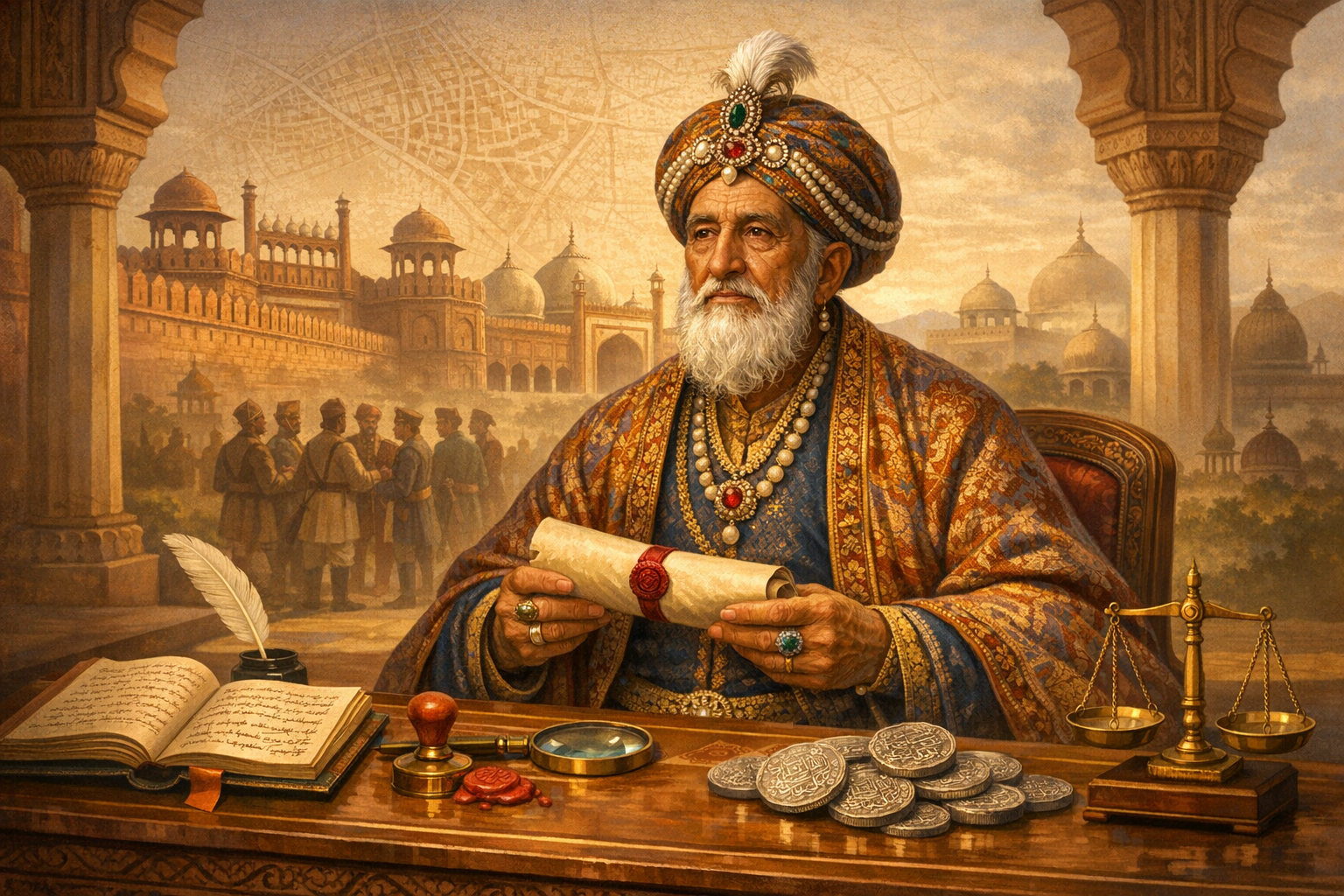
Zafar’s acceptance of the mantle was reluctant and conditioned by circumstance. At over eighty years of age, with minimal resources and no independent army, he faced immediate pressures: frightened citizens within the city, fractious rebel commanders outside his court, and the certainty of British retribution. He issued farmāns, reopened the Delhi mint to strike coins in his name, and attempted to provide a semblance of civil order. Yet these gestures of sovereignty could not, by themselves, conjure the logistics, supplies, coordination, and unified command that a protracted war demanded.
Inside Delhi, governance under rebellion proved remarkably difficult. Rebel regiments differed by origin, leadership, and immediate priorities. Attempts at administrative reorganization—most notably under the capable Bakht Khan, who arrived from Bareilly—sought to create a council-based structure to rationalize decision-making. But rivalries within the rebel camp, tensions between sepoy leadership and Delhi’s old nobility, and the absence of a single military doctrine impeded coherence. These were not failures uniquely attributable to Zafar; they were embedded in the very nature of a spontaneous, multi-centered uprising.
Zeenat Mahal, Zafar’s influential consort, figures prominently in arguments about palace politics. She favored her son, Mirza Jawan Bakht, in succession intrigues that preceded 1857 and continued during the crisis. Some British intelligence reports later alleged that she explored contacts with Company officials to secure her son’s future. Historians remain divided on the reliability and intent behind such reports; what is clear is that succession concerns, court rivalries, and the fog of siege collectively shaped decision-making during those months. Reducing this complex matrix to a singular narrative of “betrayal” oversimplifies a contested documentary record.
The British assault on Delhi culminated in September 1857. Bahadur Shah Zafar took refuge at Humayun’s Tomb, where he was captured. Several princes were executed at the Khooni Darwaza by British officer William Hodson—an episode that indelibly scarred public memory. Zafar’s subsequent trial in the Red Fort charged him with aiding and abetting rebellion and alleged complicity in the murder of Europeans. He was exiled to Rangoon (Yangon), where he died in 1862. His poetry from exile—haunted, humane, and suffused with loss—endures as testimony to a sovereign whose cultural voice outlived his political eclipse.
How then should “betrayal” be assessed? Three criteria are instructive: agency, intent, and effect. First, agency: as a titular monarch without an independent army, Zafar lacked the structural power necessary for decisive strategic leadership. Second, intent: fragmentary records show vacillation, pressure from multiple factions, and sporadic attempts to contain bloodshed and maintain civic order—hardly the hallmarks of a deliberate saboteur. Third, effect: the collapse of rebel Delhi followed from superior British logistics, internal divisions among the insurgents, and the material asymmetry of siege warfare, not from a single person’s duplicity. On balance, the charge of betrayal is not supported by robust, uncontested evidence.
Historiography further cautions against monocausal judgments. British-era works popularized the term “mutiny,” focusing on sepoy insubordination and downplaying broader social grievances. Later nationalist histories, influenced by figures such as V.D. Savarkar (who famously characterized 1857 as a war of independence), emphasized anti-colonial unity and patriotic sacrifice. Scholars like R.C. Majumdar questioned the revolt’s all-India character and degree of central coordination, while the writings of Jadunath Sarkar on late Mughal decline contextualized the institutional fragility that predated 1857. G.B. Malleson’s volumes, though framed by imperial assumptions, amassed invaluable detail on the campaign’s military chronology. Reading across these strands equips readers to distinguish rhetoric from record.
Equally important is the revolt’s social tapestry. Hindus and Muslims fought together in many theaters, and everyday solidarities often held firm despite extreme strain. Elsewhere, significant groups—including some princely states and military contingents—remained loyal to the British for reasons shaped by local calculations after earlier conflicts and realpolitik. These divergences do not negate the shared experience of colonial subjugation; rather, they underscore the need to interpret 1857 as a mosaic of regional decisions, community strategies, and moral dilemmas under unprecedented stress. For present purposes, the central lesson is constructive: solidarity across dharmic traditions—Hinduism, Buddhism, Jainism, and Sikhism—has historically been a source of civilizational resilience, and maintaining that unity today requires resisting reductive blame narratives from the past.
For many readers raised on schoolbook simplifications, encountering archival fragments—trial records, proclamations, and intelligence summaries—can be disorienting. Some accounts elevate Zafar to near-mythic heroism; others invert the myth to paint him as a liability. An evidence-driven approach encourages a third path: weigh primary materials, note contexts of production, and calibrate confidence in any claim according to the quality of corroboration. This process may feel demanding, but it is precisely how historical empathy and analytical rigor grow together.
In the end, Bahadur Shah Zafar stands neither as the architect of the revolt nor its betrayer. He is better understood as a tragic sovereign and cultural luminary whose name lent legitimacy to an insurgency born of deeper structural discontent, and whose constrained choices under siege reflected the limits of a dying dynasty rather than treachery. A balanced remembrance of 1857 honors the courage of those who resisted colonial rule while acknowledging the uprising’s fragmentation and the suffering it entailed. Such a remembrance strengthens a shared, post-colonial commitment to unity among India’s diverse communities and dharmic traditions, and it invites an ongoing engagement with sources over slogans.
Inspired by this post on Dharma Dispatch.