
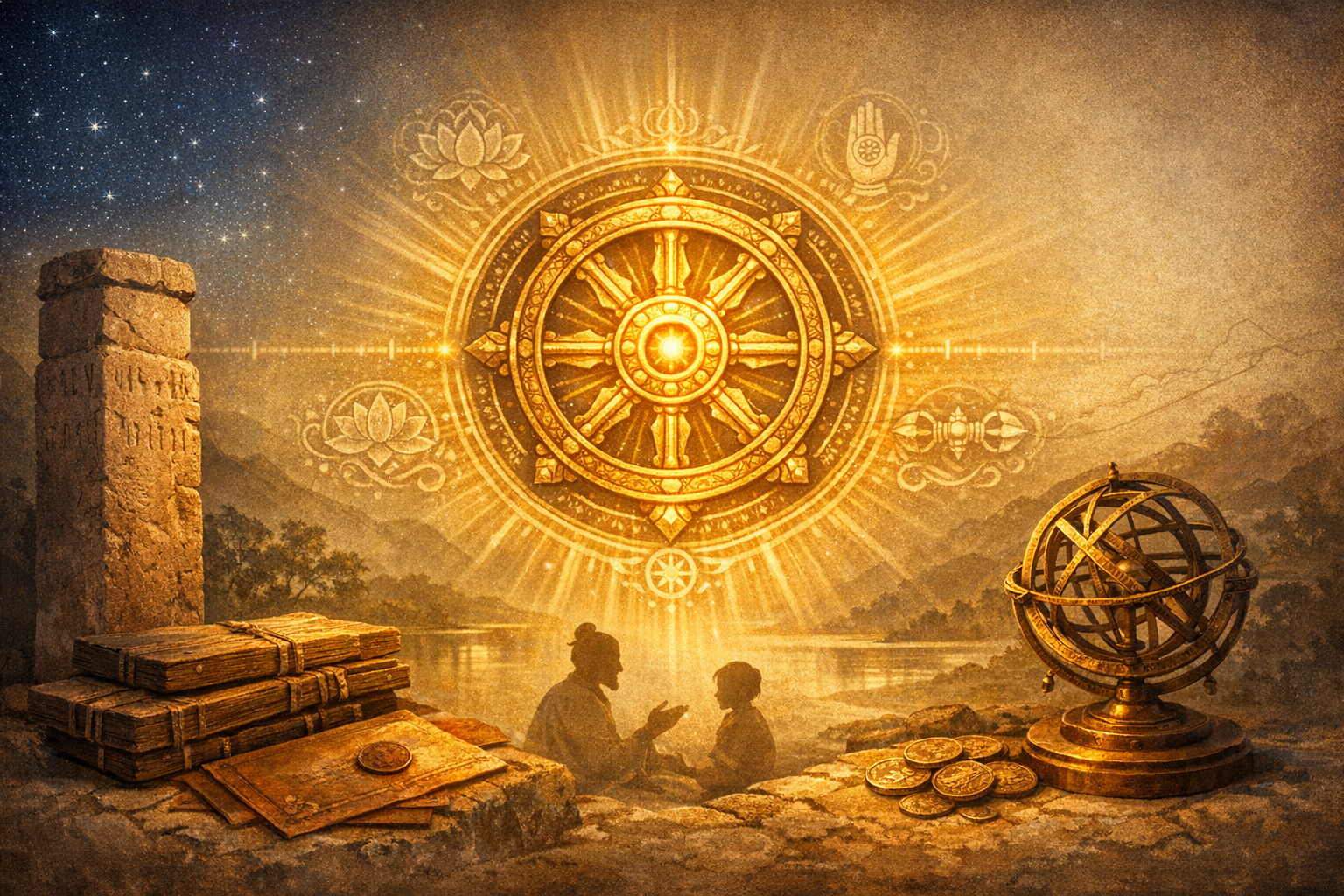
Ancient India presents a striking paradox that has long intrigued historians: a civilization that excelled in philosophy, mathematics, astronomy, medicine, and linguistics did not cultivate a sustained tradition of linear historical writing comparable to Greco-Roman chronicles. Rather than privileging exhaustive lists of dates and dynasties, the intellectual cultures of Hinduism, Buddhism, Jainism, and, later, Sikhism developed practices that preserved wisdom-oriented memory, ethical reflection, and soteriological insight. This orientation does not signify indifference to the past; it signals a distinct historiographical sensibility in which timeless truth was considered more valuable than time-bound documentation.
This sensibility becomes clear when contrasting modern, archive-driven historiography with the South Asian categories of Itihāsa, Purāṇa, and Śāstra. Itihāsaoften glossed as “thus indeed it was”does not merely recount an event sequence; it frames events to illuminate Dharma, causality (karma), and right conduct. Purāṇas weave genealogies, cosmogonies, and sacred geography to establish moral exemplars and civilizational continuity. Śāstra articulates method and principle, anchoring practice to reasoned foundations. Together, these genres embedded history within meaning, making the preservation of normative truth central to cultural memory.
Oral pedagogies deepened this orientation. The guru–śiṣya paramparā transmitted knowledge with extraordinary rigor through recitative techniques (such as pada-pāṭha and krama-pāṭha), mnemonic architectures, and ritualized performance. In the Vedas and Upaniṣads, precision of transmission was itself a sacred discipline; the fidelity of sound was treated as a vehicle of truth. Such training cultivated a cultural trust in living memory, commentarial lineages, and interpretive communities, even as it placed less emphasis on authorial biography or precise dating.
Time, too, was imagined differently. Dharmic traditions conceptualized cyclical timeyugas, manvantaras, and kalpasalongside practical calendars for agriculture, ritual, and statecraft. When time unfolds as cycles rather than a singular forward arrow, the ethical message of a narrative can be prioritized over the exactness of a chronology. This does not negate chronology; it reframes chronology as a support to Dharma and spiritual progress, not an end in itself.
A soteriological focus unified the Dharmic spectrum. Hinduism emphasized Dharma and mokṣa; Buddhism oriented memory around the Dharma and nirvāṇa; Jainism organized narratives through karma theory and the lives of the Tīrthaṅkaras; Sikhism centered history within Gurmat, where Shabad (divine Word) guides ethical action. Across these traditions, the question “What liberates?” often took precedence over “When exactly did this happen?” The past mattered insofar as it illuminated how to live truthfully and compassionately in the present.
This truth-first orientation did not eliminate evidence-based recordkeeping. India’s vast epigraphic, numismatic, and manuscript corpora demonstrate extensive historical consciousness. Inscriptions on stone and copper-plate (tamraśāsana) attest to land grants, tax remissions, temple endowments, and political claims. Coins encode symbols, regnal titles, and economic networks. Manuscripts preserve colophons with dates, places, and lineages. What is noticeably different is emphasis and intent: records aimed at justice, sanctity, legitimacy, and community welfare, more than at dispassionate narrative continuity.
Ashoka’s edicts exemplify this stance. Composed in Prakrit and, in some regions, in Greek and Aramaic, the inscriptions foreground Dhammaethical governance, compassion toward all beings, and restraint in conquestrather than Ashoka’s personal triumphs. The past appears as a moral theatre, not a biographical ledger. Likewise, the Allahabad Pillar praśasti of Samudragupta, while offering invaluable political information to modern historians, is styled as ornate eulogy; it served to articulate righteous sovereignty as much as to chronicle campaigns.
Chronicles did emerge, but often with distinctive aims. Kalhaṇa’s Rājataraṅgiṇī (12th century) in Kashmir synthesizes earlier chronicles (vaṁśāvalīs), inscriptions, and oral accounts, applying critical judgment to produce a long-span political history. Even there, the text balances chronology with moral evaluation, exemplifying an Indian historiography attuned to both sequence and significance. Buddhist sources such as the Dīpavaṃsa and Mahāvaṃsa, and Jain narratives like the Kalpasūtra and the Pariśiṣṭaparvan, similarly encode lineage and memory to sustain ethical communities, align practice to doctrine, and affirm trans-regional connections.
Calendrical and astronomical tools enabled precise time-reckoning when needed. Eras such as the Vikrama Samvat and Śaka era structured civic and ritual life; tithis, nakṣatras, and solilunar calculations governed festivals, agriculture, and temple observances. Astronomers and mathematiciansincluding Āryabhaṭa, Varāhamihira, and Brahmaguptarefined models of planetary motion, the calendar, and computation. Their work on the place-value decimal system and zero concept supported both long-cycle cosmology and practical timekeeping, demonstrating that technical exactitude flourished even as chronological narration remained selective.
Puranic genealogies, a frequent object of debate, were not casual lists; they formed civilizational scaffolds. By aligning dynasties to sacred geographies and moral archetypes, Purāṇas linked rule to responsibility and memory to ethics. Modern scholars have used epigraphy, archaeology, and external testimonia (Greek, Chinese, and Persian sources) to cross-check these lists, showing that while not uniformly precise, they preserve valuable historical cores embedded in normative frames. The fusion of world-order (ṛta) and social-order (Dharma) explains why these compilations privilege continuity over authorial self-reference.
Textual redaction practices further shaped memory. The attribution of compilations to Vyāsa signals a rolearranger, synthesizermore than a single biographical individual. Multi-recensional traditions of the Mahābhārata and the Rāmāyaṇa, later stabilized in modern critical editions, reflect living texts whose purpose was guidance, not archival stasis. As these epics traversed Hindu, Buddhist, and Jain milieus, they were reframed to address local ethical challenges, a hallmark of a civilizational canon that prized applicability over autography.
When readers trained in modern schools first encounter the Mahābhārata, the absence of exact dates can feel disorienting. Yet the poem’s power in shaping reflections on justiceYudhiṣṭhira’s dilemmas, Bhīṣma’s counsel, Karṇa’s loyaltiesillustrates why Itihāsa endures: it renders complex judgments thinkable. The Rāmāyaṇa, too, functions as ethical cartographyits sacred routes, tirthas, and exemplary characters orient families and communities to shared ideals. Such narratives braid moral psychology with civilizational geography, sustaining unity amid diversity.
Buddhist and Jain traditions developed allied strategies. The Mahāvaṃsa situates the Buddha’s teaching within Sri Lanka’s royal lineages to model righteous kingship and monastic discipline. Jain texts craft extensive karmic biographies that underscore ahiṃsā, restraint, and the cosmic arc of liberation (kevala). These literatures offer dates and sequences where useful, but their animating core is soteriological clarity. Sikh memory, preserved in janam-sākhīs and community tradition while centred on the Guru Granth Sahib, treats history as a vehicle for truthful living (sat) and service (seva), harmonizing remembrance with ethical presence.
Colonial-era judgments often misread this ecosystem. Early European thinkersfrom James Mill to Hegelequated “history” exclusively with linear chronicles, and thus concluded that India lacked historical sense. Subsequent research in Indian historiography, epigraphy, and philology has revised that view. The issue is not absence but purpose: Indian materials meticulously documented what communities neededland rights, temple endowments, ritual authority, ethical exemplarsrather than modern-style author-centered biography.
Inscriptions throughout the Gupta Empire and subsequent polities reveal administrative sophistication: grants detail metes and bounds, revenue categories, and obligations; donor records register patronage networks; temple archives track repairs, festivals, guilds, and local governance. This documentary landscape anchors the “everyday state” even when narrative chronicles are sparse. It also shows how sacred institutions functioned as repositories of social memory and economic stability for centuries.
The Arthasastra underscores another aspect of Indian historical pragmatism. Even though Kautilya’s treatise is prescriptive, its concern for intelligence, archives, law, and economic management implies continuous recordkeeping and institutional memory. Combined with the jurisprudential traditions of Dharmaśāstra and the procedural accuracy observable in copper-plate charters, the picture that emerges is not ahistoricity, but a history-in-usememory calibrated to sustain order, prosperity, and virtue.
Methodological caution remains important. Attempts to date epics solely through astronomical references must account for precession, textual layering, and genre conventions. Likewise, Purāṇic king lists require triangulation with inscriptions, coins, and archaeology. When multi-proxy methods are appliedcombining Sanskrit and Prakrit texts, Pali and Ardhamāgadhī sources, Chinese pilgrims’ accounts (Faxian, Xuanzang), Greco-Roman notices (Megasthenes, Ptolemy), and stratified material culturea coherent, though not always continuous, historical topography of Ancient India becomes visible.
This alternative historiography carried civilizational advantages. Anchoring identity in Dharma, rather than in exclusive ethnic myth or ruler-centric biography, allowed plural communities to inhabit a shared sacred geography without erasing local specificities. Because ethical exemplars rather than authorial egos led the canon, transmission remained resilient to regime changes. Emphasis on timeless truth over meticulous biography guarded what was most essential for social cohesion across long cycles of political flux.
At the same time, the tradition never denied the value of dates and documents. It integrated them instrumentallythrough eras like Vikrama Samvat and the Śaka era, through regnal years in colophons, and through temple and guild records. The result is a dual-register memory: one chronological and administrative, the other ethical and soteriological. Understanding India’s past requires reading both registers together.
For contemporary readers, this perspective has practical implications. School timelines are useful; so too is learning to ask the questions Indian texts encourage: What choices sustain Dharma? How does one navigate competing duties with compassion and courage? What aspects of memory unify communities without suppressing difference? Framed this way, Itihāsa, Purāṇa, and Śāstra become living companions rather than distant artefacts.
Unity among Dharmic traditions arises naturally from this approach. When Hinduism, Buddhism, Jainism, and Sikhism are seen as allied in prioritizing ethical truth, disciplined practice, and liberation, their varied narratives illuminate a shared civilizational commitment: knowledge that transforms conduct. This unity-in-diversity perspective strengthens interfaith respect, thwarts narrow exclusivism, and enriches historical understanding with philosophical depth.
In historiographical terms, Ancient India preferred “why” and “how to live” to “when” and “who wrote” unless the latter served Dharma, justice, or communal well-being. Seen through this lens, epigraphy, Purāṇic genealogies, court praśastis, monastic chronicles, and temple records interlock to form an archive of lived ethics. The past, in this tradition, is a mirror and a compassreflecting perennial truths and orienting actionrather than a museum of frozen dates.
Rethinking Indian history in this way does not diminish the importance of chronology; it restores balance. Timelines help situate; timeless truths help decide. Together they allow a fuller picture of Ancient India’s intellectual achievementfrom Āryabhaṭa’s computational elegance and Varāhamihira’s astronomical syntheses to Brahmagupta’s advances in algebra and zeroset within a civilizational project that prized wisdom over mere record.
The most fruitful path forward, then, is integrative. Historians and readers can combine modern critical methodsepigraphy, archaeology, textual criticism, and cross-cultural comparisonwith the interpretive keys of Itihāsa, Purāṇa, and Śāstra. Doing so reveals that Ancient India did write history, but in a register tuned to ethical resonance and spiritual ends. Recognizing that register clarifies the apparent paradox and offers a robust, unifying framework for understanding the Dharmic past.
Inspired by this post on Hindu Blog.
