
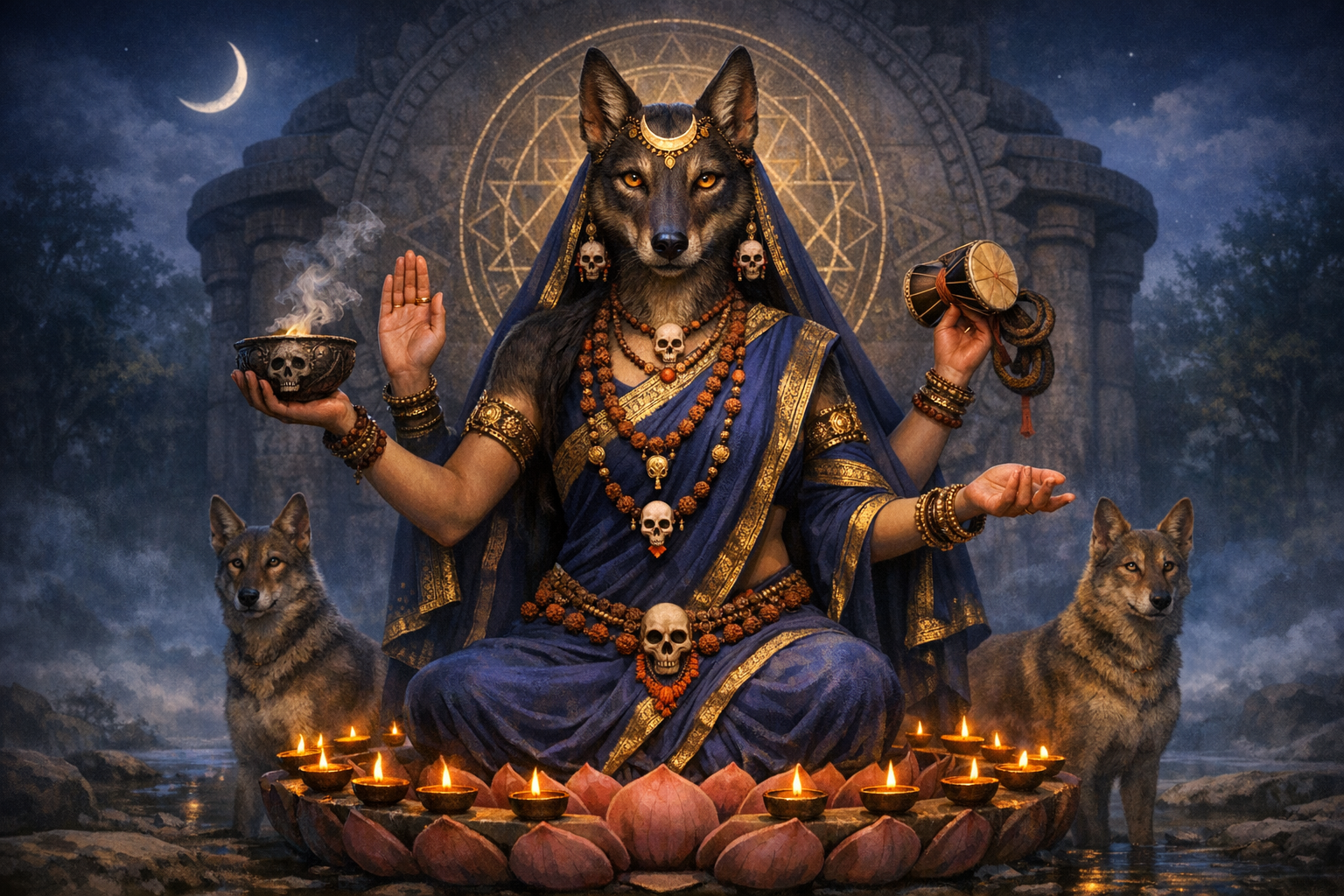
Shiyali Kalialso remembered in some traditions as Kokmukha Devidesignates a rare, jackal-faced manifestation of the Hindu Goddess. Within the vast spectrum of Hindu Dharma, such a form signals the point where the sacred intersects with the liminal: the cremation ground, the night, the threshold between life and death. Although largely absent from contemporary public worship, this fierce and compelling presence echoes through ancient texts, archaeological motifs, and regional memories that locate Kali and her sister goddesses at the very frontier of human experience.
The theonym Shiyali plausibly engages the Eastern Indo-Aryan lexeme śiyāl (Bengali/Assamese for “jackal”), while the descriptor Kokmukha (lit. “jackal-faced” in vernacular/Prakritized usage) follows the well-known Sanskritic convention of mukha-compounds used for animal-faced deities. In Hindu iconography, animal visages often signify specific cosmic functions. A jackal countenance, associated with night, scavenging, and the charnel ground, encodes the Goddess’s power over decay, dissolution, and the uncompromising truth of impermanencecore themes in both Śākta Tantra and broader Hindu philosophy.
Ancient texts and ritual manuals do not always preserve uniform nomenclature, yet they repeatedly link the fierce Goddess with jackals and cremation imagery. Puranic and Tantric sources connected to the Kamakhya-Kālikā traditions, for example, describe the Goddess amid skulls, cremation grounds, and creatures of the night. While explicit mentions of “Shiyali Kali” are scarce in printed editions, allied descriptors such as śṛgāla (jackal) recur in devotional and esoteric contexts that establish a semantic field within which a jackal-faced Kali is intelligible.
Iconographically, Chamundaone of the Matrikasprovides a crucial comparative anchor. She is famously surrounded by jackals and ghouls and personifies time’s corrosive edge. In this matrix, a jackal-faced form of Kali becomes less a curiosity and more a focused articulation of well-attested Śākta themes. The presence of jackals in Chamunda’s entourage suggests a shared symbolic grammar with Kokmukha Devi, where the animal is not merely decorative but pedagogical, teaching discernment in the face of mortality.
The Yogini corpus furthers this reading. Across 64 Yogini traditions preserved at sites such as Hirapur (Odisha), Bhedaghat and Mitaoli (Madhya Pradesh), animal-faced Yoginis appear alongside human-faced and goddess-specific manifestations. Though catalogues and identifications vary by site and scholarship, the prevalence of leonine, boar, and other zoomorphic visages makes a jackal-faced Yoginior a cognate Kokmukha-type presenceiconographically plausible within the wider Śākta ambit. Such sculptural programs, often circular and sky-oriented, emphasize multiplicity and fluidity rather than a single, uniform pantheon list.
Archaeologically, identifying jackal morphology requires attention to muzzle length, ear shape, and body posture relative to canid comparanda (dog, wolf). Where inscriptions survive, epigraphic labels aid attribution; where they do not, art-historical consensus evolves from cumulative stylistic indicators. The absence of unambiguous labels for Kokmukha Devi in museum tags should be read as a research opportunity rather than a negation, encouraging closer scrutiny of lesser-studied regional collections and village shrines.
Symbolically, the jackal occupies a liminal ecological niche. It thrives on refuse and the margins of settlement, a life-history pattern that maps onto Kali’s sovereignty over the edges of social order. As the remover of fear (abhaya) through confrontation with fear’s source, the Goddess teaches that decay and dissolution are not antithetical to dharma but necessary to cosmic balance. This liminality resonates deeply with contemplative practices across Hindu Dharma: grounding in the cremation ground (śmaśāna) is a time-honored metaphor for internalizing impermanence and cultivating equanimity.
Plural resonances appear across dharmic traditions. In Buddhism, charnel-ground contemplations (śmaśāna-sādhanā) and dakini symbolism explore the same frontier where form dissolves into emptiness; in Jainism, rigorous ahiṁsā and attention to the life-world of animals underscore ethical kinship with beings relegated to the margins; in Sikh thought, sarbat da bhala (the welfare of all) frames a world-affirming compassion that dignifies every creature. Read together, these perspectives reinforce a dharmic ethos of unity-in-diversity: multiple paths and images, one underlying quest for truth and liberation.
Regionally, faint mnemonic traces survive in oral lore that situates fierce Mother-Goddess worship alongside references to jackals, especially in eastern India where śiyāl is the everyday term. Local recitations, seasonal observances near cremation grounds, and the guardianship of gramadevatas (village deities) often preserve elements omitted in metropolitan calendars. Such living fragments argue against a strict center–periphery model of Hindu ritual history and instead highlight a polycentric map of practice.
Comparative mythology can aid interpretation without collapsing distinct traditions. The jackal-headed Egyptian Anubis, guardian of necropolises, demonstrates a globally recurring intuition: liminal canids mediate thresholds. The comparison is heuristic, not genealogical. It clarifies how societies have repeatedly chosen jackals to symbolize passage, judgment, and care for the deadfunctions that converge with Kali’s cremation-ground sovereignty in distinctly Indic ways.
Methodologically, reconstructing a form like Shiyali Kali benefits from a triangulated approach. Textual criticism examines variant readings across Puranas and Tantras; archaeology and art history assess sculptures, reliefs, and portable icons; ethnography attends to oral histories and priestly lineages (archaka paramparas). Museum catalogues, inscriptional corpora, and site reports broaden the evidentiary base, while linguistic analysis of regional theonyms (e.g., śiyāl-based epithets) links philology with practice.
An iconographic reconstruction, constrained by established Kali vocabularies, would likely include cremation-ground motifs (śmaśāna), skull-bowl (kapāla), chopper (khaḍga), and drum (ḍamaru) or noose (pāśa), adapted to a jackal-faced physiognomy, either standing upon a corpse (śava) or flanked by jackals. Such a proposal is heuristic rather than prescriptive; it respects the variation recorded in śilpaśāstra manuals and the fluidity that defines folk–tantric intersections.
The historical eclipse of Kokmukha Devi in mainstream worship may reflect aesthetic shifts toward maternal and auspicious forms, changing urban sensibilities, and the general demotion of cremation-ground imagery in public ritual life. Modernity’s sanitization of death and the loss of custodial artisan lineages further contributed to the obsolescence of many local forms. None of this implies erasure of meaning; rather, it invites scholarly and community-led retrieval grounded in respect, context, and dharmic values.
Contemporary relevance lies in what a jackal-faced Shakti teaches about resilience and clarity. To contemplate Kokmukha Devi is to practice fearlessness: to meet transience without denial, to transmute aversion into insight, and to include, not exclude, the liminal within a holistic vision of dharma. This inner posture aligns with the Bhagavad-Gita’s steadiness in sukha-duḥkha and with meditation traditions that cultivate equanimity through direct engagement with life’s impermanence.
For practitioners, researchers, and cultural stewards, a conscientious path forward includes documenting local shrines, consulting elders and hereditary priests, studying catalogued and uncatalogued pieces in district museums, and reading Ancient Texts in dialogue with Archaeology. Such a balanced method honors both śāstra and desa-kāla-pātra (place, time, person)the dharmic triad ensuring that rediscovery strengthens living communities rather than abstracting them into museum-only memory.
In sum, Shiyali Kali (Kokmukha Devi) represents a precise teaching concealed within a dramatic image. The jackal-face makes explicit what the tradition has long known: that Shakti accompanies beings through every threshold, including those often ignored or feared. Re-engaging this formacademically, ethically, and devotionallyenriches the shared civilizational heritage of Hinduism, Buddhism, Jainism, and Sikhism, and advances a unifying project rooted in humility, plurality, and the fearless pursuit of truth.
Inspired by this post on Hindu Blog.
