-
Sultan-ul-Qaum Jassa Singh Ahluwalia: Visionary Sikh Commander Who Forged Unity and Hope

Sultan-ul-Qaum Jassa Singh Ahluwalia (1718–1783) led the Dal Khalsa through one of North India’s most turbulent centuries, transforming agile resistance into orderly governance. Elected at Sarbat Khalsa assemblies, he coordinated misl forces, protected trade and pilgrimage, and became renowned for rescuing abducted civilians during Afghan retreats. His Lahore coinage—Deg Tegh Fateh, Nusrat be-darang, yaft az…
-
Unmasking Hyderabad’s Independence Myth: Evidence-Rich History from Asaf Jah I to 1948

This evidence-driven analysis dismantles the myth that Hyderabad was ever an independent state by tracing its legal position from Asaf Jah I through British paramountcy to 1948. Drawing on Jadunath Sarkar’s core insights and British Residency records, it shows that Hyderabad possessed internal autonomy but lacked external sovereignty—defense, foreign affairs, and treaty-making—throughout its history. Eyewitness…
-
Shaheedi of Guru Tegh Bahadur: 350 Years of Courage that Secured Freedom of Conscience

This long-form essay marks 350 years since the Shaheedi of Guru Tegh Bahadur Sahib Ji and examines the event’s historical context, ethical significance, and enduring legacy. It synthesizes Sikh, Persian, and European accounts while noting interpretive variations to present a rigorous, balanced narrative. Readers gain a concise timeline, a survey of key sites of memory…
-
Bahadur Shah Zafar and 1857: Evidence-Driven Reassessment Beyond Heroics and Betrayal

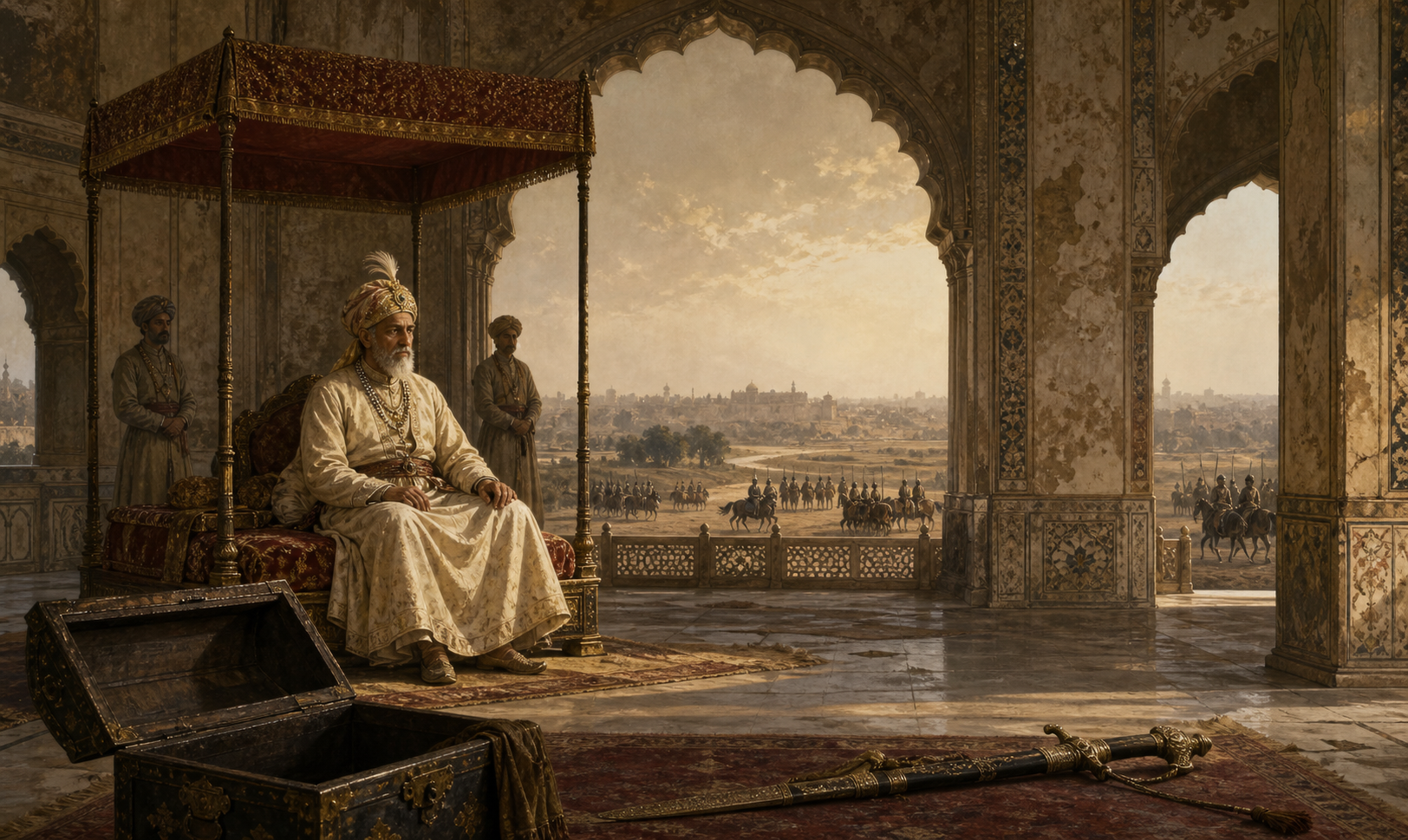
Bahadur Shah Zafar’s role in the Revolt of 1857 defies simple labels. Rather than casting him as either a heroic liberator or a betrayer, this analysis situates the last Mughal emperor within the material constraints of siege warfare, fractured command, and colonial-era power asymmetries. It traces the uprising’s structural causes—from annexations and revenue extraction to…
-
Sardar Baghel Singh: The Visionary Who Etched Sikh Heritage on Delhi’s Sacred Map (1783)

Sardar Baghel Singh (c. 1730–1802) transformed Delhi’s sacred geography in March 1783 through a negotiated accord with the Mughal court that authorized, secured, and funded the construction of Sikh shrines at historic sites. Rather than a mere military episode, his intervention institutionalized Sikh memory—most notably at Sees Ganj Sahib and Rakab Ganj Sahib—through a sustainable…
-
Sardar Baghel Singh: The Visionary Who Etched Sikh Heritage on Delhi’s Sacred Map (1783)

Sardar Baghel Singh (c. 1730–1802) transformed Delhi’s sacred geography in March 1783 through a negotiated accord with the Mughal court that authorized, secured, and funded the construction of Sikh shrines at historic sites. Rather than a mere military episode, his intervention institutionalized Sikh memory—most notably at Sees Ganj Sahib and Rakab Ganj Sahib—through a sustainable…
-
Sitakund and Monghyr Fort: Shah Shuja’s Turmoil and a Sacred City’s Resilience

This long-form analysis reconstructs the layered history of Munger (Monghyr) from Gupta-era epigraphy and regional dynasties to Mughal turbulence and East India Company conquest. It clarifies Monghyr’s form as a classical Kaṭaka—fortified capital and garrison—while situating the city’s beauty on a bend of the Ganges documented by Viscount Valentia. It explains the ritual ecology of…
-
Shakti-Putra Shivaji: Strategic Genius, Dharmic Virtue, and a Timeless Blueprint for Just Power

Chhatrapati Shivaji’s legacy emerges as a rare fusion of strategic brilliance and dharmic virtue. Positioned alongside Chandragupta Maurya and Skandagupta, he exemplifies the Shakti-putra ideal—uniting shakti (force) and yukti (strategy) to redirect history. His conduct in victory—protecting civilians, honoring women, and respecting places of worship—shows a plural, ethical framework consonant with Sanatana Dharma and shared…
-
Beyond the ‘Muslim Era’ Myth: India’s Dharmic Resistance and Civilizational Resilience

This article challenges the simplistic label of a singular ‘Muslim era’ in India and presents a more rigorous, dharmic-centered account of medieval and early modern history. It highlights how Indian polities—Hindu, Jain, Buddhist, and later Sikh—checked, accommodated, and ultimately reshaped external and transregional powers over centuries. Readers gain a clearer timeline of key resistances, from…
-
Reclaiming Indian Historiography: Hindu Civilizational Memory, Foreign Rule, and Dharmic Unity

This essay reassesses Indian historiography through evidence-based analysis and the lived memory of Bharatavarsha. It explains why popular Hindu remembrance did not typically view certain medieval sultanates as indigenous while carefully separating critique of historical regimes from respect for present-day communities. It situates debates like Aryan Migration -vs- Out of India within an open, scholarly…
-
Shaheedi Asthan of Baba Banda Singh Bahadur: A Moving Tribute to Courage and Dharma
The Shaheedi Asthan of Baba Banda Singh Bahadur offers a powerful encounter with Indian history and Sikh heritage. It commemorates a principled leader whose life exemplified dharma, courage, and service. The memorial contextualizes Mughal–Sikh interactions while honoring Indian martyrs. Visitors experience a contemplative environment shaped by shabad kirtan, ardas, and living heritage. The site models…
-
Inside Nehru’s Marxist Lens: Indo-Islamic Art, Mughal Decline, and India’s Enduring Vitality

This essay reassesses Jawaharlal Nehru’s Marxist interpretation of medieval India, including his claim that “Islam shook India to its very foundations” and his use of Indo-Islamic architecture as a marker of social renewal. It explains how Nehru links aesthetic change to broader historical progress and why critics caution against drawing civilizational conclusions from art alone.…
-
Chittorgarh’s Silent Fort: A Warrior’s Pilgrimage, Kshatra Dharma, and Enduring Memory

Chittorgarh Fort emerges as a solemn Tirtha-Kshetra where memory, duty, and Kshatra Dharma converge. Framed as a pilgrimage rather than a tour, the narrative follows Padmasimha’s disciplined leadership, his refusal of the throne, and his guidance to Vikramasimha amid the silent ruins of a UNESCO World Heritage Site. The Rampol gate, the Vijaya Stambha, and…
-
From Near Annihilation to Empire: The Sikh Rise through Khalsa, Misls, and Ranjit Singh

This article traces how the Sikh Community rebuilt power after near-annihilation in the eighteenth century, culminating in a pluralist, stable state in Punjab. It explains how Khalsa discipline, Misls, and the Dal Khalsa translated spiritual ideals into practical governance. Readers gain clarity on pivotal moments from Anandpur Sahib and Banda Singh Bahadur to the Vadda…
-
Viscount Valentia’s India Voyage: A Candid Colonial Chronicle and Dharmic Unity Lessons

This analytical retelling situates Viscount Valentia’s 1802–1806 voyage within the accelerating arc of British East India Company power and the late-Mughal political landscape. It highlights the work’s value as a meticulously dated primary source that blends geography, society, and statecraft across India, Ceylon, the Red Sea, Abyssinia, and Egypt. Readers gain a clear view of…
-
Assam Textbooks Drop ‘Great’ for Akbar and Tipu: NCERT’s Neutral Language Move Explained

NCERT has removed the honorific “Great” from references to Akbar and Tipu Sultan in Assam history textbooks, with CM Shri. Himanta Biswa Sarma supporting the change. The shift promotes neutral language, aligning with best practices in historiography and the Indian education system’s focus on evidence-based learning. Students benefit from clearer criteria for evaluating historical figures…
-
Discover the Taj Mahal’s Hidden Past: A Complete, Evidence-Based Reexamination for Unity

A new film on the Taj Mahal invites an evidence-based reexamination of contested narratives without foreclosing mainstream scholarship. Presented within an academic framework, it highlights how archaeology, epigraphy, and architectural analysis can clarify complex claims such as “Tejo Mahalaya” or earlier temple hypotheses. The discussion foregrounds rigorous methods—provenance, peer review, and open archives—over rhetoric or…
-
Shah Alam II and the Mughal Collapse: The Complete, Source-Backed History You Must Discover

This source-backed history of Shah Alam II explains how courtly indulgence, fiscal crisis, and regional realignments converged to bring the Mughal Empire to its twilight. Readers discover the Maratha role at Delhi, the British East India Company’s decisive entry in 1803, and archival details on opium use and palace finances. European observers like John Shore,…
-
Discover the Complete Story of Shah Alam II: Proven Insights into an Empire’s Unraveling

Shah Alam II’s long and turbulent reign reveals how imperial symbols persisted even as real power shifted to Maratha, Sikh, Afghan, and British actors. This clear, chronological analysis traces his return to Delhi under Mahadji Scindia, the Sikh reconfiguration of Delhi’s sacred landscape under Baghel Singh, and the decisive impact of the Battle of Buxar…