
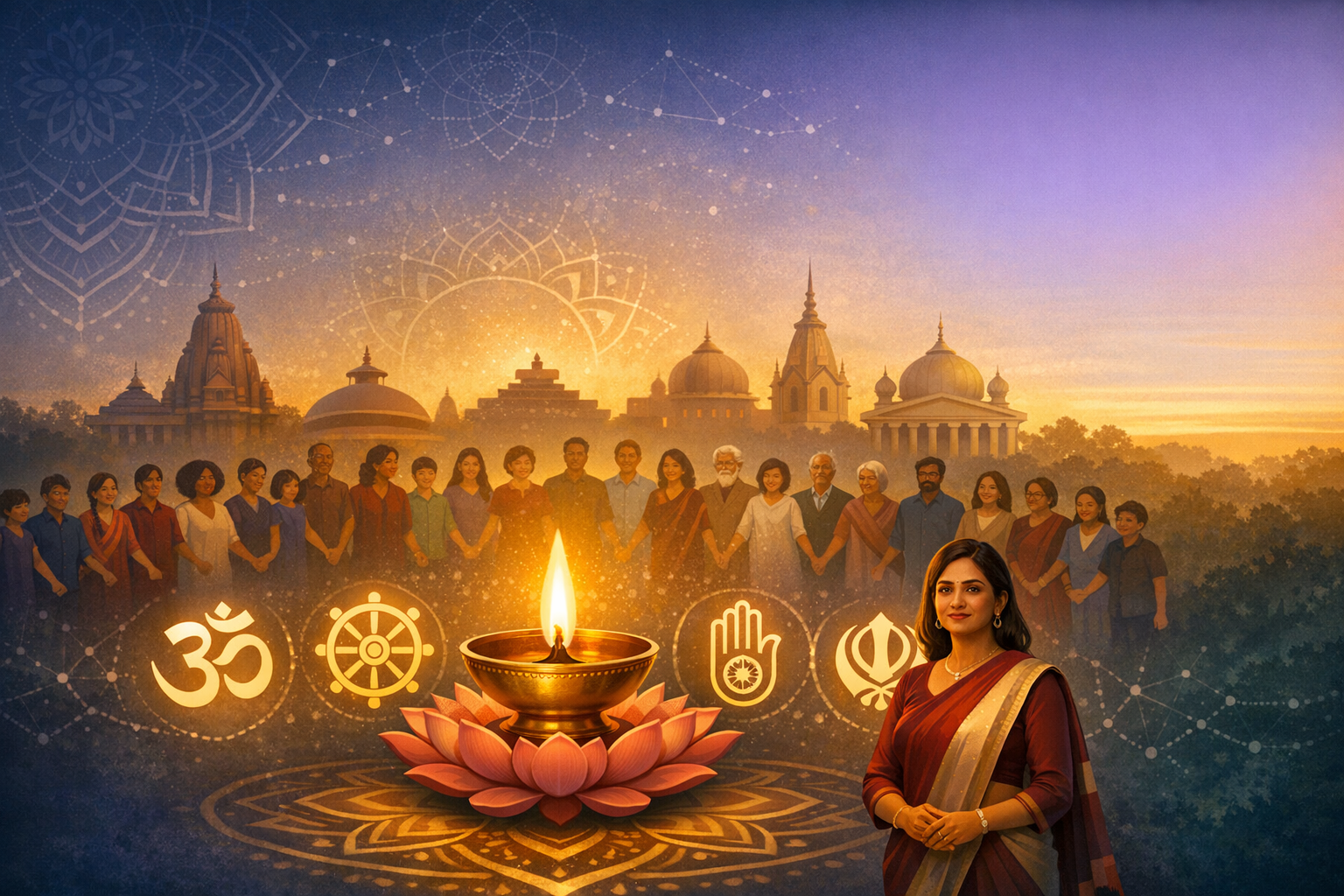
At the Grand Hindu Convention in Wing, Ku. Kranti Petkar of Hindu Janajagruti Samiti (HJS) issued a measured but urgent call: rekindle pride in Dharma, reinforce Hindu Unity, and remain vigilantpeacefully and lawfullyagainst challenges to society, culture, and sacred institutions. The appeal, while rooted in Sanatan Dharma, naturally extends to the wider family of dharmic traditionsHinduism, Buddhism, Jainism, and Sikhismwhose shared civilizational values can sustain India’s pluralism and constitutional freedoms.
Understood in a civilizational frame, Dharma is the ethical architecture that guides righteous action and social harmony. In Hindu thought it integrates personal conduct (svadharma), institutional responsibility (rajadharma), and universal welfare (lokasangraha). Its cognate ideals find resonance across the dharmic spectrum: ahimsa in Jainism, karuna in Buddhism, and seva in Sikhism. Petkar’s emphasis on awakening pride therefore aligns with a constructive ethosconfidence without chauvinism, resilience without aggression, and stewardship without exclusion.
Such pride must be calibrated by humility and mutual respect. In practical terms, this means rejecting zero-sum identity politics and affirming Vasudhaiva Kutumbakamthe world as one familyas a guiding paradigm. Responsible pride safeguards temples, viharas, derasars, and gurdwaras; champions equitable access and dignity; and nurtures social capital that binds neighborhoods during festivals, crises, and civic endeavors alike.
The contemporary landscape presents multi-layered risks to community cohesion: misinformation that corrodes trust, targeted intimidation and vandalism against places of worship, digital radicalization that exploits youth, and regulatory or administrative lapses that expose institutions to avoidable litigation and mismanagement. Responding effectively requires ethical Counterextremism grounded in law, data, and dialogueeschewing rumor, collective blame, or retaliatory rhetoric.
India’s Constitution offers a robust framework for religious freedom and institutional autonomy. Article 25 secures freedom of conscience and the right to profess, practice, and propagate religion; Article 26 protects the autonomy of religious denominations to manage their own affairs; Article 27 prohibits taxation that explicitly promotes a particular religion; and Article 28 regulates religious instruction in state institutions. Petkar’s call may thus be read as an invitation to deepen constitutional literacy and to deploy these guaranteescalmly and consistentlyto safeguard pluralism.
An ethical, whole-of-society approach to Counterextremism prioritizes the rule of law, non-violence, and transparent processes. Strategic priorities include: documenting incidents with verifiable evidence; liaising with law enforcement through formal channels; strengthening legal aid networks for vulnerable congregations; and investing in community resilience training that lowers the temperature of public discourse even amidst provocation.
Community safety can be enhanced without securitizing everyday life. Practical steps include volunteer marshals for major festivals, basic crowd-management and first-aid training, clear signage and evacuation routes at large gatherings, and neighborhood watch protocols co-designed with local authorities. For a temple volunteer or a gurdwara sevadar, such readiness transforms concern into competenceprotecting life, dignity, and devotion.
Digital hygiene is now indispensable. Communities benefit from simple verification protocols for viral content, rumor-control helplines during sensitive events, and open-source intelligence (OSINT) practices that respect privacy and law. Establishing a chain-of-custody for digital evidence, preserving metadata, and time-stamping eyewitness accounts add credibility when filing complaints or engaging the media. Equally vital is training youth to recognize manipulation patternsbots, deepfakes, and coordinated inauthentic behaviorthat can inflame tensions.
Inter-dharmic solidarity is a force multiplier. Joint sevalangar, annadanam, blood donation drives, and disaster-relief kitchensreduces prejudice through shared labor and shared meals. When Buddhist, Jain, Sikh, and Hindu groups coordinate environmental campaigns, skill-development programs, or women’s safety initiatives, they exemplify Unity in Diversity and model Religious tolerance in Hinduism as a living practice rather than a slogan.
Youth leadership thrives when paired with service-learning. Heritage stewardship projectsinscription documentation, oral-history archives, and campus study circles on itihasa and nitican be coupled with civic internships at legal-aid clinics or NGOs. Hackathons for heritage mapping, cyber-safety workshops, and debate clubs on Article 25–28 cultivate a generation that is rooted in tradition and fluent in constitutionalism.
Women’s leadership must be central, not supplemental. Frameworks that honor Shakti translate into mentoring networks for women trustees, safe-transport protocols for late-evening events, and equitable representation in decision-making bodies. In many towns, mothers’ collectives already anchor seva, mediation, and education; formal empowerment strengthens what daily life has proven.
Heritage governance benefits from professionalization. Periodic risk audits, finance and compliance reviews, volunteer background checks, and standard operating procedures (SOPs) for high-footfall events reduce both legal exposure and on-ground risk. Conservation plans should blend ritual needs with preservation sciencehumidity control, secure storage for manuscripts, and trained documentation for iconographyso that living worship and cultural safeguarding reinforce, rather than impede, each other.
Public discourse matures when it is fact-based and fair. A shared style guide can help community spokespeople avoid unverified claims, group generalizations, and incendiary adjectives. When criticisms arise, responding with verifiable data, citations to applicable law, and an even tone earns public trust. Over time, such discipline inoculates society against rumor cycles and performative outrage.
Metrics keep efforts honest. Communities can track: participation in civic-education workshops; the number and quality of incident reports filed; resolution rates of grievances; festival safety outcomes; and reductions in rumor-driven mobilizations. Transparent dashboardspublished quarterlygive congregants and neighbors confidence that concerns are heard and acted upon.
Economic inclusion and seva clarify priorities. Joint micro-scholarships for low-income students, health camps in underserved localities, and skill-building for youth and widows reduce the social vulnerabilities that extremists exploit. Seva reframes identity from what communities fear to what they contributequietly, tangibly, and consistently.
At its ethical core, the call to awaken is a call to character: Ahimsa in conduct, Satya in speech, Karuna in intent, Seva in action, and Shraddha in worship. When dignity governs method, even firm resistance to coercion remains anchored in compassion. This is not passivity; it is principled strength aligned with law and conscience.
Ku. Kranti Petkar’s message, heard through the wider dharmic lens, asks society to pair spiritual conviction with civic competence. Pride in Dharma should expand the circle of care, not narrow it; vigilance should defend constitutional freedoms for all, not erode them; and unity should empower institutions to protect the sacred while honoring neighbors of every faith. In choosing this path, communities do more than react to threatsthey model the civilizational confidence that sustains pluralism across generations.
Inspired by this post on Hindu Jagruti Samiti.
