Parāvartanawidely understood today as Ghar-Wapsievolved as a social and religious mechanism of voluntary return and reintegration within the broader dharmic society. As political powers changed across medieval and early-modern Hindustan, the practice became more complex, yet the underlying objective remained remarkably consistent: restoring dignity, safeguarding community cohesion, and aligning reconciliation with dharmic ethics shared across Hindu, Buddhist, Jain, and Sikh traditions.
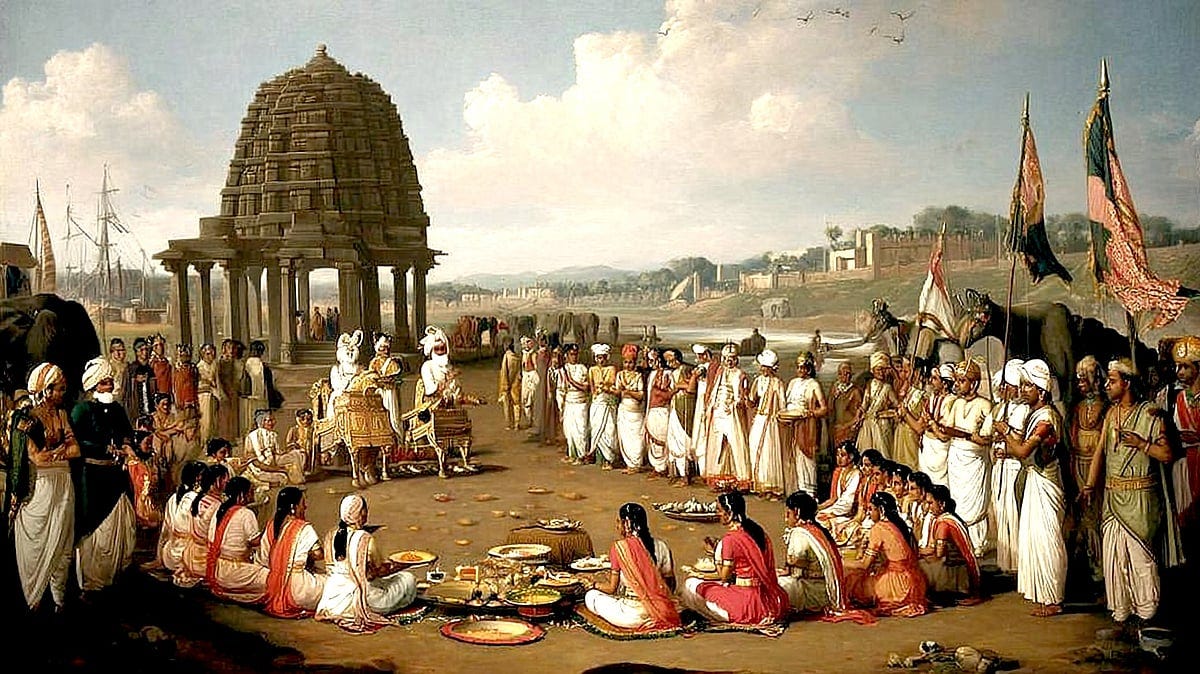
One early and significant instance emerged in the Vijayanagara Empire after the Bahmani–Vijayanagara conflict that concluded in 1398 CE. Historical records describe how the Bahmani ruler Tajuddin Firuz detained large numbers of local Hindus near Vijayanagara, enforced conversions, committed grave violations, and used hostages to compel a treaty with Harihara II. The settlement stipulated the payment of ten lakh honnu (gold coins) and secured the release of the captives. A mass Shuddhi ceremony then readmitted both men and women to Hindu society, an event that stands out for its scale and its emphasis on social rehabilitation.
This Vijayanagara episode illustrates how Parāvartana functioned not as coercion but as a communal pathway to reconcile trauma, restore social place, and affirm pluralistic values. Readers acquainted with dharmic traditions will recognize a recurring ethical thread: repair over retaliation, consent over compulsion, and the primacy of shared social order. In lived family memories and regional narratives, such reconciliation practices often endure as quiet, dignified examples of community-led healing.
A second notable case appeared in the Maratha Empire seeded by Chhatrapati Shivaji. Drawing on P.V. Kane’s scholarship, institutional mechanisms under the Ashta Pradhan created clear jurisdiction over religious matters through the Panditarao. Learned Brahmanas from Paithan, Nasik, and Karad, and, on occasion, holders of the gadi of Sankaracharya at Sankeshwara and Karavira, were consulted on complex questionsespecially the restoration of those forcibly converted. With collective deliberation, the Panditarao issued prayascitta that enabled return to one’s caste and community, embedding Parāvartana within due process and social consensus.
The Maratha framework reveals a structured approach that combined scriptural reasoning, administrative accountability, and community approval. For many contemporary readers, this resonates with familiar experiences of local councils, family elders, and temple institutions working together to resolve sensitive matters with both compassion and procedural clarity. It shows how governance and dharmic duty can complement each other to sustain social trust.
The next expansive movement of Shuddhi unfolded under Swami Dayananda Saraswati and the Arya Samaj. In challenging circumstances, Arya Samaj initiatives pursued education, social service, and Parāvartana as pathways to cultural renewal. Swami Shraddhananda’s mass Shuddhi campaigns gained prominence across northern India, demonstrating both organizational reach and a strong emphasis on voluntary return and social reintegration. His assassination in 1926 profoundly shocked the public and underscored the risks faced by those engaged in sensitive work at the intersection of faith, identity, and community reform.
Reformers, thinkers, and later commentatorsamong them Sita Ram Goelhave emphasized the Arya Samaj’s pivotal cultural role in revitalizing confidence and ethical clarity within society. Their reflections highlight how Shuddhi, when framed as return by choice and supported by education and service, can strengthen pluralism and social harmony within the dharmic family.
Debate around the period also included Mohandas Gandhi’s advocacy of clemency for Abdul Rashid, the assassin of Swami Shraddhananda. Historians differ on the implications: critics contend that such positions discouraged ongoing Shuddhi efforts, while others view them as attempts to prevent communal escalation. The scholarly consensus acknowledges that the episode shaped perceptions of risk and restraint, while work anchored in education, service, and consent continued in various forms.
Across these epochsfrom Vijayanagara and Maratha models to modern reform movementsthe throughline is clear. Parāvartana and Shuddhi aimed at restoring individuals to their social networks without coercion, affirming the dharmic ethos of dignity, compassion, and responsibility. When understood in a pan-dharmic spirit, these practices parallel reconciliation ideals found across Hindu, Buddhist, Jain, and Sikh traditions, and remain relevant to contemporary conversations on identity, inclusion, and cultural continuity.
Subsequent analyses will explore recent instances of Parāvartana expressed through education, community service, legal aid, and heritage preservationfields where dharmic institutions and volunteers continue to translate timeless principles into practical, people-centered outcomes.
Inspired by this post on Dharma Dispatch.