
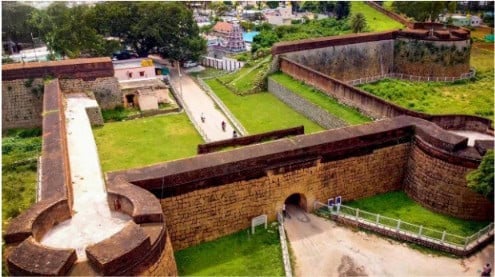
Devanahalli, often treated merely as an outer settlement of Bengaluru because of its proximity to Kempegowda International Airport and the expanding urban corridor, deserves a far more serious place in discussions of Karnataka’s historical and sacred geography. Its fort walls, temple clusters, inscriptions, kalyanis, and living ritual traditions reveal a layered civilizational landscape shaped by the Vijayanagara Empire, the Avati Nadaprabhus, the Kingdom of Mysore, Hyder Ali, Tipu Sultan, and the British East India Company. What may first appear to be a peripheral town gradually discloses itself as a compact archive of South Indian history, Hindu temple culture, military architecture, and community memory.
The first striking marker of this heritage is the Sri Krishna Dvāra near the old bus stand. Its visual presence is not merely decorative; it establishes the town’s Vaishnava devotional vocabulary before one even reaches the temple precincts. The depictions of multiple avatāras of Mahavishnu transform a public gateway into a theological threshold. In a region increasingly associated with real estate, transport, and airport-led development, such a structure quietly reminds the visitor that Devanahalli’s cultural identity was not created by modern expansion. It belongs to a much older sacred and political geography.
The road leading inward from the old bus stand functions almost like a narrative corridor. Everyday market life, vegetable vendors, school buildings, modest homes, and small shrines exist in close proximity. This is important because Devanahalli’s heritage is not isolated inside a museum-like enclosure. A small Anjaneya Temple, a Devi shrine, and the Kanyakaparameshwari Temple appear within the rhythm of daily life. Their scale may be modest, but their placement demonstrates how Hindu temples in South India often serve as neighborhood anchors, social markers, and repositories of inherited memory.
The sudden appearance of the fort wall marks a transition from ordinary settlement to historical discovery. Devanahalli Fort is protected by the Archaeological Survey of India, yet it remains embedded within a living town. This coexistence of habitation and monument raises an important question for heritage studies: how should a community inhabit a historically significant space without reducing it to either a tourist object or a neglected ruin? Devanahalli offers one answer. Its fort survives not as a detached relic, but as part of a lived environment where temples, homes, processions, roads, and memories continue to interact.
The Historical Arc of Devanahalli Fort
The history of Devanahalli Fort is generally traced to 1501 CE, when Malla Baire Gowda, associated with the Avati Nadaprabhus and operating within the broader political world of the Vijayanagara Empire, established it as a mud fortification. The early fort was not merely a defensive wall; it was a statement of local authority, agrarian administration, and strategic control. The settlement then known as Devanapura developed within a network of fortified towns that connected local chieftains, temple institutions, land grants, and regional military obligations.
As Vijayanagara power weakened after the sixteenth century, Devanahalli passed through changing political hands. The fort later came under the Kingdom of Mysore and then under Hyder Ali, who is associated with rebuilding the fort in stone and giving much of its current physical form. This shift from mud to stone is architecturally significant. It indicates a change in military technology, administrative investment, and the strategic importance of the site. The fort’s later association with Tipu Sultan, whose birthplace lies nearby, adds another layer to its importance in the history of Mysore and the Anglo-Mysore Wars.
In 1791, during the Third Anglo-Mysore War, British forces under Lord Cornwallis captured Devanahalli Fort. This event placed the town within the larger military contest between Mysore and the British East India Company. Yet the fort’s deeper significance cannot be limited to colonial military history. Its walls preserve memories of local chieftaincy, Vijayanagara-era patterns of governance, Mysorean state formation, temple patronage, and the everyday life of communities who continued to live around the fort long after dynasties changed.
Venugopalaswamy Temple: A Sacred Core Inside the Fort
Within the fort precinct stands the Sri Rukmini–Satyabhama Sametha Venugopalaswamy Temple, one of Devanahalli’s most important sacred structures. The temple is significant not only because it is active as a place of worship, but also because it condenses multiple architectural and historical traditions. Its layout includes a prakara, navaranga, mukhamantapa, and garbhagriha, reflecting the grammar of South Indian temple architecture. The shrine enshrines Sri Venugopalaswamy, the flute-bearing form of Krishna, along with Rukmini and Satyabhama, thus placing the temple firmly within Vaishnava bhakti traditions.
The temple’s architectural vocabulary reflects a synthesis of regional styles. Its iconography bears the stamp of the Vijayanagara period, while its shikhara follows the broader Dravidian idiom. The tall Rayagopuram, flanked by two statues of Lord Vishnu believed by local tradition to be connected with the Ganga period, creates a powerful visual introduction to the temple. The outer stone walls include narrative friezes from the Ramayana, especially scenes associated with the Balakanda. These carvings are not merely ornamental; they function as stone narratives through which sacred history becomes publicly visible.
The comparison sometimes made between this temple and the larger complexes of Belur and Halebidu should be understood carefully. Devanahalli’s Venugopalaswamy Temple does not match those Hoysala monuments in scale, but it does share a commitment to detailed carving, sculptural density, and devotional refinement. Its pillars, frescoes, stucco niches, and wall programs reveal a high degree of craftsmanship. The result is a temple that rewards slow observation. Its artistry is not overwhelming in size; it is compelling in detail.
The annual observances during Chaitra Poornima show that the temple is not only an archaeological site, but also a living institution. Ritual cleaning, maintenance, offerings, and festival activity sustain the relationship between deity, devotee, and locality. This continuity matters because many historical temples survive physically while losing active ritual life. In Devanahalli, the sacred structure remains tied to community participation, devotional responsibility, and inherited practice.
The Donation Inscription and the Memory of Devanapura
One of the most valuable historical sources within the Venugopalaswamy Temple is its donation inscription, or Dana Shasana. This inscription preserves the older name Devanapura and provides crucial evidence for the political and religious life of the region. It records that Sannabairegowda of the Avati Nadaprabhus initiated governance of the Devanapura kingdom in 1501 CE, and that the ruling line continued until the period of Chikkappagowda in 1749 CE. Such inscriptions are indispensable for reconstructing regional history because they connect genealogy, administration, religious endowment, and social obligation in one textual record.
The inscription refers to Gopalagowda of the Kashyapa Gotra, son of Immadi Sonnabhairegowda and Kempamma, and grandson of Muddubhairegowda, as the ruler associated with the grant. It states that the ruler’s ancestors had established the temple at the center of the fortified town. This detail is especially important because it shows that the temple was not peripheral to political life. It occupied a central position within the fort, suggesting that sacred authority and administrative authority were closely interwoven in the organization of Devanapura.
The grant was made in Shaka 1619, during Ishwara Nama Samvatsara, on Magha Shuddha 15. Its purpose was to sustain regular worship and festival cycles, including Nityotsava, Pakshotsava, Masotsava, Samvatsarotsava, and Rathotsava. This range of observances demonstrates the complexity of temple management. A temple required land, oil, agricultural produce, priests, attendants, ornaments, processional equipment, food distribution systems, and administrative oversight. The inscription therefore reveals the temple as a sophisticated institution, not merely a devotional site.
The endowments listed in the inscription include villages such as Moluru and Madduru in Vadigenahalli Hobli, as well as grants connected with Somattanahalli Hobli, Arahalli village, Hosakere, and Kempamma’s garden. Savakanahalli was assigned to the Chatripalakiyaru, female attendants associated with ceremonial umbrellas in temple processions. The allocation of agricultural produce from Baichapura villages further indicates how temple economies were integrated with agrarian revenue systems. Surplus income, after ritual and administrative expenses, was to be used for ornaments for the deity.
The inscription also mandates the supply of oil for temple lamps from royal storehouses, and, if required, from the palace itself. Such provisions show that ritual continuity was treated as a royal responsibility. The reference to daily Annaprasada distribution is equally significant. It confirms that the temple functioned as a social institution serving devotees, pilgrims, and the local community. In this sense, Devanahalli’s temple culture belongs to the wider Dharmic pattern in which worship, charity, food distribution, community gathering, and public welfare were inseparable.
The concluding warning in the inscription, addressed across social categories including Brahmin, Kshatriya, Vaishya, and Shudra, reflects a common medieval South Indian epigraphic practice. Such clauses were designed to protect religious endowments across generations by attaching moral and spiritual consequence to their violation. Read historically, the clause is not merely punitive. It expresses a worldview in which temple property, ritual continuity, and lineage duty formed a shared ethical order.
Nanjundeshwara Temple and Shaiva Continuity
To the right of the Venugopalaswamy Temple stands the Nanjundeshwara Temple, locally regarded as one of Devanahalli’s older shrines. Its presiding deity, Sri Nanjundeshwara Swamy, is worshipped in the form of a Shiva Linga. Local traditions suggest possible Vijayanagara-period origins, though some claims remain difficult to verify through inscriptions or firm archaeological evidence. This distinction is important. Academic treatment of sacred sites must respect local memory while also identifying where historical proof is available and where tradition remains oral.
The temple’s devotional traditions include the belief that the yoni pedestal of the Shiva Linga once rotated, though it no longer does so, possibly due to age, structural wear, or neglect. Another local belief associates the nearby image of Goddess Parvathi with a living presence, with devotees maintaining that her breath may be felt near the nose of the image. Such accounts cannot be treated as archaeological data, but they are valuable as religious anthropology. They reveal how devotees experience sacred presence, continuity, and intimacy with the deity.
The proximity of Vaishnava and Shaiva shrines within the fort area is especially meaningful for a Dharmic understanding of heritage. Devanahalli does not present Hindu practice as a rigidly divided field. Krishna, Vishnu, Hanuman, Shiva, Parvathi, Devi, village deities, and matha traditions coexist within a compact landscape. This shared sacred geography reflects a broader Hindu pattern in which diverse sampradayas and devotional forms sustain a unified civilizational ethos while preserving distinct ritual identities.
A Sacred Cluster Beyond a Single Temple
The wider fort area includes the Marigudi Temple dedicated to the village deity, Raghavendra Swamy Matha, Siddhalingeshwara Swamy Temple, Chandramoulishwara Swamy Temple, and multiple Hanuman shrines. This density of sacred sites suggests that Devanahalli functioned as more than a defensive settlement. It was a ritual landscape in which different deities, communities, and institutions contributed to local identity. The repeated presence of Hanuman temples is particularly notable because Hanuman worship is often associated with strength, protection, devotion, and martial courage.
Behind the fort, one encounters another Hanuman temple near a lake, along with the Sarovara Kalyani Anjaneya Swamy Temple and its substantial temple tank. Even when dry, a kalyani carries historical meaning. Temple tanks were not incidental architectural additions; they supported ritual purification, festival activity, water management, and community gathering. Their scale often reveals the resources and planning once invested in the site. The absence of inscriptions may leave the precise age uncertain, but the architectural presence of the tank itself points to a significant past.
The nearby birthplace of Tipu Sultan, located only a short distance from this sacred cluster, intensifies the historical complexity of Devanahalli. The area brings together fortification, royal memory, temple worship, agrarian endowment, colonial conflict, and living community practice within a very small radius. Such proximity is a reminder that Indian history is rarely linear. It is layered, contested, devotional, political, and local at the same time.
Why Devanahalli Matters Today
Devanahalli matters because it challenges the habit of viewing heritage only through famous capitals and monumental pilgrimage centers. It shows how smaller towns preserve essential evidence of civilizational continuity. The fort records military and political history. The temples preserve ritual and artistic traditions. The inscriptions document land grants, temple finance, social obligations, and royal patronage. The kalyanis point to older systems of water, worship, and public space. The living festivals show that sacred memory has not been reduced to archaeology alone.
For Karnataka’s cultural history, Devanahalli is a reminder that Bengaluru’s surrounding regions are not empty suburbs waiting to be modernized. They are historically dense landscapes whose older identities continue beneath new roads, institutions, and economic corridors. The emotional pull of such a place lies precisely in this contrast. Amid markets, buses, schools, and houses, one suddenly meets a fort wall, a gopura, a temple inscription, or a dry kalyani that reopens five centuries of memory.
For Hindu heritage studies, Devanahalli offers an instructive case of sacred pluralism within a shared Dharmic framework. Vaishnava, Shaiva, Shakta, Hanuman, and matha traditions do not appear as isolated fragments. They form a mutually reinforcing sacred ecology. This is the cultural strength of many historic Indian towns: diversity does not erase unity, and unity does not flatten diversity. The result is a living civilizational pattern in which different forms of worship remain connected through locality, memory, ritual, and Dharma.
Devanahalli Fort and its temple cluster therefore deserve careful documentation, conservation, and public awareness. The site should be approached not only as a historical monument but as a living heritage zone. Responsible preservation would require attention to the fort walls, inscriptions, temple sculptures, ritual practices, water structures, local oral histories, and the needs of residents who inhabit the area. Academic study, community stewardship, and sensitive tourism can work together when the place is understood in its full complexity.
Ultimately, Devanahalli is not simply a town near Bengaluru. It is Devanapura remembered through stone, worship, inscription, and community life. Its fort speaks of power and conflict. Its temples speak of devotion and continuity. Its inscriptions speak of governance and public welfare. Its streets speak of ordinary people living within extraordinary history. To walk through Devanahalli is to recognize that India’s civilizational inheritance often survives most powerfully in places that modern narratives too quickly overlook.
Source reference: Indica Today, “Devanahalli: A Timeless Confluence of Fort, Temples and Untold History,” July 04, 2026.
Inspired by this post on Hindu Post.








Leave a Reply
You must be logged in to post a comment.