
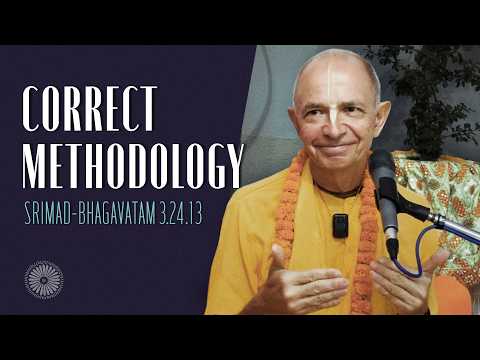

Śrīmad-Bhāgavatam 3.24.13 presents a compact but demanding teaching on correct spiritual methodology. The verse, spoken within the narrative of Kardama Muni, Devahūti, and the divine appearance of Kapila, focuses on the discipline of receiving instruction with humility. Its Sanskrit reads: etāvaty eva śuśrūṣā kāryā pitari putrakaiḥ bāḍham ity anumanyeta gauraveṇa guror vacaḥ. The traditional translation explains that a son should render service to the father to this extent: one should accept the command of the father or spiritual master with respectful assent.
The subject is not merely family etiquette. In the Bhāgavata framework, the relationship between father, guru, disciple, and seeker becomes a technical model for the transmission of transformative knowledge. The verse teaches that spiritual knowledge is not acquired by casual curiosity alone, nor by intellectual display, nor by selective agreement with teachings that already flatter the ego. It is received through śuśrūṣā, a term that implies attentive service, disciplined listening, willingness to learn, and a sincere disposition toward guidance.
This is why the phrase “correct methodology” is so important. A spiritual conclusion in the Dharmic traditions is never separated from the means by which it is approached. Hindu, Buddhist, Jain, and Sikh traditions all preserve disciplined methods of learning: listening, reflection, ethical restraint, practice, humility before realized teachers, and verification through lived transformation. The Bhāgavata adds a distinctly bhakti-centered emphasis: knowledge ripens when the heart becomes receptive through service, reverence, and surrender to truth.
At first glance, the verse may sound severe to a modern reader because it speaks of obedience. Yet the deeper principle is not blind authoritarianism. The spiritual master is not honored as a social controller but as a transparent medium of śāstra, paramparā, and divine wisdom. Correct obedience in this setting means aligning oneself with a disciplined path that has already been tested by realized practitioners. It is the humility to accept that the conditioned mind often resists precisely the instruction that can liberate it.
The Bhāgavata’s use of pitari and guroḥ also carries theological significance. The biological father gives the first birth, while the guru gives the second birth through knowledge and spiritual orientation. This idea connects with the broader Vedic concept of dvija, the twice-born person, whose second birth is not biological but educational and spiritual. The point is not social pride; it is responsibility. A genuine second birth requires discipline, purification, and the willingness to be reshaped by higher instruction.
In the context of Kapila’s appearance, this instruction becomes even more meaningful. Kapila is revered in the Bhāgavata as an avatāra who teaches sāṅkhya in a theistic and devotional form. His teachings to Devahūti later clarify the distinction between matter and consciousness, the bondage created by attachment, and the liberating power of devotion. Śrīmad-Bhāgavatam 3.24.13 therefore prepares the reader for a larger methodological lesson: one cannot understand subtle truth while remaining dominated by pride, argumentativeness, and self-centered independence.
Academic study can explain the grammar of the verse, its narrative placement, and its doctrinal vocabulary. Such study is valuable. Yet the Bhāgavata insists that sacred knowledge also has an existential condition. A person may know the words guru, śuśrūṣā, śāstra, and bhakti, but still miss their force if the heart remains closed. The text is concerned with a form of knowledge that changes conduct, softens ego, and establishes a life of service.
This principle is especially relevant in an age of rapid information. Modern seekers often encounter fragments of Hindu philosophy, Yoga, Vedānta, Buddhism, Jain ethics, Sikh devotion, and other Dharmic teachings through short videos, quotations, and social media summaries. Such access can be beneficial, but it can also create the illusion that spiritual knowledge is simply content to be consumed. Śrīmad-Bhāgavatam 3.24.13 challenges that assumption. It teaches that sacred learning requires a proper relationship with knowledge, not merely exposure to information.
The emotional power of this teaching lies in its realism. Most people know from ordinary life that meaningful growth often begins when resistance gives way to trust. A student improves when willing to be corrected. A musician advances by submitting to disciplined practice. A patient benefits by following a competent physician’s treatment. In a similar way, the spiritual aspirant progresses when guidance is received not as an insult to autonomy but as an invitation to become free from deeper forms of bondage.
Still, the Bhāgavata’s teaching must be read with care. Reverence for the guru is never a license for exploitation, manipulation, or abandonment of dharma. A genuine guru is recognized by fidelity to śāstra, self-control, compassion, humility, and the capacity to guide others toward God-realization rather than personal dependence. The disciple’s “yes” is not a surrender to whim; it is a surrender to truth as transmitted through a trustworthy spiritual lineage.
This distinction protects the unity and dignity of Dharmic traditions. Hinduism’s guru-śiṣya paramparā, Buddhism’s teacher-disciple discipline, Jainism’s reverence for tīrthaṅkaras and ācāryas, and Sikhism’s devotion to Guru Granth Sahib and the Guru’s path all affirm that spiritual life requires guidance, humility, and ethical seriousness. Their methods differ, but they converge on a shared insight: the ego cannot be its own final authority in the search for liberation.
The word gauraveṇa, “with due deference,” is therefore crucial. It does not describe mechanical compliance. It describes the inner posture of respect. In Sanskritic learning, reverence is epistemological; it affects what can be known. A hostile or cynical mind may collect data, but it struggles to receive wisdom. A reverent mind is not uncritical in the shallow sense; rather, it is disciplined enough to distinguish sincere inquiry from egoistic objection.
Correct methodology begins with hearing. In bhakti traditions this is śravaṇam, the first of the nine processes of devotional practice. Hearing is not passive. It requires attention, moral preparation, and the willingness to let the text question the listener. When Śrīmad-Bhāgavatam is heard in this mood, the scripture does not remain a distant ancient work. It becomes a mirror in which the seeker sees pride, distraction, longing, dependence, and the possibility of divine relationship.
The second movement is service. Śuśrūṣā is related to the desire to hear and serve. This is a profound feature of Bhakti Yoga: service is not an external add-on to knowledge; it is part of how knowledge becomes real. Service trains the senses, purifies intention, reduces self-absorption, and makes the practitioner capable of receiving subtler instruction. Without service, knowledge easily becomes a possession of the ego. With service, knowledge becomes a path of transformation.
The third movement is assimilation. The disciple does not merely repeat the guru’s words; the disciple lives them. The command of the guru becomes “life and soul” because it reorganizes priorities. Time, speech, relationships, study, worship, and ethical choices begin to move around a higher center. In the Bhāgavata vision, this center is Bhagavān, the Supreme Person, approached through devotion, remembrance, humility, and loving service.
Rishikesh, the setting indicated in the video title, adds another layer of meaning. Traditionally associated with tapas, pilgrimage, the Ganga, Yoga, and renunciation, Rishikesh symbolizes the movement from worldly noise toward disciplined spiritual inquiry. A teaching on methodology delivered in such a place naturally invites reflection on how sacred geography can support sacred practice. The place itself does not replace inner discipline, but it can intensify the seriousness with which one hears.
Bhakti Vijnana Goswami’s treatment of this verse, as suggested by the title, points toward a central concern in devotional education: how should one approach śāstra so that the result is realization rather than argument? The answer is not anti-intellectual. Vaiṣṇava traditions have produced rigorous commentaries, philosophical debates, grammatical analysis, and systematic theology. Yet their intellectual culture is anchored in devotion. Reason functions best when purified by humility and guided by the goal of service.
This balance matters for contemporary Hindu studies and spiritual practice. A purely sentimental approach can become vague and unstable. A purely academic approach can become detached from transformation. A purely rebellious approach may mistake resistance for insight. The Bhāgavata proposes another path: disciplined inquiry within a living tradition, guided by guru, śāstra, and sādhana. This is a methodology in which knowledge, character, and devotion grow together.
The verse also speaks to family life. When it mentions the father, it recognizes the sacred responsibility of parenthood and the duty of gratitude. In Dharmic culture, parents are not merely private individuals; they are the first teachers of language, conduct, discipline, reverence, and belonging. Yet this principle is strongest when parental authority itself serves dharma. The ideal is not domination within the family, but a culture in which elders guide with integrity and younger generations respond with respect.
For seekers navigating modern life, this teaching can be applied practically. It encourages careful selection of teachers, serious study of scripture, regular practice, respect for lineage, and honest self-examination. It also asks practitioners to notice how often the mind resists guidance through defensiveness, comparison, and selective hearing. The real test of learning is not whether a teaching sounds impressive, but whether it produces humility, steadiness, compassion, and deeper remembrance of the Divine.
In this sense, Śrīmad-Bhāgavatam 3.24.13 is not a narrow instruction about obedience. It is a technical statement about receptivity. Spiritual knowledge descends through a relationship of trust, service, and disciplined hearing. The guru’s instruction becomes effective when the disciple receives it with reverence and then embodies it through practice. This is why the verse remains powerful: it identifies the inner condition required for sacred knowledge to become living wisdom.
The broader lesson is both demanding and compassionate. The ego wants methods that leave it untouched; the Bhāgavata offers a method that heals by transforming the ego at its root. Correct methodology means approaching truth with humility, honoring those who carry wisdom, testing teachings through dharmic conduct, and allowing devotion to mature into realization. In a fragmented age, this message offers a disciplined path toward unity, depth, and spiritual clarity.
Inspired by this post on Dandavats.










Leave a Reply
You must be logged in to post a comment.