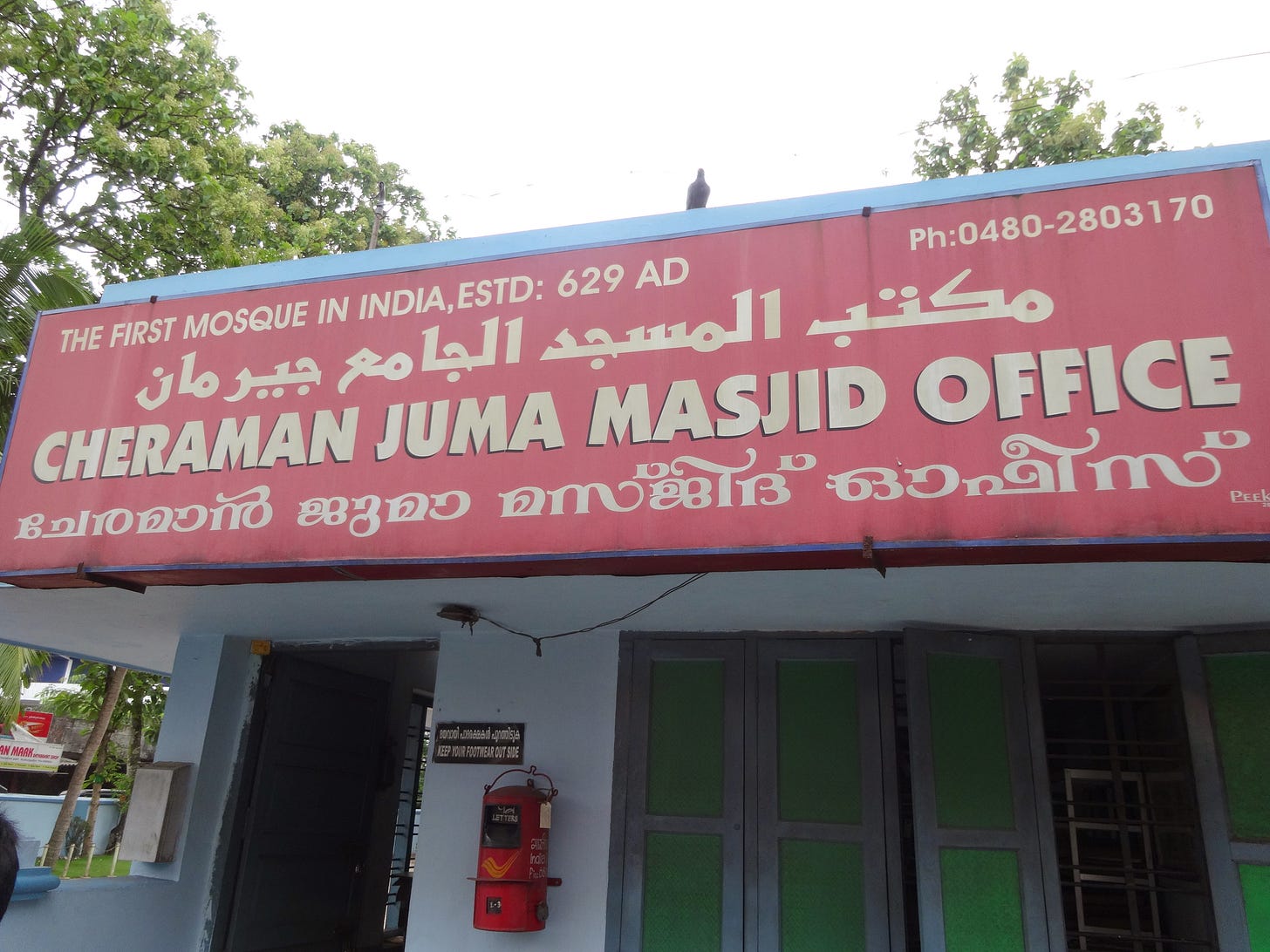
Outside the Cheraman Perumal Juma Masjid near present-day Kodungallur in Kerala stands a board asserting that the mosque was founded during the lifetime of Prophet Muhammad. If accepted at face value, this would place the site among the earliest mosques outside the Arabian Peninsula and Chinaearlier than those in Iraq (639 CE), Egypt (642 CE), Tunisia (670 CE), and Syria (715 CE). Such a claim raises three intertwined questions central to Kerala history: why a mosque arose so far from the deserts where Islam first spread, who was responsible for its establishment, and whether the date asserted can withstand historical scrutiny.
A well-known Kerala legend provides a dramatic origin story. A Cheraman PerumalPerumal being a title, not a personal nameobserved the moon splitting and rejoining while standing on his palace balcony. After consultation with astrologers, visitors from Arabia informed him that the miracle was associated with Prophet Muhammad and a new faith. The king then abdicated, divided the realm, sailed to meet the Prophet in Mecca, embraced Islam, and died on the journey back. Tradition holds that his companions later reached Cranganore (Kodungallur) and established early mosques, including those at Kodungallur, Kollam (north, not Quilon), Maravi (Matayi), Fakanur, Manjarur (Mangalore), Kanjirakuttu (Kasargode), Jarfattan (Karippat), Dahfattan (Dharmatam), Fandarina (Pantalayani Kollam), and Caliyath (Chaliyam near Beypore).
The term Cheraman denoted the Chera dynasty, and Perumal meant “the great one.” According to Keralolpathi (Origins of Kerala), compiled in the 17th or 18th century, Kerala’s 64 settlements agreedfollowing 9th-century conflictsto invite Perumals from outside Kerala, each to reign for twelve years, with certain notable exceptions. One such exception anchors the chronology of this story.
The first analytical question is one of historicity. Elements of the narrative appear in Muslim accounts such as that of Sheikh Zeinuddin and in the Brahminical Keralolpathi. Portuguese and Dutch writers repeatedly retold it, and court chronicles in Calicut and Cochin begin with this theme. Epigraphic evidenceparticularly a Chola inscription noting that the Cheras “took to the sea” after attackhas been read to allude to the Perumal’s maritime departure. There are even Arabian references to a Malabar ruler who adopted Islam and was buried on the Arabian coast. A cautious synthesis suggests a Malabar notable did embrace Islam and depart by sea; the more difficult question is when.
The earliest European record appears in 1510 CE from Duarte Barbosa, a deeply informed observer of Kerala’s society and trade. He recounts that some 600 years before his time, a powerful lordChirimay (Cheraman) Perumalwas engaged by Muslim merchants (“Moors”), embraced Islam, and journeyed to Mecca, after which he was not seen again in Malabar. Barbosa adds that the once-unified kingdom was partitioned into Cannanore, Calicut, and Quilon, with Calicut holding coinage rights. Crucially, Barbosa places the episode roughly 600 years earlier, not 875 years, thereby locating it closer to the 9th–10th centuries rather than the Prophet’s lifetime.
Roughly eight decades later, Sheikh Zeinuddin, a Malayali Muslim with Arab ancestry, offered a convergent yet refined account. He narrates that Arab Muslims bound for Adam’s Peak in Ceylon stopped at Cranganore, held a dialogue with the Cheraman Perumal, andafter a discreet departurethe king sailed with them. Zeinuddin emphasizes that the ruler governed lands from Kasargod to Kanya Kumari and, most importantly, dates the episode two centuries after the Prophet, reinforcing a post-7th-century timeframe.
In 1610 CE, Joas de Barros (with Diogo do Couto completing the work) presented another version. Here, a great kingSarama/Sarama Perumalclosely engaged with Muslim traders, accepted Islam, divided his dominions, and proceeded to Mecca. Do Couto then introduces a striking variant: the Perumal’s close association with the St. Thomas Christians of Kodungallur and a claim that he accepted Christianity and died at the house of the Apostle St. Thomas in Mylapore, contradicting the Mecca voyage. The divergence reflects the era’s mercantile and political competition along the Malabar coast and the narrative adaptations that often accompany it.

Further retellings followed. In 1723, the Dutch chaplain Canter Visscher wrote that the king traveled either to the Ganges in fulfillment of a vow or, as the Moors maintained, to visit the Prophet in Arabia and embrace his faithindicating that multiple theories coexisted. The narrative recurs in the accounts of Dutch Commander Van Adriaan Moens (1781 CE), Francis Buchanan (1801 CE), Keralolpathi, and Granthavari, underscoring its deep embedment in Kerala’s cultural memory.
Despite political inflections and minor variations, Muslim and Portuguese strands share a core claim: a Kerala ruler undertook a voyage to Arabia. Yet they do not support the assertion that the event occurred during the Prophet’s lifetime. Epigraphy helps anchor a later date. An inscription of Vikrama Chola from 1122 CE notes that while the Pandyas “took to the Ghats,” the Cheras “took to the sea.” Historians interpret this as the last Chera PerumalRama Kulasekharadeparting by sea. A temple record from the same year mentions a garland offered for the benefit of Cheramar Rama, confirming that he was alive in 1122 CE.
Traditions further hold that the Perumal who reached Arabia sent envoys to Kerala, who founded ten mosques, including the one at Matayi. An inscription at the Matayi mosque dates it to 1124 CEtwo years after Cheraman Rama Kulasekhara’s disappearance. The names of contemporary rulers connected with the last PerumalUdaya Varman of Koluttunadu and Kavi Alupendra of the Tulu countryalso align, via inscriptions, with the early-to-mid 12th century, supporting a 12th-century horizon for these developments.

Arabian evidence provides yet another layer. In 1882, William Logan recorded that, around 1867, a man arrived from Arabia seeking funds to repair a mosque and tomb at Zafar. The tomb bore an inscription naming Abdul Rahman al-Samiri, a king of Malabar, arriving in 212 AH (827–828 CE). The title al-Samiri resembles Samuthiri (Zamorin), but no record confirms a Zamorin traveling abroad and converting. This datum may represent a different Malabar dignitary or a parallel strand of memory that has interlaced with the Perumal story over time.
Placing these strands within Kerala’s political economy clarifies the pressures of the era. Under sustained Chola and Pandya attacks from north and south, the Chera regime depended on alliances with Jewish, Muslim, and Christian trading networks for revenue, security, and maritime leveragearrangements that could unsettle established elites and temple bureaucracies. As multiple regions asserted autonomy, partition likely formalized an emergent decentralization. In this light, the Perumal’s departure becomes a symbolic shorthand for the disintegration of centralized rule and the birth of successor polities along the Malabar coast.
The Brahminical narrative in Keralolpathi supplies motives in the register of moral order. It notes the Perumal’s concern at having exceeded the customary twelve-year reign (having ruled for thirty-six years) over land consecrated as a gift of Parasurama. It also records remorse over ordering the execution of a supreme commander based on a woman’s words. In such tellings, a spiritual journeyincluding conversionfunctions as expiation, reflecting the era’s belief in moral causality and the quest for dharmic balance.
As historiography intersects with inscriptional anchors and layered oral traditions, two chronological windows emerge: a 9th-century horizon (echoed by Barbosa’s “600 years earlier” and the Zafar tomb date) and a 12th-century horizon (tightened by the 1122 CE Vikrama Chola inscription, the 1124 CE Matayi mosque inscription, and the reign of Rama Kulasekhara). The cumulative weight of epigraphy leans toward a 12th-century institutionalization of mosques and polity transition, while earlier memories may reflect precursor contacts or a different Malabar dignitary’s journey. Either way, the claim that the Kodungallur mosque arose during the Prophet’s lifetime finds little support in the convergent evidence.
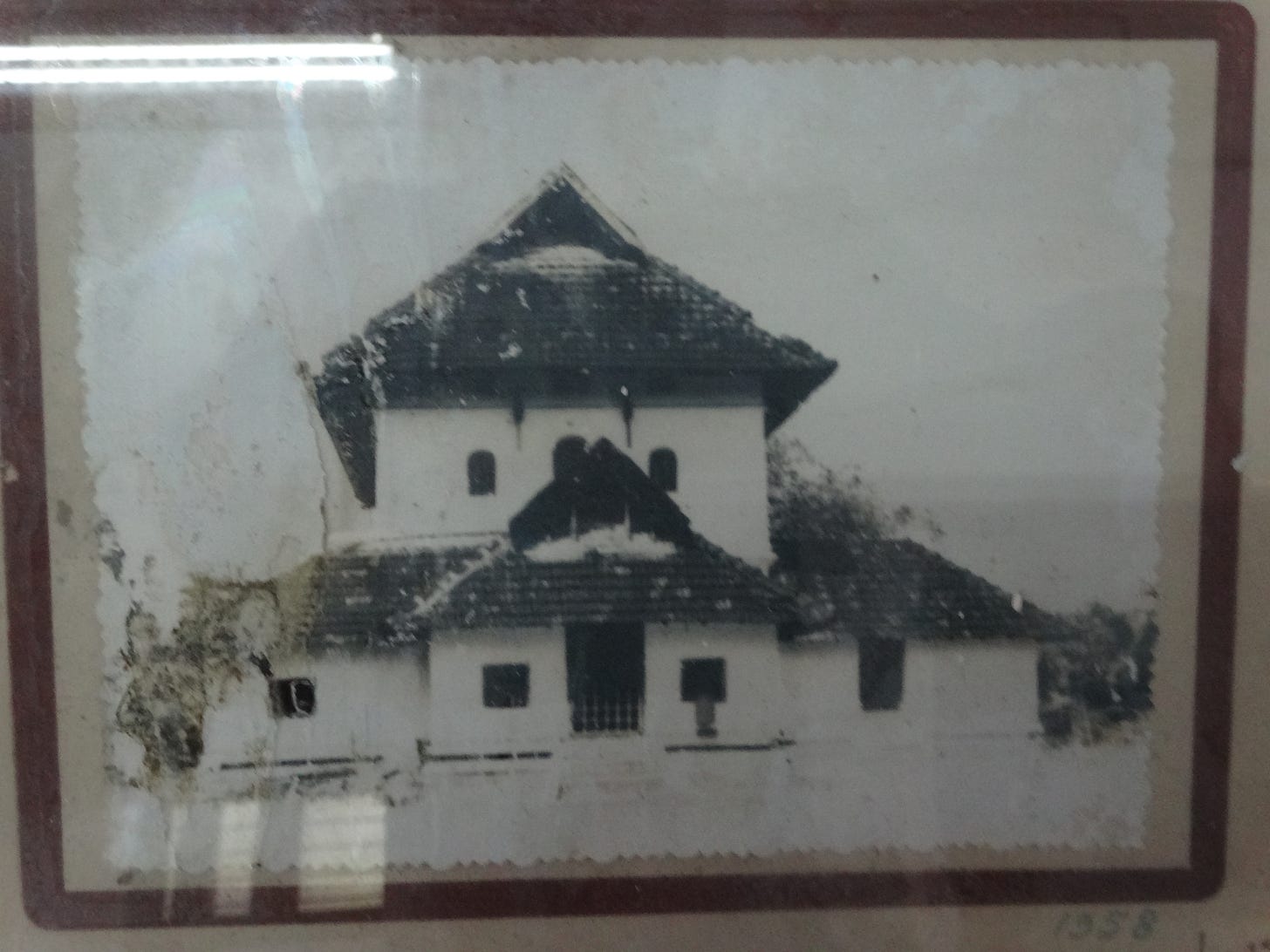
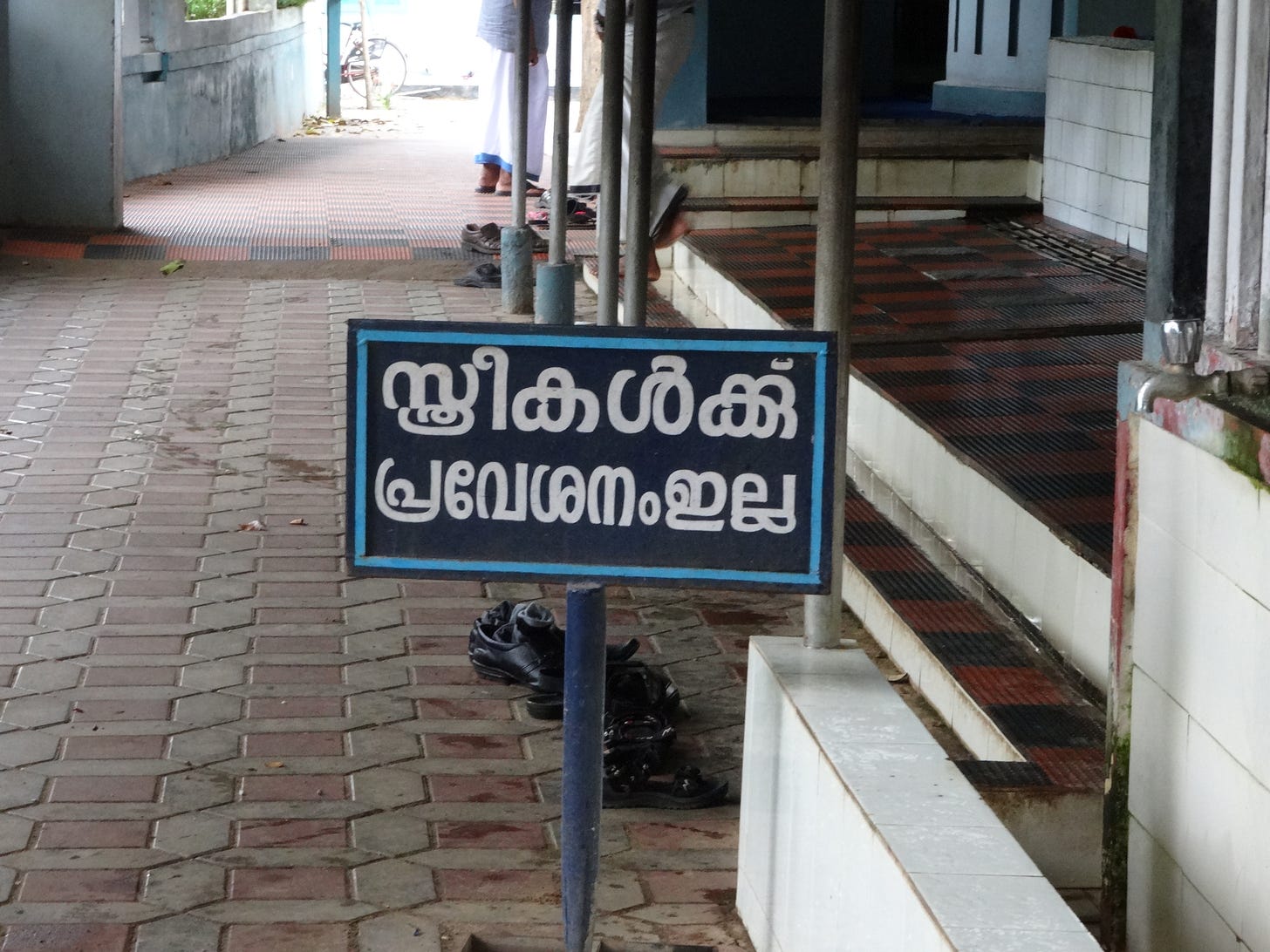
Material culture and memory continue to shape public understanding. Models of the old mosque and the present structure present an evocative continuum, while a Malayalam notice once restricting women’s entry survives as a historical artifactreminding readers that social norms evolve and that contemporary commitments to inclusion and dignity guide present practice. The Kodungallur landscape itselflong a confluence of Hindu, Buddhist, Jain, and later Sikh-friendly communities, interacting with Jewish, Christian, and Muslim tradersinvites a nuanced reading of coexistence, exchange, and shared stewardship of sacred space.
Viewed through the lens of unity among dharmic traditions, the Cheraman Perumal narrative encourages respectful inquiry rather than rivalry. It underscores how Kerala’s maritime world knit together diverse communitiesfrom temple-centered societies to merchant diasporasthrough dialogue, trade, and ritual hospitality. By anchoring legend to epigraphy and placing conversion narratives within broader currents of polity, ethics, and economy, historical reflection can deepen interfaith respect and strengthen a culture of harmony.
References: Perumals of Kerala by Prof. M. G. S. Narayanan; Survey of Kerala History by Prof. A. Sreedhara Menon.
Inspired by this post on Varnam.