
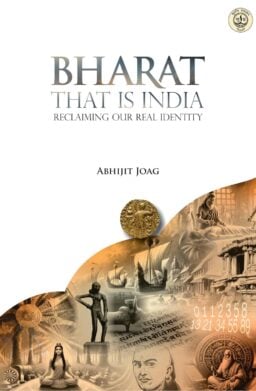
Bharat That Is India: Reclaiming Our Real Identity by Abhijit Joag is best understood as a wide-ranging work of cultural history, civilizational reflection, and intellectual recovery. Published in December 2025, it entered public discussion at a time when questions about Indian identity, historical memory, colonial inheritance, and the continuing influence of Western interpretive frameworks had become especially prominent. Its launch at the Indira Gandhi National Centre for the Arts, attended by scholars, cultural thinkers, and policymakers, reflected the seriousness with which the book was received in contemporary debates on Indian history and cultural self-understanding.
The book’s central concern is the recovery of India’s indigenous civilizational consciousness. Rather than treating India merely as a modern political formation produced by colonial administration and twentieth-century nationalism, Bharat That Is India presents Bharat as a cultural and spiritual continuum. This continuity is described through concepts such as dharma, ethical responsibility, social order, philosophical inquiry, and the lived traditions that have shaped communities across the Indian subcontinent for millennia.
This framing gives the book its distinctive force. It does not approach Indian history only through dynasties, invasions, colonial policy, or constitutional politics. Instead, it seeks to understand Indian civilization through ideas, practices, institutions, and ways of knowing. The result is a narrative in which Bharat appears not simply as territory, state, or market, but as a civilizational organism sustained by memory, pilgrimage, knowledge traditions, sacred geography, philosophical plurality, and social resilience.

A major strength of the work lies in its treatment of dharma. The term is not reduced to religion in the narrow modern sense. It is presented as a broad framework of duty, moral balance, responsibility, and right conduct. This is important because many contemporary discussions of Indian identity become trapped in categories inherited from European political and theological history. By returning to dharma, the book invites readers to consider whether Indian civilization must be understood through its own conceptual vocabulary rather than through imported binaries.
The discussion of Advaita Vedanta and other philosophical traditions further deepens this civilizational argument. Indian thought is shown as intellectually rigorous, metaphysically subtle, and capable of holding diversity without dissolving into fragmentation. This point has relevance beyond Hindu philosophy alone. A broader dharmic lens can help readers appreciate the shared civilizational environment in which Hinduism, Buddhism, Jainism, and Sikhism developed distinctive paths while retaining deep conversations around ethics, liberation, discipline, compassion, self-knowledge, and the nature of reality.
The book’s emphasis on Indian Knowledge Systems is another important contribution. Ancient India’s achievements in mathematics, medicine, metallurgy, astronomy, linguistics, logic, and education are discussed as part of a larger knowledge culture. Such claims require careful reading, because civilizational pride should not become exaggerated certainty. Yet the broader point remains valuable: India possessed sophisticated traditions of learning, debate, classification, experimentation, and transmission long before colonial modernity presented itself as the sole source of reason and science.
The treatment of ancient education is especially significant. The memory of institutions such as Takshashila, Nalanda, Vikramashila, and other centers of learning reminds readers that the Indian subcontinent was not intellectually isolated. Students, monks, merchants, scholars, and pilgrims moved across Asia through networks of learning, translation, travel, and spiritual exchange. This history complicates the simplistic view that knowledge moved only from West to East. It also shows how Indian civilization participated in a wider Asian intellectual world.
The chapter on science, as described in the review, appears to be one of the most engaging sections. Metallurgy, medicine, and mathematics are not treated as disconnected technical achievements, but as expressions of a knowledge society. The civilizational importance of this approach lies in showing that spiritual inquiry and scientific curiosity were not mutually hostile in India’s intellectual history. Disciplines such as Ayurveda, geometry, astronomy, grammar, and logic often developed within a worldview that saw knowledge as both practical and transformative.
The economic argument is equally striking. The book’s discussion of India as a major contributor to global GDP before British colonial domination connects cultural history with material history. Agriculture, textile production, maritime trade, manufacturing, artisanal skill, and market networks are presented as foundations of a prosperous Bharat. This is a necessary corrective to narratives that portray pre-colonial India as static, poor, or economically backward. At the same time, the strongest reading of such claims requires attention to historical method, regional variation, and the difference between broad economic estimates and lived social complexity.
The claim that India once contributed roughly a quarter of world output is often associated with long-range economic histories of the pre-modern world. Within the book’s argument, this point functions not merely as a statistic but as a reminder that colonialism did not arrive in an empty or stagnant land. It entered a region with productive agriculture, skilled craftsmanship, commercial networks, and deep institutional memory. The damage caused by colonial extraction, deindustrialization, revenue policy, and intellectual deracination therefore becomes central to understanding modern India’s historical condition.
One of the more compelling aspects of Bharat That Is India is its refusal to separate identity from memory. Civilizations survive not only through political sovereignty but through the continuity of stories, rituals, educational practices, ethical codes, languages, and philosophical categories. When a people lose confidence in their inherited vocabulary, they often begin to see themselves through the judgments of others. The book’s decolonial impulse emerges from this concern: India must interpret itself with intellectual honesty, but not with inherited self-contempt.

This is where the work enters the field of historiography. It challenges historical interpretation shaped by colonial assumptions, Eurocentric categories, and postcolonial frameworks that sometimes remain dependent on the very intellectual structures they criticize. The book does not appear to claim neutrality in a detached academic sense. Rather, it offers a civilizational reinterpretation that seeks to restore agency to Bharat’s own voice. Such a project will naturally invite agreement, criticism, and debate, but it is valuable precisely because it forces readers to examine the assumptions behind familiar narratives.
The prose has been described as encyclopaedic in scope while remaining free flowing and accessible. That balance matters. Works on Indian civilization often fail in one of two ways: they either become too technical for general readers or too simplified for serious students. Bharat That Is India appears to occupy a middle space, giving students, culturally curious readers, and historically engaged thinkers a structured entry point into complex questions of identity, continuity, and civilizational inheritance.
Its accessibility does not reduce its seriousness. The book brings together philosophy, history, culture, economy, science, and national identity in a single interpretive frame. This breadth can be intellectually energizing, especially for readers who have encountered Indian history mostly through school textbooks, colonial records, or fragmented political debates. It can also create the need for careful reading, since a sweeping civilizational thesis must be evaluated with attention to evidence, chronology, and scholarly disagreement.
The emotional appeal of the book lies in its invitation to reconsider inheritance. Many readers shaped by modern education may recognize the experience of learning about India as a series of defeats, invasions, social failures, and colonial reforms. Bharat That Is India offers a different orientation: not denial of historical wounds, but recovery of civilizational confidence. That confidence is most meaningful when it remains disciplined by evidence, humility, and openness to the plurality that has always marked dharmic traditions.
The book also has contemporary relevance because debates over secularism, nationalism, cultural authenticity, and education continue to shape public life in India. A civilizational approach does not have to reject modern constitutionalism or democratic citizenship. Instead, it can ask whether modern India can draw strength from older ethical and philosophical resources while remaining committed to justice, dialogue, and social harmony. This is where dharma becomes especially important: it speaks not only of identity but also of responsibility.
In the context of dharmic unity, the book’s broader implications are significant. Bharat’s civilizational identity has never been a single, uniform expression. It has included Vedic, Shaiva, Vaishnava, Shakta, Buddhist, Jain, Sikh, folk, regional, philosophical, and devotional currents. A mature reclamation of identity must therefore protect plurality rather than flatten it. The strongest civilizational argument is not one that narrows Bharat, but one that recognizes how many paths have contributed to its spiritual and intellectual landscape.
Dr. Vikram Sampath’s praise of the book as a “wonderful contribution to Indian historiography” indicates the esteem it has already received among notable voices interested in Indian history and cultural interpretation. Such recognition will likely help the book reach readers concerned with decolonization, Indian Knowledge Systems, Hindu civilization, dharmic traditions, and the recovery of historical memory.
Ultimately, Bharat That Is India: Reclaiming Our Real Identity appears to be a serious and thought-provoking contribution to the ongoing conversation about India’s civilizational self-understanding. Its value lies not only in the conclusions it advances but in the questions it compels readers to ask. What is Bharat beyond the modern state? How should Indian history be interpreted after colonialism? Can civilizational pride coexist with intellectual rigor? How can dharmic traditions sustain unity without erasing diversity? These questions make the book important for readers of Indian history, cultural heritage, philosophy, and national identity.
Whether every argument persuades every reader is less important than the larger intellectual task the book undertakes. It calls for a renewed engagement with India’s past, not as nostalgia, but as a living resource for ethical, cultural, and civilizational renewal. In that sense, Bharat That Is India succeeds as a work that informs, provokes, and invites deeper reflection on the meaning of Bharat in the present age.
Inspired by this post on Indica Today.

Leave a Reply
You must be logged in to post a comment.