
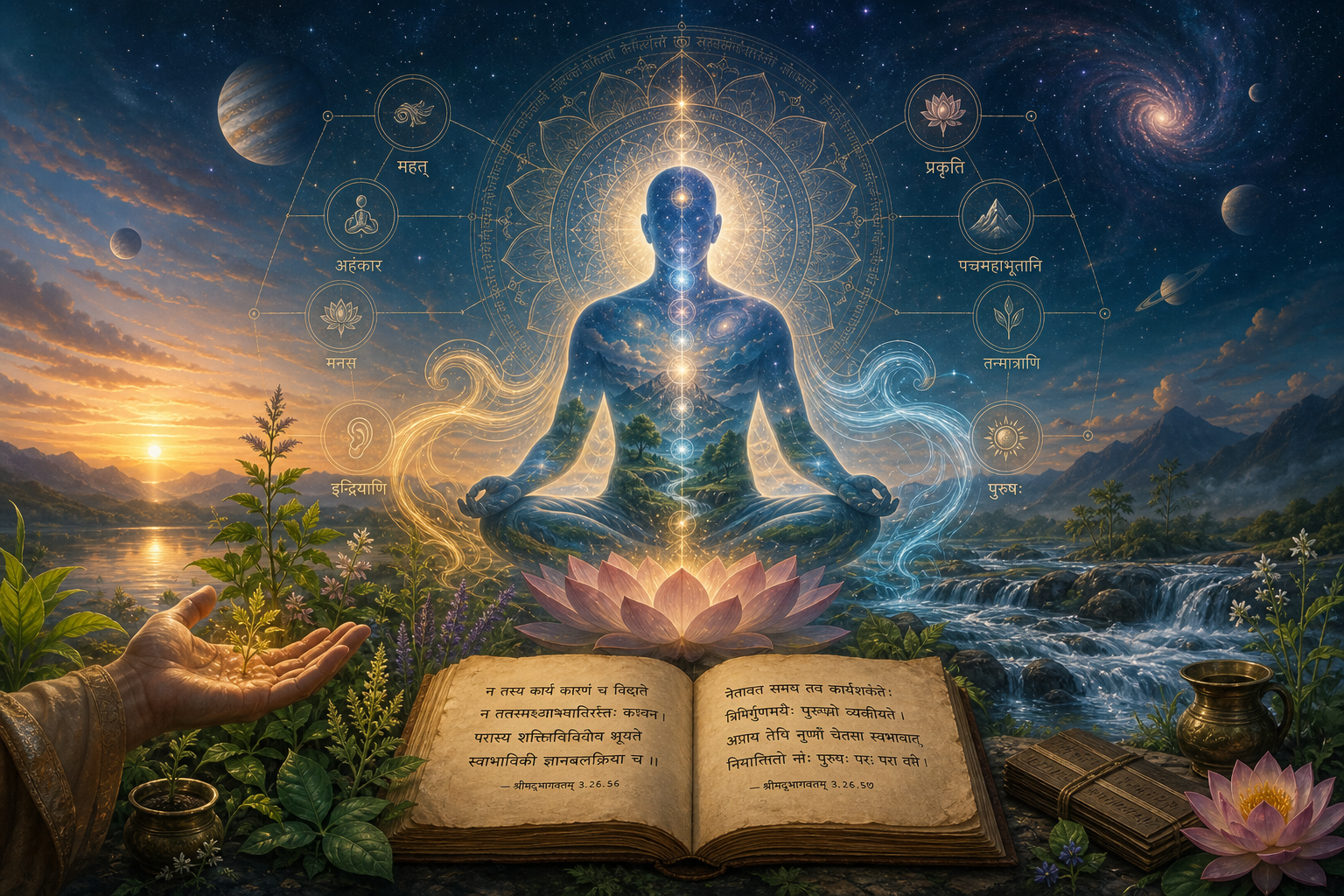
Śrīmad Bhāgavatam 3.26.56-57 belongs to a dense and philosophically technical section of the Third Canto in which Lord Kapila explains the fundamental principles of material nature. These verses describe the progressive manifestation of the virāṭ-puruṣa, the universal form, by connecting bodily organs, sensory functions, natural elements, presiding deities, and existential realities such as procreation and death. The subject may appear unusual at first, because it speaks of skin, hair, herbs, genitals, semen, water, the anus, apāna, and mṛtyu in a sacred theological setting. Yet this is precisely why the passage deserves careful attention: it refuses to separate spirituality from embodied life.
The verses present the universe as an ordered, living system rather than as a random assembly of matter. In this vision, the human body is not an isolated machine, nor is nature merely external scenery. The body, the senses, medicinal plants, reproductive power, elimination, water, and mortality are all woven into a single cosmic pattern. The Śrīmad Bhāgavatam therefore invites reflection on a profound principle of Vedic philosophy: the microcosm of the body mirrors the macrocosm of the universe.
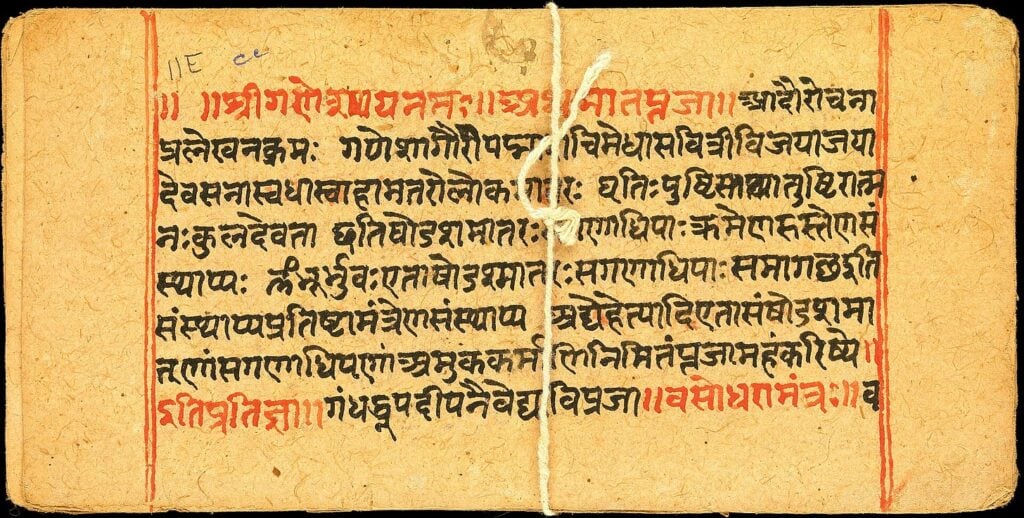
The Sanskrit of Text 3.26.56 reads: “nirbibheda virājas tvag-roma-śmaśrv-ādayas tataḥ tata oṣadhayaś cāsan śiśnaṁ nirbibhide tataḥ.” The verse explains that the skin of the universal form appeared, followed by hair, mustache, beard, herbs, medicinal substances, and then the organ of generation. Its sequence is not casual. Skin is associated with touch, hair grows from skin, and herbs are connected with nourishment, healing, and the tactile relationship between embodied beings and the earth.
Text 3.26.57 continues: “retas tasmād āpa āsan nirabhidyata vai gudam gudād apāno ’pānāc ca mṛtyur loka-bhayaṅkaraḥ.” This verse moves from generative potency to water, then to the organ of evacuation, the function of apāna, and finally to death, described as feared throughout the universe. The movement is striking: the same embodied system that enables life, continuity, nourishment, and reproduction also carries decay, waste, limitation, and mortality.
In Sāṅkhya thought, the body is understood through categories that include the elements, senses, sense objects, organs of action, mind, ego, intelligence, and the subtle operations of material nature. The Bhāgavatam’s presentation is theological Sāṅkhya, meaning that its analysis of matter is not atheistic or merely mechanical. Matter is intelligible because it is governed, ordered, and connected to the Supreme Consciousness. The virāṭ-puruṣa becomes a contemplative framework through which the practitioner can see the sacred order behind physical existence.
The mention of skin and touch is especially important. Touch is among the most immediate ways embodied beings experience reality. Warmth, cold, pressure, pain, comfort, illness, affection, and vulnerability are all mediated through touch. The Bhāgavatam links this tactile field to the manifestation of skin and to the appearance of herbs and medicinal substances. This suggests that healing is not outside the sacred order; it is part of the same cosmic arrangement by which embodied life is sustained.
The appearance of oṣadhayaḥ, herbs and medicinal plants, reflects a worldview in which ecology and spirituality are inseparable. Plants are not treated as inert resources alone, but as participants in the maintenance of life. Ayurveda, Vedic ritual culture, and traditional Indian ecological thought all preserve this intuition in different ways. The human body depends on the plant world for food, medicine, fragrance, shelter, and ritual offerings, and the Bhāgavatam places that dependence within a sacred cosmology.
This ecological dimension has contemporary relevance. Modern life often trains people to think of health in fragmented terms: the body is medical, the environment is political, food is commercial, and spirituality is private. The Bhāgavatam resists that fragmentation. It presents a more integrated anthropology in which health, restraint, ecology, duty, and devotion belong to the same moral universe. Such a view does not reject modern medicine or scientific inquiry; rather, it deepens the ethical imagination through which human beings approach the body and nature.
The verses then turn to the reproductive organ and retas, the generative seed. In the traditional commentary, reproductive energy is not treated casually, because it is tied to life, continuity, responsibility, and mortality. The language may sound severe to modern ears, especially when sexual indulgence is linked with decline and death. A careful reading should understand this within the ascetic and yogic context of the Bhāgavatam, where mastery over desire is considered essential for spiritual progress.
The point is not contempt for the body, nor hostility toward family life. The broader Hindu tradition contains both renunciant and household paths, and the Bhāgavatam itself honors devotion in many social conditions. The deeper teaching is that generative power carries responsibility. When desire becomes compulsive, identity becomes bound to consumption, possession, and bodily pleasure. When desire is disciplined, the same energy can support clarity, service, devotion, learning, and compassion.
This principle resonates across dharmic traditions. Hindu yoga speaks of brahmacarya as disciplined conduct and conservation of vital energy. Jain traditions emphasize restraint and non-attachment as pathways to purification. Buddhist teachings analyze craving as a cause of suffering and train attention toward freedom from compulsion. Sikh teachings uphold disciplined living, remembrance of the Divine, and ethical responsibility while rejecting empty ritualism and escapism. These traditions differ in metaphysics and practice, yet they share a civilizational concern: ungoverned desire clouds wisdom.
The reference to āpaḥ, the presiding principle of waters, also deserves attention. Water is life-bearing, purifying, adaptive, and essential to reproduction and bodily function. In Vedic symbolism, water often carries associations of fertility, continuity, ritual purity, and cosmic possibility. By linking retas with water, the Bhāgavatam frames generative power within a larger natural and divine order. Life emerges through dependence, not autonomy.
The next movement in the text is toward gudam, apāna, and mṛtyu. Apāna is the downward-moving vital function associated with elimination and reproductive processes in yogic anatomy. Its inclusion is philosophically important because spirituality is not presented as a denial of biological processes. Digestion, elimination, decay, and death are not embarrassing accidents outside divine knowledge. They are part of the condition of embodied existence and must be understood without sentimentality.
Mṛtyu, death, is described as loka-bhayaṅkaraḥ, that which causes fear throughout the universe. This phrase captures a universal human experience. Whether one is educated or uneducated, wealthy or poor, powerful or ordinary, the fear of death shapes choices, anxieties, ambitions, and attachments. The Bhāgavatam does not trivialize this fear. Instead, it places death within a metaphysical map so that fear can become inquiry, and inquiry can become spiritual discipline.
The verses therefore function as more than cosmology. They are a meditation on embodiment. Every person lives within the same pattern: the skin seeks comfort, the senses seek contact, the body depends on plants and water, desire seeks expression, waste must be released, vitality declines, and death remains unavoidable. When these realities are ignored, life becomes shallow. When they are contemplated through śāstra, they become sources of humility and spiritual intelligence.
For contemporary readers, one of the most relatable insights is the need to recover reverence for the ordinary body. Modern culture often oscillates between indulgence and shame: the body is either worshiped as an object of pleasure or criticized as an obstacle to success and appearance. The Bhāgavatam offers a different orientation. The body is temporary, but it is not meaningless. It is material, but it can be used for devotion. It is vulnerable, but that vulnerability can awaken compassion, discipline, and gratitude.
The teaching also challenges the modern habit of treating freedom as the absence of restraint. In dharmic philosophy, freedom is not merely the ability to follow impulse. True freedom requires mastery over impulse, because a person ruled by craving is not free in any meaningful sense. The disciplined practitioner does not reject pleasure because of bitterness; discipline is cultivated because higher joy, steadier awareness, and deeper service become possible when the senses are not tyrants.
At the same time, this teaching should be handled with maturity. Scriptural discussions of semen retention, celibacy, longevity, and yogic restraint belong to a traditional spiritual framework and should not be reduced to simplistic health claims. The practical lesson is ethical and contemplative: vital energy should be respected, desire should be governed, and the body should be used in ways that support dharma rather than deepen bondage. Spiritual seriousness requires both reverence and discernment.
H.G. Vraja Vinod Syama Das’s selected topic, centered on Śrīmad Bhāgavatam 3.26.56-57, points toward a larger devotional principle: knowledge of the body and cosmos should culminate in remembrance of the Supreme. The virāṭ-puruṣa is not merely an abstract diagram. It is a way of training perception so that the world is no longer seen as spiritually empty. Skin, herbs, water, breath, elimination, birth, and death all become reminders that existence is ordered, dependent, and sacred.
The academic value of these verses lies in their layered structure. They can be read cosmologically as an account of manifestation, psychologically as a map of embodied experience, ritually as a sacred ordering of natural functions, ecologically as a reminder of dependence on herbs and water, and spiritually as a call to self-mastery. This layered reading is one reason the Bhagavata Purana remains a central text for Hindu philosophy, devotional theology, and comparative study of dharmic traditions.
The emotional force of the passage is equally significant. It brings the reader face to face with the intimate facts of life: touch, healing, desire, waste, fear, and death. These are not remote philosophical abstractions. They are present in daily experience. A person caring for an aging parent, managing illness, struggling with impulse, seeking discipline, or reflecting on mortality can recognize the truth that the body is both precious and passing.
Śrīmad Bhāgavatam 3.26.56-57 therefore offers a powerful lesson in integrated living. It teaches that the body should be understood, not despised; nature should be honored, not exploited; desire should be disciplined, not blindly obeyed; and death should be contemplated, not denied. Such contemplation does not produce pessimism. Properly understood, it produces humility, gratitude, restraint, and devotion.
In the broader aim of Sanatana Dharma, the passage encourages unity rather than sectarian narrowness. It reminds practitioners across Hindu, Buddhist, Jain, and Sikh traditions that embodied life must be approached with ethical seriousness and spiritual purpose. The shared dharmic inheritance is not merely a collection of rituals or identities; it is a disciplined way of seeing life as sacred, interdependent, morally consequential, and oriented toward liberation.
The final takeaway is clear: the virāṭ-puruṣa teaching transforms ordinary embodiment into a field of wisdom. The skin that feels, the herbs that heal, the waters that sustain, the energies that create, the apāna that eliminates, and the death that humbles all point toward a deeper reality. When studied with care, Śrīmad Bhāgavatam 3.26.56-57 becomes not only a technical passage of Sāṅkhya cosmology, but a profound guide to self-control, ecological reverence, and spiritual awakening.
Inspired by this post on Dandavats.






Leave a Reply
You must be logged in to post a comment.