
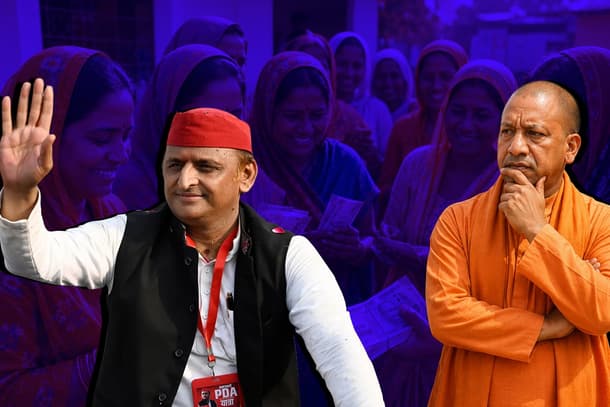
The promise of Rs 40,000 a year to poor women in Uttar Pradesh has turned the 2027 Assembly election into a serious test of welfare politics, fiscal prudence, and political communication. Akhilesh Yadav’s proposed Nari Samriddhi Samman Yojana is not merely another campaign announcement; it reflects a wider pattern in Indian politics in which direct cash support to women has become one of the most powerful electoral instruments of the decade. The question before Yogi Adityanath and the Bharatiya Janata Party is therefore precise: can a government answer a simple, emotionally compelling cash promise without issuing an equally large cheque?
The issue matters because women’s welfare has moved from the margins of manifesto writing to the centre of political strategy. Across states such as Madhya Pradesh, Maharashtra, Jharkhand, and Bihar, parties have learned that women voters respond strongly to programmes that place money, security, or essential assets directly in their hands. This is not difficult to understand. In many low-income households, a modest but predictable transfer can pay for school supplies, medicines, cooking fuel, transport, nutrition, or a small emergency. A promise such as Rs 40,000 annually therefore speaks not in abstract ideological language, but in the language of household survival.
According to the original discussion in Swarajya, the Samajwadi Party has placed this pledge within its broader 2027 Uttar Pradesh pitch. Akhilesh Yadav, who will have spent a decade out of power by the time the state votes, has framed the proposal as direct annual assistance for poor women. Reported campaign coverage from Noida also placed the promise alongside wider claims on farmers, youth, land compensation, and backward communities, indicating that the SP is attempting to build a welfare-heavy coalition rather than rely only on its older social arithmetic.
The political appeal is obvious. Cash transfers are easy to explain, easy to remember, and easy to compare. A voter does not need a technical briefing to understand Rs 40,000 a year. By contrast, a multi-layered governance record involving roads, policing, electricity, welfare delivery, investment, industrial corridors, and social schemes requires patient explanation. This is the asymmetry that makes cash promises so potent: one side speaks in a single number, while the other must defend an entire administrative model.
Yet the fiscal question cannot be avoided. If one crore women were covered, the annual bill would be about Rs 40,000 crore. If two crore women were covered, the cost would rise to about Rs 80,000 crore every year. These figures do not include administrative expenses, beneficiary verification, grievance systems, banking failures, data correction, or possible inflation-linked revisions. Uttar Pradesh already carries large commitments in salaries, pensions, infrastructure, policing, health, education, power, irrigation, and rural development. A transfer of this scale would require either new revenue, reprioritisation of expenditure, borrowing, or reductions elsewhere.
This is why the phrase without writing the same cheque is politically significant. Yogi Adityanath can answer the promise in three broad ways. The first is to match it with a comparable cash transfer, thereby neutralising the immediate emotional advantage of the SP’s pledge. The second is to offer a smaller but more targeted transfer combined with existing welfare schemes. The third is to argue that durable empowerment comes through safety, employment, education, health, self-help groups, digital access, property-linked benefits, and reliable public services rather than an expensive universalised cheque.
The first option is electorally direct but fiscally heavy. It would allow the BJP to remove the contrast between promise and counter-promise, but it would also validate the SP’s framing of the election. Once the contest becomes a bidding war over annual cash amounts, governance claims become secondary. That is risky for any incumbent government that wants to campaign on law and order, infrastructure, welfare delivery, religious tourism, investment, and administrative continuity. It may also create future pressure to raise the amount before every election cycle.
The second option is politically more flexible. Uttar Pradesh already has women-oriented programmes and schemes connected to Mission Shakti, Kanya Sumangala, widow pension support, working women’s hostels, women helplines, one-stop centres, legal support, skill development, and financial inclusion. Public reporting in June 2026 highlighted Mission Shakti and related welfare initiatives as a major part of the state’s women-centric governance model. If these schemes are consolidated, better communicated, and made easier to access, the government can present a practical empowerment package rather than a single cash promise.
However, this approach has a communication problem. Beneficiaries often experience government schemes as paperwork, eligibility conditions, local-level discretion, and delayed approvals. A bank transfer, by contrast, is visible and personal. For a poor household, the difference between a scheme that exists on paper and money that arrives in an account is enormous. Any answer to Akhilesh Yadav’s proposal must therefore address not only policy design, but the lived experience of welfare delivery. A technically superior programme can fail politically if the intended beneficiary cannot access it easily.
The third option requires the strongest political discipline. It would ask voters to value long-term social capacity over immediate cash. In principle, this is a serious argument. Women’s empowerment is not reducible to a transfer. Safety in public spaces, reliable policing, girls’ education, maternal health, access to markets, affordable transport, digital literacy, clean cooking fuel, secure housing, and local employment all shape the real freedom of women. In practice, however, such an argument must be paired with tangible benefits. Moral lectures on fiscal prudence rarely defeat a simple promise of money.
A credible counter-offer would therefore need to combine administrative credibility with emotional clarity. For example, the government could build a single women’s welfare platform that maps every eligible woman to relevant benefits, ensures Direct Benefit Transfer where appropriate, links self-help groups to market access, supports widows and vulnerable women, improves hostel and transport access for working women, and gives girls a clear education-to-employment pathway. Such a platform would need a strong grievance redressal system, transparent beneficiary lists, clear timelines, and social audits to prevent exclusion.
From a policy perspective, the central technical challenge is targeting. A scheme for poor women requires a defensible method of identifying poverty, household vulnerability, marital status, income insecurity, and exclusion from existing benefits. If eligibility is too narrow, many needy women will be left out. If eligibility is too broad, the cost may become difficult to sustain. If local officials control access without transparency, the programme may generate resentment. If the scheme relies only on outdated databases, migration, widowhood, abandoned women, informal workers, and women without complete documents may fall through the cracks.

Direct Benefit Transfer infrastructure has improved welfare delivery across India, but it is not a magic solution. Bank account access, Aadhaar seeding, mobile number linkage, biometric authentication, name mismatches, dormant accounts, and last-mile banking availability remain practical issues. Women in vulnerable households may also face intra-household capture of benefits, where money credited to their account is controlled by others. A serious women’s welfare policy must therefore think beyond transfer mechanics and include financial literacy, account control, community support, and institutional safeguards.
The political economy of such schemes also deserves attention. Cash transfers can increase dignity when they reduce dependence and give women a measure of bargaining power. They can also become fiscally addictive if parties treat them only as electoral instruments. The balance depends on design. A transfer linked with nutrition, education, health check-ups, skill development, or livelihood opportunities may create broader social gains. A poorly designed transfer may provide temporary relief while leaving structural barriers untouched. The difference lies in whether the state treats women as voters to be appeased or citizens to be empowered.
For Uttar Pradesh, this debate has special importance because of the state’s scale. A policy that appears manageable in a smaller state can become a massive fiscal commitment in UP. The number of potential beneficiaries is high, the regional diversity is large, and the administrative machinery must operate across dense urban centres, semi-urban belts, agrarian districts, and poorer rural regions. Even a small design flaw can multiply into lakhs of grievances. Conversely, a well-designed programme can shape national welfare policy because Uttar Pradesh’s scale gives it exceptional political visibility.
The BJP’s existing advantage lies in its claim of governance continuity and welfare delivery. The Yogi Adityanath government has often foregrounded law and order, infrastructure, religious tourism, investment, and targeted welfare as core achievements. Women-focused initiatives such as Mission Shakti are part of this narrative. But the SP’s Rs 40,000 promise forces the incumbent to translate broad governance into household-level value. The voter is likely to ask a practical question: what does the current model deliver directly to women, and how does it compare with a clearly stated annual amount?
The SP’s challenge is different. A promise of Rs 40,000 a year creates expectation, but it also invites scrutiny. Voters, economists, and political opponents can ask how many women will qualify, what the total fiscal burden will be, which departments will lose funds, how the scheme will be funded, and whether the transfer will be guaranteed by law or remain a manifesto pledge. The more attractive the promise, the greater the need for financial clarity. A welfare proposal that cannot explain its own budget may still win attention, but it will remain vulnerable to the charge of populism.
There is also a deeper social dimension. In Indian families, especially in poorer households, women often manage scarcity before anyone else sees it. They adjust meals, delay medical care, stretch school expenses, support elders, and absorb economic shocks. This is why women-centred welfare has moral force. It recognises the invisible labour that sustains the household. In dharmic civilisational thought, social order is not merely a contract between state and individual; it is also a web of duties, dignity, restraint, and care. Welfare that strengthens women strengthens families, communities, and social harmony.
That principle should avoid sectarian or divisive framing. A serious welfare debate in Bharat must uphold dignity across communities while remaining rooted in the ethical vocabulary of responsibility and social cohesion. Hindu, Buddhist, Jain, and Sikh traditions differ in theology and practice, but they share a civilisational respect for self-discipline, compassion, service, and the moral duty to protect the vulnerable. A women-centred policy that supports household resilience, education, safety, and livelihood can therefore be understood as part of a wider dharmic commitment to social wellbeing rather than a narrow transaction.
The most effective answer to the Rs 40,000 promise may not be a rejection of cash support. It may be a more disciplined version of it. A fiscally responsible government could identify the most vulnerable women for direct income support while expanding livelihood-linked assistance for others. It could differentiate between destitute women, widows, single women, women with disabilities, women-led households, poor mothers of school-going girls, and women in self-help groups. This would make the policy more complex than a universal slogan, but also more sustainable and socially precise.
For such a counter to work, the government would need to communicate outcomes in a language voters can verify. How many women received pensions on time? How many girls continued education because of support? How many women received skill training that led to income? How many police complaints were resolved? How many women-led enterprises accessed credit? How many families moved out of extreme poverty? These questions matter because women’s empowerment cannot be measured only by announcements. It must be measured by control over resources, mobility, safety, health, education, and voice within the household and community.
The 2027 Uttar Pradesh election may therefore become a referendum on two models of welfare politics. One model offers a large direct transfer with strong emotional appeal. The other must show that governance, security, targeted welfare, and economic opportunity can produce deeper empowerment than a single cheque. Neither model can be dismissed casually. Cash support has real value for poor women, but fiscal sustainability and institutional design are equally real concerns. The decisive political battle will be over which side can make its promise feel both compassionate and credible.
Yogi Adityanath’s task is difficult precisely because Akhilesh Yadav’s offer is simple. The incumbent cannot answer only with statistics, nor can it rely only on ideological confidence. It must convert its governance record into a clear women-first proposition that is financially believable, administratively accessible, and emotionally intelligible. If it fails to do so, Rs 40,000 a year may become the number around which the opposition frames the election. If it succeeds, Uttar Pradesh may produce a more sophisticated welfare debate, one that respects women as citizens, workers, mothers, voters, entrepreneurs, and custodians of social resilience.
Inspired by this post on Hindu Post.
