On 27 October, Rutgers University hosted a panel titled “Hindutva in America: A Threat to Equality and Religious Pluralism,” chaired by Audrey Truschke. Many Hindu American attendees and observers perceived the discussion as one-sided, with limited Hindu representation at the table, and argued that it reinforced entrenched stereotypes about Hindus and Hinduism. The event has reignited a broader conversation about academic freedom, scholarly responsibility, and how to include Hindu, Buddhist, Jain, and Sikh voices in deliberations about the dharmic traditions.
Critics of such events contend that they often echo colonial-era narratives, normalize Hinduphobia, and deny its existence despite historical references to the term in anglophone sources dating to the late nineteenth century. They argue that this pattern manifests through selective framing, mischaracterization of core symbols and practices, and a reluctance to engage substantively with Hindu perspectives. Supporters of open dialogue stress that academic freedom thrives on rigorous, two-way engagement rather than on performative rhetoric that sidelines those being discussed.
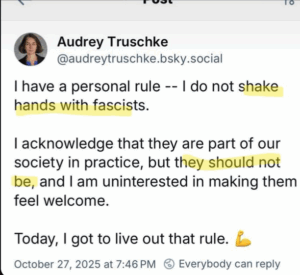
Members of the Coalition of Hindus of North America (CoHNA) attended the Rutgers event to observe and, if possible, engage in civil discussion. According to accounts shared publicly, attendee Suresh Krishnamoorthy approached Audrey Truschke after the talk to request dialogue and was declined; subsequent posts on X characterized Hindu activists as “fascists.” Regardless of intent, such exchangeswhen viewed by students and the wider publiccan harden mistrust and make good-faith engagement more difficult.
Beyond a single campus, Hindu Americans frequently report a climate in which Hinduphobic rhetoric circulates online and off. Examples cited by community organizations include derogatory slurs on social media, isolated but visible incidents such as masked protestors labeling Hindu deities as “foreign demons,” and a rise in vandalism targeting Hindu temples. Hindu students and yoga instructors likewise describe pressure or pushback when using Hindu terms or practices in academic and community spaces. These experiences, while varying by context, point to a need for consistent, clear standards of respect in universities and media.
Precision in language and symbols is crucial. The Swastika, sacred across Hinduism, Buddhism, and Jainism, is distinct from the Nazi Hakenkreuz. Conflating the two stigmatizes dharmic traditions and erases a symbol’s millennia-long benign meaning. Ensuring accurate terminology helps protect religious freedom while equipping students and the public with the context required to evaluate claims about Hindutva, Hinduism, and the wider dharmic family.
Concerns about bias are not new. Historical debatesranging from contested portrayals in early twentieth-century writings such as Katherine Mayo’s Mother India to responses from Hindu teachers like Swami Vivekananda and Swami Paramahansa Yoganandaillustrate a long arc of argument over how Hindu traditions are represented in Western institutions. Many contemporary scholars note that these recurring cycles can be addressed only through transparent methods, balanced panels, and a willingness to engage competing evidence.
International human-rights frameworks offer a constructive baseline. The Universal Declaration of Human Rights (Articles 18 and 19) and the International Covenant on Civil and Political Rights affirm the freedoms of belief, expression, and participation in public discourse. Applying these principles requires that Hindu, Buddhist, Jain, and Sikh communities be allowed to define their identities, symbols, and philosophical commitments in their own voices, and that academic platforms facilitate rather than foreclose good-faith exchange.

To advance this aim, community leaders have called for an open, transparent, and evidence-led public forum: “Who Owns Hindutva?” Such a debate would invite Audrey Truschke and colleagues to present their arguments and evidence, while ensuring equal footing for scholars and practitioners who study or identify with the dharmic traditions. Potential interlocutors include academics such as Prof. Vamsee Juluri, Dr. Lavanya Vemsani, Jeffery Long, Prakash Shah, and Dr. Koenraad Elst, alongside researchers and authors like Rajiv Malhotra, Vishal Ganeshan, Sai Deepak, and Sandeep Balakrishna.
Ensuring gender balance and breadth of experience is equally important. Invitations could extend to Hindu women communicators and researchers active on public platforms, including Sahana Singh, Samyu Singh, Maria Wirth, Nupar J Sharma, Savitri Mumukshu, Renee Lynn, Karolina Goswami, and Rashmi Tantra from Kalifornia Dharamshala. Because unity and mutual respect among dharmic traditions are central, Buddhist, Jain, and Sikh scholars should share the stage, and conversation partners from Native American and other indigenous communities can offer comparative perspectives on how ancient traditions are framed within modern institutions.
A well-designed format could span a weekend, combining moderated debates with exhibits and teach-ins. Sessions might cover the history and usage of the term “Hinduphobia,” comparative religious pluralism in India, the distinction between religious symbols and political ideologies, and methodological standards for the study of Hinduism, Buddhism, Jainism, and Sikhism. Such programming would help students, journalists, and policymakers examine claims with evidence, assess sources critically, and recognize the diversity within and across dharmic traditions.
Responsible security protocols are part of campus practice and should remain standard without sensationalism. The public interest is best served when universities reduce friction, increase clarity, and model the norms of civil disagreementespecially on topics that carry deep identity salience for minority communities.
Community engagement can also be effective beyond lecture halls. Hindu, Buddhist, Jain, and Sikh advocates have found that when they present their concerns directly to neighbors, journalists, and local institutions, audiences often respond with empathy. In one instance, a public campaign over religious imagery opened space for a fair media portrayal; in another, a conversation hosted by a race-relations office acknowledged a recurring pattern in which Hindu concerns were dismissed as “nationalism.” In both cases, respectful dialogue and careful explanation helped shift perceptions.
Ultimately, campaigns for accurate representation are not confrontations but commitments to clarity, dignity, and justice. Every community deserves self-representation, fair hearing, and participation in evidence-based debate without fear or distortion. A substantive “Who Owns Hindutva?” forumgrounded in academic standards and inclusive of Hindu, Buddhist, Jain, and Sikh voiceswould demonstrate how universities can uphold intellectual rigor while advancing genuine pluralism. If pursued earnestly, such dialogue can help transform polarization into learning and build unity across the dharmic traditions.
Inspired by this post on Hindu Human Rights Blog.