
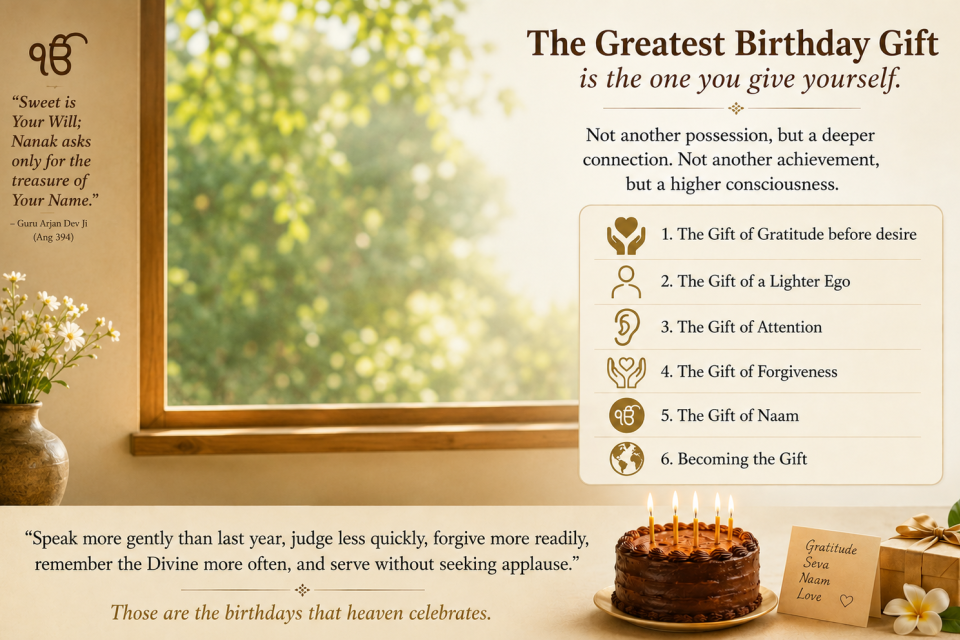
The birthday gift most worthy of Guru Nanak is not an ornament, a ceremony, or a public display of devotion. It is the disciplined offering of a transformed self: a mind made truthful, a livelihood made ethical, a heart made compassionate, and a community made more just through service.
Guru Nanak, the first Sikh Guru and the founder of the Sikh tradition, is remembered across the world on Guru Nanak Jayanti or Gurpurab with kirtan, processions, langar, prayer, and reflection. Yet the deeper question behind the celebration is not merely how a community remembers him, but what kind of human being his teachings ask society to become. His life, beginning in 1469 at Talwandi, now Nankana Sahib in Pakistan, unfolded as a sustained challenge to ritual pride, social arrogance, religious exclusivism, exploitation, and spiritual emptiness. The gift he would ask is therefore not something external to the devotee. It is the gift of moral reform.
At the center of Guru Nanak’s message stands the conviction that the Divine is one, truth is higher than social vanity, and human beings are bound by a shared spiritual dignity. The opening formulation of the Sikh tradition, Ik Onkar, points toward the oneness of ultimate reality. This is not an abstract doctrine alone. It carries social consequences. If the Divine is one, then caste arrogance, sectarian hostility, gender contempt, economic exploitation, and religious hatred become signs of spiritual failure rather than markers of strength.
A birthday offering to Guru Nanak, understood academically and ethically, would begin with truthfulness. In the Sikh tradition, truth is not limited to correct speech. It includes truthful living. A person may speak sacred words, attend religious gatherings, and perform visible acts of piety, yet still remain inwardly divided if daily conduct is governed by greed, deceit, prejudice, or indifference. Guru Nanak’s teaching presses beyond verbal religiosity into lived integrity.
This is why the famous ethical triad often associated with Sikh life remains so powerful: Naam Japna, Kirat Karni, and Vand Chakna. Naam Japna refers to remembrance of the Divine Name, not as mechanical repetition but as inward orientation. Kirat Karni means earning through honest labor. Vand Chakna means sharing with others. These principles join contemplation, work, and social responsibility into one integrated discipline. They prevent spirituality from becoming escapism and prevent worldly success from becoming selfishness.
The first gift, then, is attention. Modern life trains the mind to scatter itself across anxiety, comparison, performance, and consumption. Guru Nanak’s path calls the mind back to remembrance. Naam is not merely a sound; it is a mode of awareness. To remember the Divine is to remember that life is not self-created, that power is temporary, that status is fragile, and that every person encountered carries a spiritual claim upon one’s conduct.
The second gift is honest work. Guru Nanak did not glorify withdrawal from responsibility as the only spiritual path. His teaching affirms that household life, labor, family responsibility, and social participation can all become vehicles of dharma when guided by integrity. Honest livelihood is spiritual practice because it resists exploitation at its source. It asks the merchant, the official, the teacher, the laborer, the professional, and the student to examine whether their success has been built on fairness or manipulation.
The third gift is sharing. Vand Chakna turns private earnings into social nourishment. Its most visible institutional expression is langar, the community kitchen associated with gurdwaras across the world. Langar is not charity in the narrow sense. It is a theological statement enacted through food: all sit together, all are fed, and no human being is reduced to rank before hunger. In a world still divided by class, caste, ethnicity, and religious identity, this practice remains radical in its simplicity.
Guru Nanak’s birthday therefore becomes an invitation to examine how devotion is embodied in society. A lamp lit in reverence has meaning, but a hungry person fed with humility carries the teaching further. A hymn sung beautifully has value, but a harsh word restrained in daily life may be equally sacred. A procession can inspire public memory, but the transformation of ordinary relationships is where spiritual memory becomes civilizational strength.

One of the most enduring features of Guru Nanak’s teaching is its rejection of empty religious superiority. He moved across cultural, linguistic, and religious boundaries, engaging Hindus, Muslims, ascetics, householders, merchants, rulers, and common people. His conversations show a deep concern for what may be called the ethics of spiritual authenticity. The question was never whether a person had inherited a label, but whether the person’s life reflected humility, compassion, and truth.
This point is especially important for dharmic unity. Hinduism, Buddhism, Jainism, and Sikhism differ in theology, metaphysics, practices, and historical development, yet they share a civilizational concern for self-discipline, moral causality, compassion, liberation from ego, and reverence for truth. Guru Nanak’s message can be received as a powerful bridge within this broader dharmic landscape. It does not erase differences. It asks traditions to recognize one another without hostility and to compete only in service, wisdom, and ethical refinement.
In this sense, the gift Guru Nanak would ask is also the gift of humility. Humility is not weakness, passivity, or loss of conviction. It is the ability to recognize the limits of ego. It is the refusal to turn religion into a weapon of vanity. It is the discipline of listening before judging and serving before claiming superiority. Such humility has practical value in family life, community institutions, public discourse, and interfaith relations.
Guru Nanak’s critique of social hierarchy remains central to his legacy. The spiritual equality of human beings cannot remain a slogan while society continues to humiliate people by birth, occupation, gender, poverty, or community. His teaching confronts any structure that treats inherited status as a substitute for virtue. The true measure of a person is not lineage, wealth, ritual expertise, or public authority, but the quality of consciousness and conduct.
This has direct relevance for contemporary society. Many communities today celebrate saints with grandeur while tolerating the very injustices those saints opposed. Guru Nanak’s birthday can become more than commemoration when it produces self-audit. Does devotion reduce arrogance? Does worship increase compassion? Does identity create responsibility rather than hostility? Does religious education produce ethical citizens? These questions turn celebration into sadhana.
There is also a deeply human dimension to this gift. Families often gather on birthdays to express affection through food, flowers, music, and remembrance. In the case of a spiritual teacher, the most meaningful offering is imitation of the teacher’s virtues. A child learning to share food, a professional refusing corrupt gain, a student speaking truth despite pressure, a family choosing reconciliation over ego, and a community serving strangers without publicity all become living tributes.
Guru Nanak’s teaching on seva, or selfless service, is especially relevant in an age of performative generosity. Service becomes spiritually meaningful when it reduces the ego rather than inflating it. The act itself matters, but so does the inner posture. Feeding, teaching, protecting, healing, cleaning, mentoring, and comforting others can all become seva when performed without contempt for the recipient and without hunger for praise.
The technical structure of Sikh ethical life is therefore not accidental. Remembrance disciplines consciousness. Honest labor disciplines economic life. Sharing disciplines social relationships. Service disciplines the ego. Sangat, the holy congregation, disciplines isolation by placing the individual within a moral community. Pangat, the practice of sitting together in equality, disciplines hierarchy through embodied experience. Together, these practices create a spiritual ecology rather than a loose collection of ideals.

Guru Nanak’s life also demonstrates the importance of fearless speech. He spoke against hypocrisy, injustice, and domination without reducing spirituality to anger. This balance is difficult and necessary. A dharmic society cannot be built on silence before injustice, but neither can it be built on resentment alone. Guru Nanak’s example suggests that truth must be spoken from clarity, not hatred; from compassion, not ego; and from courage, not social convenience.
The gift of truthful speech is urgently needed in public life. Contemporary discourse often rewards outrage, exaggeration, and tribal loyalty. Guru Nanak’s teaching invites a different discipline: speak what is true, speak it with moral seriousness, and speak it in a way that does not dehumanize. This is not a demand for artificial politeness. It is a demand for speech aligned with spiritual responsibility.
Another birthday gift worthy of Guru Nanak is the healing of religious relationships. The Sikh tradition emerged in a complex historical environment shaped by Hindu, Islamic, devotional, and regional currents. Guru Nanak’s genius was not syncretism in a shallow sense, but spiritual discernment. He honored truth wherever it appeared and rejected falsehood wherever it hid behind authority. This approach remains valuable for interfaith and intra-dharmic dialogue today.
For Hindu, Buddhist, Jain, and Sikh communities, the practical implication is clear. Unity does not require uniformity. Dharmic traditions can maintain distinct doctrines, scriptures, disciplines, and institutions while cooperating on cultural preservation, ethical education, family stability, compassion for the vulnerable, and resistance to hatred. Guru Nanak’s message encourages a unity rooted in shared responsibility rather than shallow sameness.
His teachings also correct a common misunderstanding of spirituality as private comfort. Spiritual life is certainly a source of peace, but it is not merely emotional relief. It demands reform of habits, economics, speech, social structures, and relationships. The person who remembers the Divine but exploits workers has not understood. The person who sings of compassion but humiliates family members has not understood. The person who defends religion but despises the poor has not understood.
This makes Guru Nanak’s birthday a mirror. It asks society to look carefully at its forms of devotion and determine whether they produce inner change. The mirror may be uncomfortable, but its purpose is restorative. Spiritual traditions remain alive when they can correct their own followers with love and firmness. A living tradition does not merely preserve memory; it renews character.
The role of music and kirtan in remembering Guru Nanak also deserves attention. In Sikh practice, sacred singing is not entertainment placed beside doctrine. It is a method of internalizing truth. The Guru Granth Sahib gives central importance to revealed hymns arranged in musical measures. This shows that beauty, discipline, and theology are linked. Music opens the heart, but it must also educate the conscience.
When communities gather for kirtan on Gurpurab, the emotional power of collective singing can become a form of moral education. The individual voice enters a shared soundscape, and the isolated self is reminded that spiritual life is communal. Yet the test of kirtan arrives after the singing ends. The sweetness of the hymn must become sweetness of conduct. The rhythm of devotion must become rhythm in work, family, and society.
Guru Nanak’s message also speaks strongly to material excess. Birthdays in modern consumer culture often revolve around acquisition. The celebration of a saint reverses that logic. The question is not what can be acquired in the Guru’s name, but what can be relinquished: ego, greed, prejudice, laziness, bitterness, dishonesty, and indifference. Renunciation here does not necessarily mean abandoning household life. It means abandoning the inner distortions that corrupt household life.
This is a practical philosophy. A person can begin with small acts: eating with gratitude, setting aside a portion of income for service, refusing gossip, correcting unfair behavior at work, learning from another dharmic tradition with respect, visiting a gurdwara or temple with humility, serving in a community kitchen, or repairing a strained relationship. These acts may appear ordinary, but Guru Nanak’s vision dignifies the ordinary when it is aligned with truth.
The birthday gift Guru Nanak would ask society to give itself is therefore the recovery of moral seriousness. This seriousness is not gloomy. It is liberating because it frees life from superficiality. It teaches that devotion is not measured by noise, wealth, or spectacle, but by the transformation of perception and conduct. The sacred is encountered not only in pilgrimage or prayer, but in the just wage, the shared meal, the gentle word, and the courageous refusal to exploit.
From an academic perspective, Guru Nanak’s continuing influence can be understood through the durability of the institutions and values that followed him: the Guru tradition, the Guru Granth Sahib, the Khalsa, the gurdwara, langar, kirtan, seva, and the global Sikh diaspora’s service-oriented identity. These institutions did not emerge from sentiment alone. They grew from a coherent spiritual anthropology: human beings are capable of ego, but also capable of disciplined awakening through grace, remembrance, ethical labor, and community.
His relevance is not confined to Sikhs alone. Guru Nanak belongs to the larger heritage of Indian spirituality and global religious history. His teachings can speak to anyone concerned with religious pluralism, ethical economics, social equality, and the transformation of the self. For Hinduism, Buddhism, Jainism, and Sikhism together, his life offers a reminder that dharma is protected not merely by argument, but by conduct that makes dharma credible.
In the end, the most compelling birthday offering to Guru Nanak is a vow of alignment. Let remembrance align with action. Let worship align with humility. Let community pride align with service. Let identity align with responsibility. Let dharmic traditions stand together without erasing their differences. Let the shared civilizational pursuit of truth, compassion, self-discipline, and liberation become visible in daily life.
Such a gift cannot be wrapped, displayed, or exhausted in a single festival day. It must be practiced repeatedly. Guru Nanak’s birthday becomes spiritually meaningful when it awakens the courage to live differently after the celebration has ended. The true offering is not merely to remember him with reverence, but to allow his teaching to reorder the self. That is the gift he would ask humanity to give itself.
Inspired by this post on SikhNet – News.







Leave a Reply
You must be logged in to post a comment.