In Hong Kong’s fast-paced urban landscape, the Hare Krishna temple community quietly thrives on the dedication of long-time practitioners. Among them, Shereimony and Suchandraboth disciples of their spiritual teacherstand out as steady exemplars of humility, discipline, and service. In a recent interview, they reflected on what sustains Krishna consciousness in a demanding city and how spiritual practice equips them to navigate uncertainty.
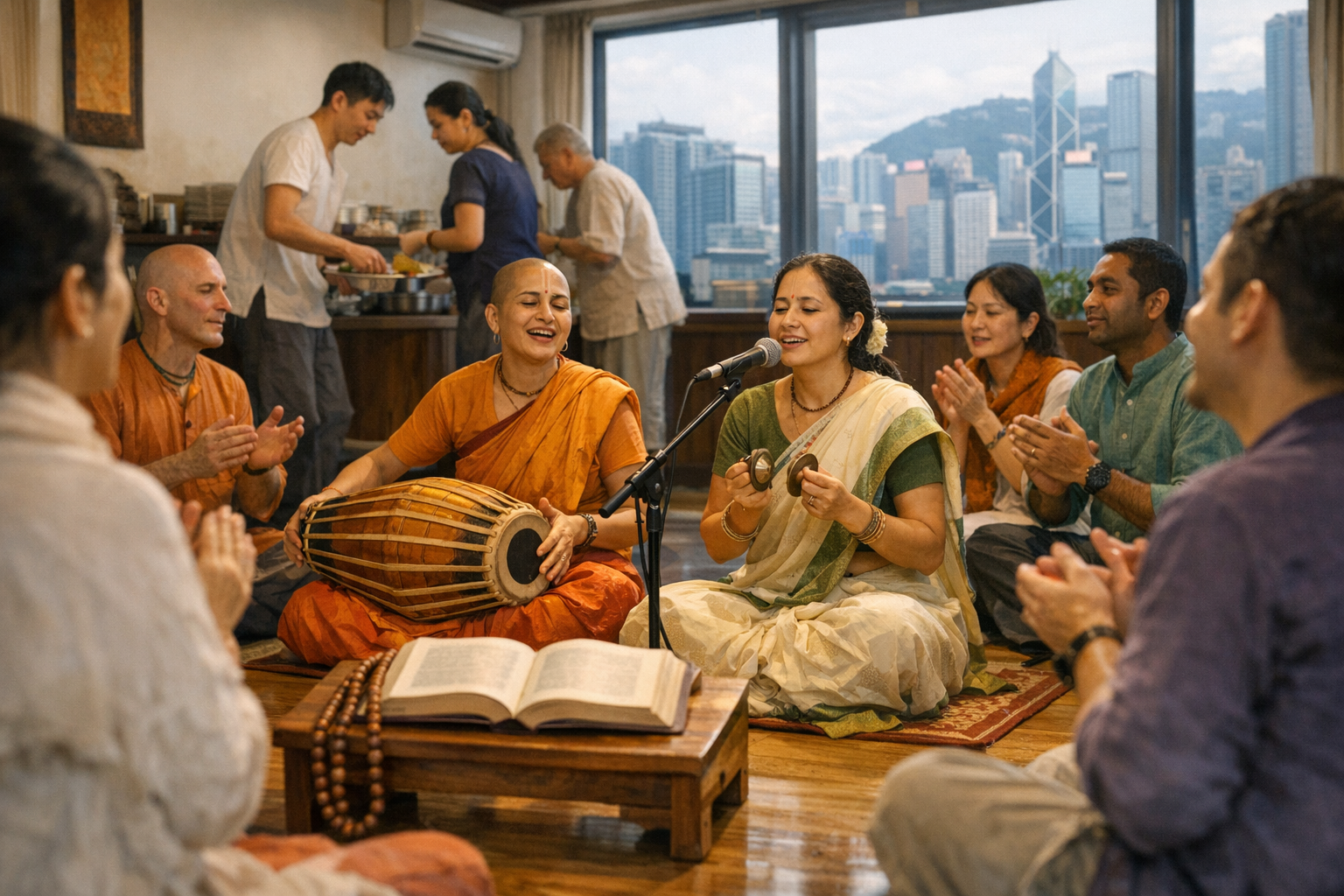
As an institutional hub for ISKCON (International Society For Krishna Consciousness), the temple functions as a spiritual commons where diaspora families, students, and professionals gather for kirtan, Bhagavad-Gita study, and prasadam. Volunteer-managed programs, often scheduled around the city’s intense work hours, exemplify how Hindu temples abroad adapt to urban constraints while maintaining continuity with Gaudiya Vaishnavism’s bhakti tradition.
Krishna consciousness, rooted in Bhakti Yoga, organizes daily life around interlocking disciplines: japa (mantra meditation on Krishna’s names), kirtan (congregational chanting), seva (selfless service), and sādhu-saṅga (association with devotees). Classical teachings consistently emphasize sādhu-saṅga as a catalytic force for transformation, echoing instructions preserved in texts such as the Bhagavad-Gita and the Gaudiya canon. In practice, association offers accountable friendship, scriptural guidance, and a steady rhythm of encouragement necessary for long-term spiritual progress.
Shereimony identifies association with other devotees as the strongest source of inspiration. In community terms, sādhu-saṅga is not merely sociability; it is a structured field of influence in which language, habits, and priorities reorient toward dharma. Regular satsang, shared kirtan, and cooperative seva create positive feedback loopsdevotion deepens, service expands, and resilience grows. For many in Hong Kong, small-group sanghas hosted in apartments or workplace break rooms have become practical lifelines that fit the city’s compressed schedules.
Suchandra underscores the complementary role of discipline and service. Personal sadhanasteady japa, participation in kirtan, and study of foundational textsbuilds clarity and emotional ballast. Seva channels that inner steadiness into outward benefit, whether through temple maintenance, community kitchen support, or simply mentoring younger practitioners. Together, sadhana and seva form a two-way bridge: practice energizes service, and service tests and refines practice.
From a technical perspective, mantra meditation and kirtan engage breath regulation, attentional focus, and affective regulation. Repetitive auditory patterns and rhythmic breathing can help downshift stress responses, while collective singing synchronizes emotion and intention across participants. Social-scientific literature on religious coping consistently associates such routines and communal bonds with increases in psychological resilience and social trustoutcomes especially valuable in high-density environments like Hong Kong.
Operating a diaspora temple in a global finance hub entails distinctive challenges. Time scarcity and shift work complicate attendance; property costs compress usable space; multi-language constituencies require inclusive communication; and regulatory compliance demands careful governance. The Hong Kong setting also presents unique opportunities: high public transport connectivity enables micro-gatherings, and digital fluency supports hybrid events that blend on-site and online participation.
Effective program design reflects these constraints and opportunities. Communities that thrive in Hong Kong typically deploy micro-sanghas near transit nodes, rotating seva rosters to prevent burnout, hybrid Bhagavad-Gita classes for commuters, and multilingual facilitation across English, Cantonese, Mandarin, and Hindi where possible. Safety and child-protection protocols, food safety standards in prasadam distribution, and transparent financial reporting strengthen public trust and align with best practices for temples abroad.
A unifying aim across dharmic traditions is evident in the community ethos. Shared valuesahimsa, seva, satsang or simran, and respect for multiple pathscreate natural bridges with Buddhism, Jainism, and Sikhism in Hong Kong. Practical collaborations can include joint food relief inspired by langar and prasadam, meditation and mindfulness dialogues that respect distinct vocabularies, and service projects framed around environmental stewardship. Such inter-dharmic cooperation exemplifies unity in spiritual diversity without diluting distinct practices.
Women’s leadership is another decisive strength. Shereimony’s example illustrates how consistent practice, facilitation of satsang, and mentoring can normalize women’s visibility in the bhakti tradition. Inclusive leadership pipelinesfacilitator training, scriptural study circles, and public kirtan opportunitieshelp ensure that devotion translates into shared responsibility across generations.
The day-to-day realities of practitioners in Hong Kong are relatable. Many devotees integrate japa into MTR commutes, schedule a brief kirtan before dinner, and reserve a weekly evening for satsang. These micro-habits, combined with a culture of mutual care, offer emotional steadiness amid market volatility, family obligations, and the quick tempo of the city.
Good governance anchors the spiritual ecosystem. Clear roles for temple councils, codes of conduct for volunteers, and grievance redressal channels protect community dignity. Regular training in hospitality, conflict sensitivity, and intercultural communication enhances the welcome extended to newcomers and visitors. Periodic reviews of program load and volunteer capacity prevent overextension and preserve the quality of kirtan, classes, and seva.
At the narrative core, Shereimony and Suchandra demonstrate four durable levers of resilience: sādhu-saṅga (association that uplifts), sadhana (disciplined practice), seva (service that externalizes love), and śāstra (study that clarifies purpose). Their contributions are quiet yet decisivethe kind of unsung heroism that sustains communities through ordinary weeks and extraordinary disruptions alike.
For a metropolis renowned for speed, the Hare Krishna community in Hong Kong communicates a countercultural message: depth over haste, community over isolation, and devotion over distraction. By aligning personal practice with collective service and by collaborating across dharmic traditions, practitioners convert the pressures of urban life into opportunities for growth. In doing so, they model a form of spiritual citizenship that honors Krishna’s names while strengthening the broader social fabric.
Inspired by this post on Dandavats.