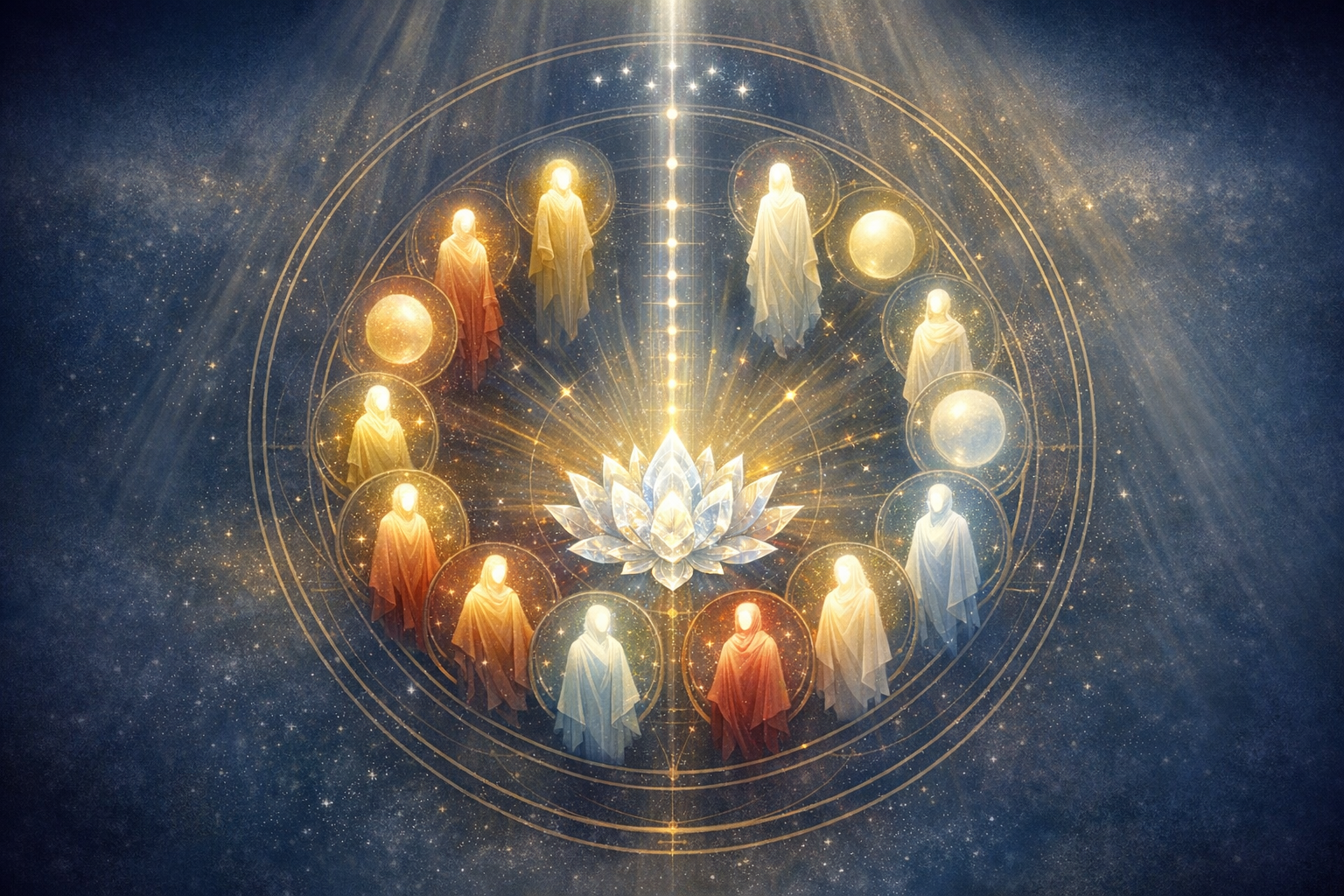
Within the vast architecture of Hindu cosmology, the Abhūtarājasas (also attested as Abhutarayas or Abhutarajasas) designate a distinct deva-ganaa class of celestial beingsassociated with the fifth Manvantara, presided over by Raivata Manu. Textual traditions position this collective among the functional groupings of devas that periodically assume stewardship roles in the cosmos across cyclical epochs.
Philologically, the compound “Abhūtarājasas” is interpretable as “those in whom rajas (the quality of passion or dynamism) has not arisen” or is notably attenuated. This semantic cue situates the group in a sattva-forward register, aligning with classical guna theory in Sāṅkhya-Yoga and wider Hindu philosophy, where sattva, rajas, and tamas index luminosity, activity, and inertia respectively.
Hindu time-reckoning frames these beings within a Manvantaraa governance cycle within each kalpa (a “day” of Brahmā). Each kalpa comprises fourteen Manvantaras; every Manvantara comprises seventy-one mahāyugas, with each mahāyuga spanning four yugas in sequence (Kṛta, Tretā, Dvāpara, and Kali). This layered schema emphasizes periodic renewal: new Manus, new sets of Saptarṣis, and new assemblies of devas assume cosmic responsibilities suitable to the qualities of their age.
Raivata Manu, remembered as one of the Manus arising in the early cosmic generations, is traditionally linked to the lineage of Priyavrata; this genealogical anchoring appears in Purāṇic narrative cycles that outline how dharma is curated and transmitted through dynasties of Manus. During Raivata’s tenurethe fifth Manvantarathe Abhūtarājasas are counted among the presiding deva-groups.
Purāṇic literature (notably the Viṣṇu Purāṇa and the Bhāgavata Purāṇa, Canto 8) preserves the schema of alternating deva-groups across Manvantaras. While familiar collectives such as the Ādityas, Vasus, Rudras, Sādhyas, Aśvins, and Viśvedevas populate many cycles, certain Manvantaras highlight less commonly discussed cohorts. The Abhūtarājasas stand out as one such specialized designation linked to the Raivata epoch.
Sources that preserve numeric specifications describe the Abhūtarājasas as a cadre of fourteen deities. The number is emblematic in Purāṇic cosmology: fourteen Manus in a kalpa, fourteen worlds (lokas), and other chaturdaśa (fourteenfold) enumerations (e.g., the chaturdaśa-vidyā). Such numerical symmetry functions as a cosmographic signature, conveying order, recurrence, and completeness.
Standard Purāṇic listings of each Manvantara usually include: (1) the name of the Manu, (2) the current Indra (the office and its occupant change), (3) the deva-groups serving that epoch, (4) the Saptarṣis guiding knowledge and rites, and (5) characteristic avatāras manifest to re-establish dharma. In the fifth Manvantara, the Abhūtarājasas fulfill the third criterion as the named deva-gana. Many recensions also note the Indra of this era as Vibhu, though particulars can vary by textual lineage.
Because Purāṇas are transmitted through multiple regional and sectarian recensions, minor divergences in names, counts, and ordering occur. Nonetheless, the consistent cross-textual thread is clear: a specific deva-gana identified as Abhūtarājasas is linked to Raivata Manu’s manvantaric administration, and their number is held to be fourteen.
From a philosophical vantage, the very name Abhūtarājasas hints at an ethical-cosmological charter. Emphasis on reduced rajas suggests roles consonant with steadying, clarifying, and preserving functionsqualities that sustain cosmic order (ṛta) and dharma rather than agitate it. In Manvantaras where creative turbulence must be balanced, naming a deva-gana by its diminished rajas quality underlines the primacy of composure and discernment.
It is noteworthy that the Abhūtarājasas are not a widely worshipped pantheon in contemporary temple practice. Their significance is primarily scriptural and cosmological. For practitioners engaged in Purāṇic study, manvantaric lists encountered in daily svādhyāya (self-study) or during ritual recitations are a reminder that divine stewardship is dynamic and cyclic, unfolding through precisely defined offices and collectives rather than a single immutable roster.
In lived experience, encountering names such as Abhūtarājasas often evokes a sense of scale and humility. Readers and ritualists alike recognize that the texts invite contemplation of deep time, rhythmic governance, and moral qualities (gunas) as metaphysical levers. That recognition can be emotionally grounding, much like standing before the ocean: there is continuity, movement, and an order that exceeds any individual lifetime.
Comparative dharmic perspectives amplify this insight. While the designation Abhūtarājasas is specific to Hindu Purāṇic discourse, the broader motifs of cyclical time and ethical cultivation find resonances across Dharmic traditions. Buddhism elaborates kalpas and mahākalpas; Jainism preserves expansive time cycles and epochal shifts; Sikh scriptural poetry interweaves reflections on cosmic order and the moral life. These convergences encourage a shared appreciation for plural paths that honor dharma, compassion, and disciplined inquiry.
From a hermeneutic standpoint, the Abhūtarājasas also illustrate how nomenclature in sacred literature encodes doctrine. Names are not merely labels but pedagogical cues: they bridge cosmography, psychology (guna theory), and soteriology. Studying such terms develops literacy in Purāṇic methodhow numbers, qualities, and offices harmonize to convey meaning at multiple levels.
For students of scripture and history, the Abhūtarājasas thus serve as a compact case study in Puranic cosmology: they are (a) historically anchored to Raivata Manu’s tenure, (b) structurally defined as a fourteen-member deva-gana, (c) philosophically suggestive of sattva-rich function via a rajas-attenuated name, and (d) hermeneutically illustrative of how Hindu texts systematize the cosmos through recurring numerical and qualitative patterns.
In sum, recognizing the Abhūtarājasas within the fifth Manvantara enriches understanding of Hindu cosmology’s precision and pluralism. The tradition’s willingness to articulate different deva-groups for different cycles underscores a living principle: cosmic care is collaborative, role-based, and responsive to the character of time. That visionrooted in shared dharmic valuesinvites both scholarship and reverence, uniting textual study with a contemplative appreciation for the many-tiered order of reality.
Inspired by this post on Hindu Blog.