
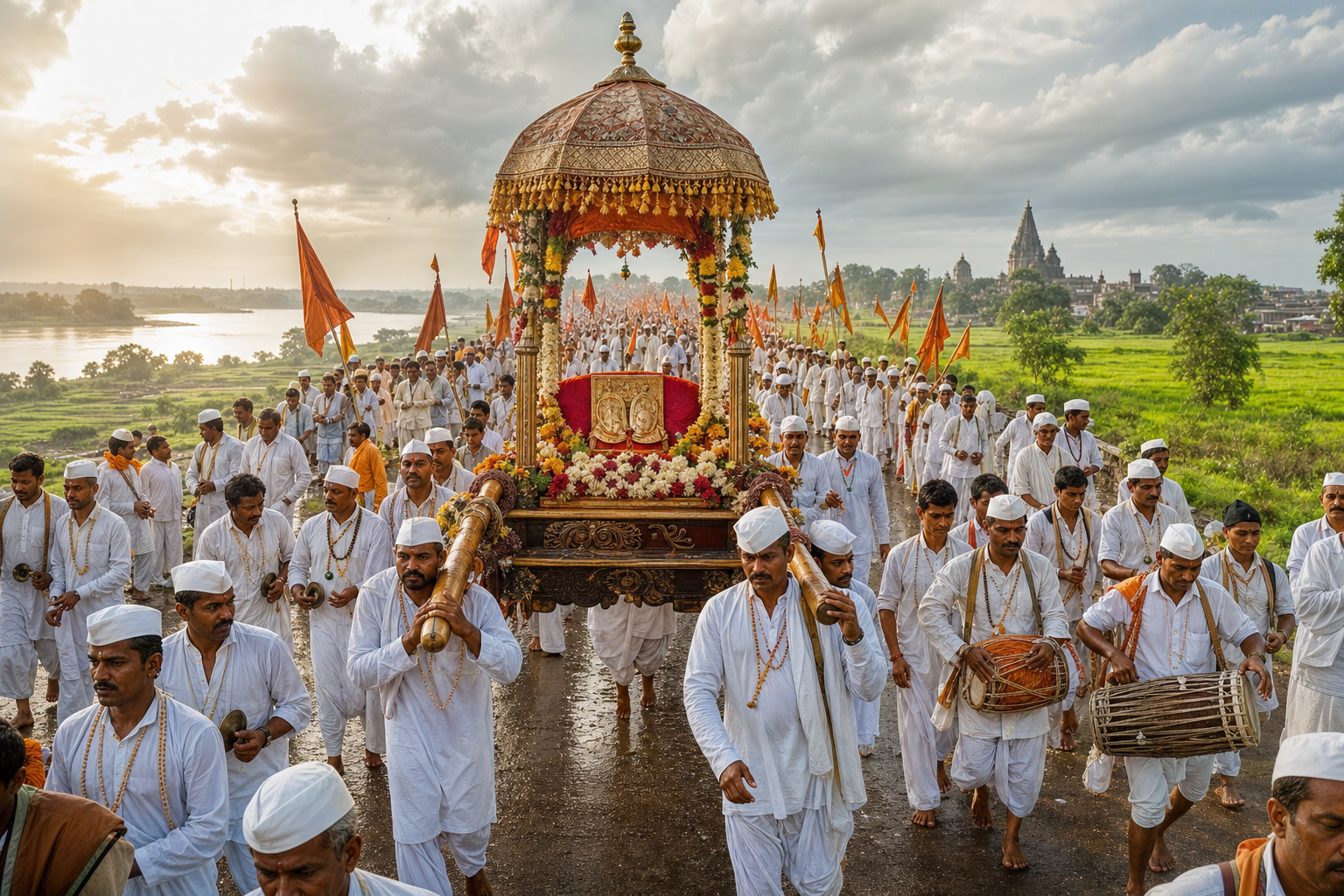
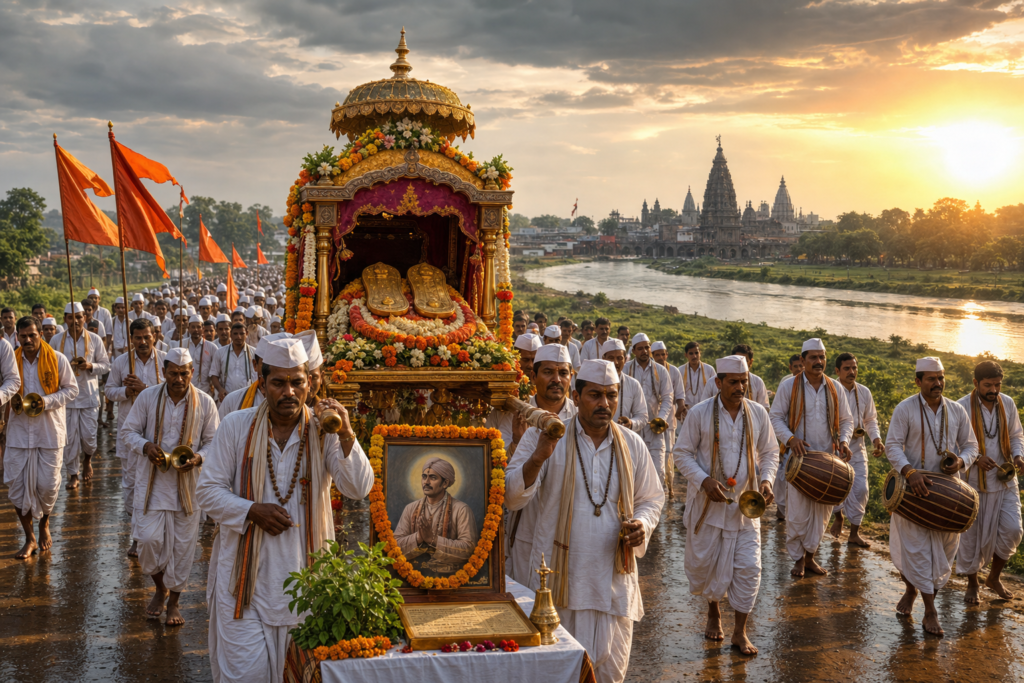
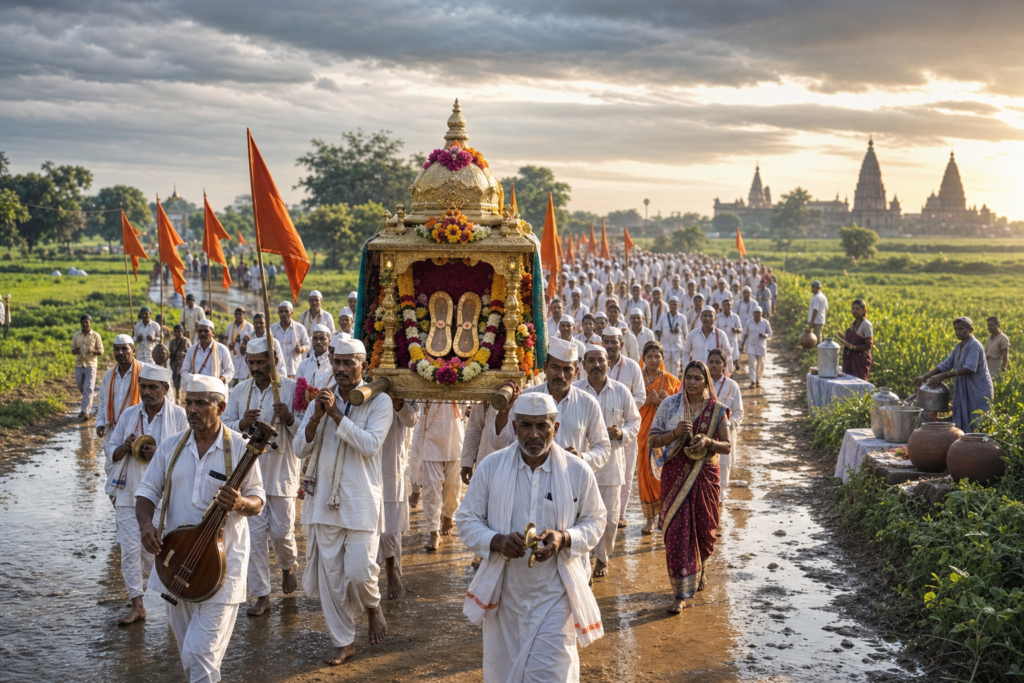
The Sant Eknath Maharaj Palkhi Sohala 2026 stands within one of Maharashtra’s most enduring devotional institutions: the Ashadhi Wari to Pandharpur. In this sacred procession, the padukas associated with Sant Eknath Maharaj are ceremonially carried from Paithan, his samadhi sthal on the banks of the Godavari, toward Pandharpur, where devotees gather for darshan of Vithoba on Ashadhi Ekadashi. The event is not merely a journey across distance; it is a disciplined movement of memory, music, theology, community service, and shared dharmic identity.
For 2026, Ashadhi Ekadashi is reported for 25 July, and the larger Ashadhi Wari season is expected to unfold through July, with major palkhis such as those of Sant Tukaram Maharaj and Sant Dnyaneshwar Maharaj beginning their journeys from Dehu and Alandi in the first half of the month. The Sant Eknath Maharaj Palkhi traditionally follows the same spiritual logic of arrival: the pilgrimage is oriented toward reaching Pandharpur in time for the Ekadashi observance. Devotees planning to join the Paithan-to-Pandharpur procession should confirm the precise departure date, daily halts, and administrative instructions from the Sant Eknath Maharaj Sansthan, local authorities, and official Wari coordination channels before travel.
Sant Eknath Maharaj occupies a central position in the Varkari tradition. He is remembered as a saint, philosopher, poet, and devotee of Vithoba, active in the sixteenth century, whose life and works strengthened the bridge between scriptural learning and everyday devotional practice. His compositions, especially the Eknathi Bhagavata and Bhavarth Ramayan, helped bring sacred ideas into Marathi literary and social life. The Palkhi Sohala therefore functions as a moving tribute to a teacher whose legacy made spiritual knowledge more accessible to common households.
Paithan gives the procession its historical depth. The town, also known in older sources as Pratishthana, stands on the Godavari and has long been associated with saints, learning, trade, and pilgrimage. For the Sant Eknath Maharaj Palkhi, Paithan is not simply a starting point on a map; it is the symbolic womb of the journey. The samadhi, the river, the memory of Eknath’s teaching, and the gathering of Varkaris together create the devotional atmosphere from which the Wari begins.
The religious destination is Pandharpur, the great center of Vithoba worship in Maharashtra. In Vaishnava understanding, Ashadhi Ekadashi, also called Devshayani Ekadashi or Shayani Ekadashi, marks the beginning of Chaturmas, the four-month sacred period associated with Lord Vishnu’s yogic rest. For Varkaris, the day is inseparable from the sight of Vithoba, the sound of abhangas, the collective rhythm of tal and mridang, and the belief that disciplined devotion purifies both the individual and the community.
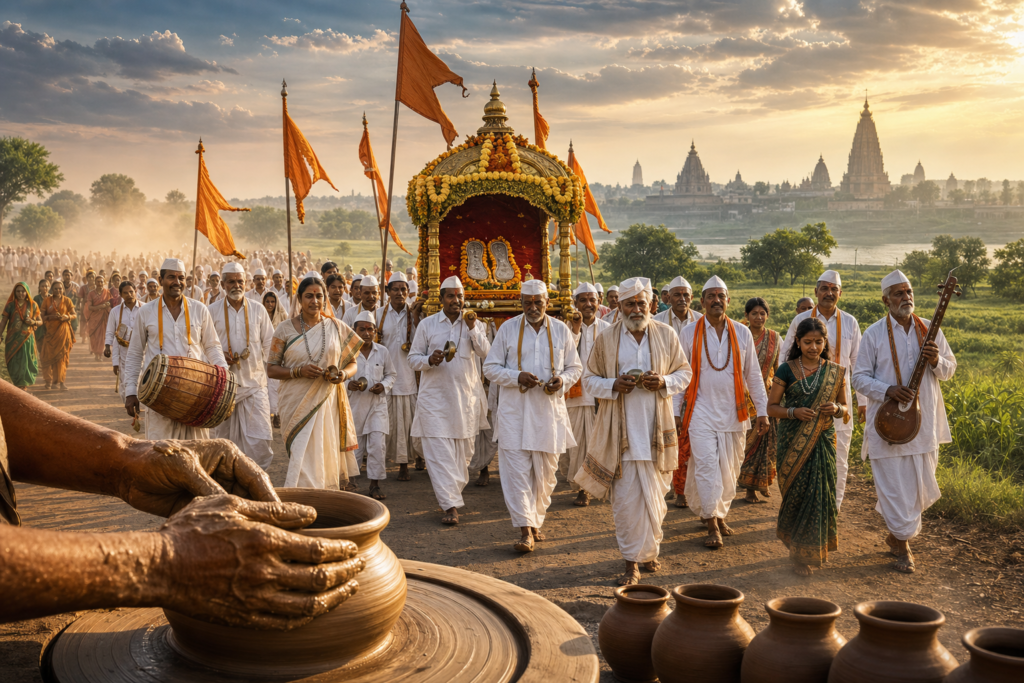
The word Palkhi refers to the palanquin in which the saint’s padukas are carried. In the Varkari context, the Palkhi is not treated as a decorative object but as a sacred vehicle of remembrance. The padukas represent the saint’s continuing presence, and the movement of the Palkhi allows devotees to walk with that presence through villages, fields, roads, and public spaces. The result is a public theology of humility: the saint does not remain confined to a shrine, but travels among the people.
The Wari is also an extraordinary example of social organization. Devotees travel in dindis, or disciplined groups, often arranged around a shared village, lineage, mandal, or devotional association. Each dindi has its rhythm, responsibilities, singing patterns, food arrangements, rest discipline, and internal order. This structure allows very large numbers of pilgrims to move with remarkable coordination while preserving the spiritual intimacy of small community units.
For many Maharashtrian families, the Sant Eknath Maharaj Palkhi is emotionally connected with inherited devotion. Elders may remember walking barefoot in rain, children may first encounter abhangas through family stories, and village communities may prepare water, food, medical support, or resting spaces as seva. Such memories explain why the Wari cannot be reduced to a festival date. It is a living transmission of discipline, tenderness, endurance, and belonging.
The devotional vocabulary of the procession is deeply musical. Abhangas, kirtan, namasmaran, and collective chanting shape the psychological atmosphere of the walk. Repetition is not mechanical in this tradition; it is a method of interior training. The body moves forward, the voice repeats the divine name, the mind settles into rhythm, and the community becomes a shared field of attention. This is one reason the Wari continues to attract not only ritual participants but also scholars of religion, culture, performance, and public ethics.
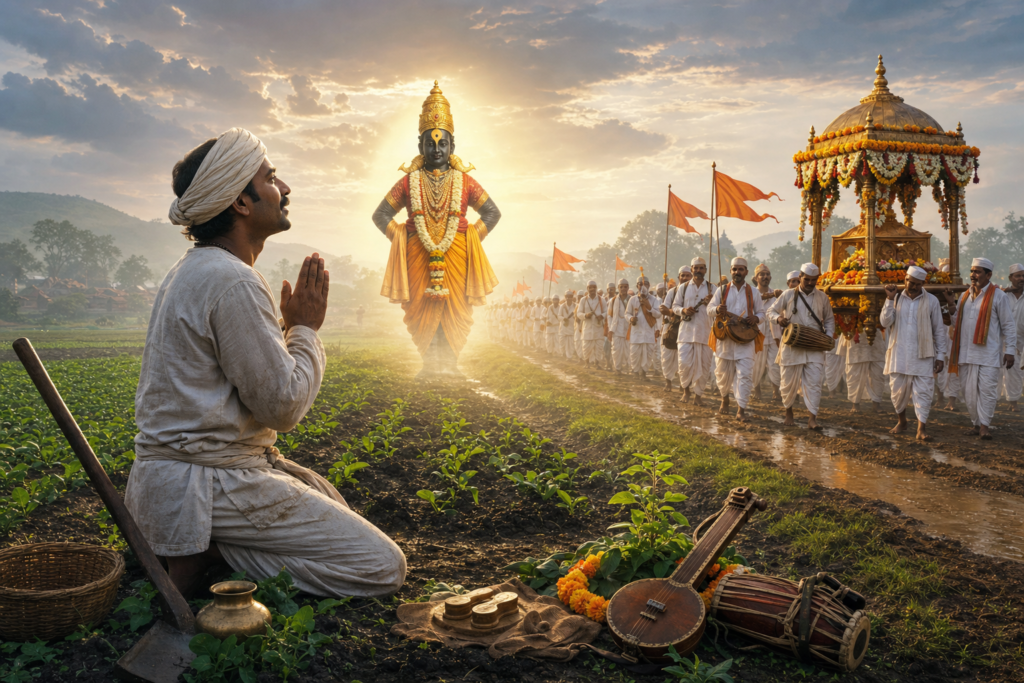
Sant Eknath’s importance becomes especially clear when viewed through the wider bhakti movement. His teaching emphasized devotion, moral clarity, compassion, and accessibility. The Varkari tradition does not place spiritual aspiration only in monastic withdrawal or scholastic authority; it also honors the farmer, artisan, worker, singer, parent, and pilgrim. The Palkhi thus expresses a dharmic ideal in which ordinary life becomes a vehicle for inner refinement.
The Sant Eknath Maharaj Palkhi Sohala also supports the broader unity of dharmic traditions. Its emphasis on pilgrimage, remembrance, ethical conduct, humility, non-harm, community discipline, and reverence for the guru resonates across Hindu, Buddhist, Jain, and Sikh civilizational practices. While its immediate theological center is Vithoba bhakti, its social message is wider: human beings are refined through self-restraint, service, sacred memory, and respect for diverse paths of spiritual seeking.
From a practical standpoint, the 2026 Wari requires careful preparation. Pilgrims should track the confirmed route, halts, weather advisories, traffic diversions, medical camps, and local instructions. July in Maharashtra can bring heat, humidity, and monsoon rain, so footwear, simple clothing, hydration, basic medicines, and personal identification are important. Those walking with elderly family members or children should plan shorter participation segments rather than assuming that the entire route is physically manageable for everyone.
Food and fasting practices vary among devotees. Some observe Ekadashi fasting strictly, while others follow family tradition, medical necessity, or guidance from elders. The academic point is that fasting in the Ekadashi tradition is not merely dietary restriction; it is understood as discipline of the senses, reduction of excess, and orientation of the mind toward worship. In a public pilgrimage, this discipline is balanced with health, safety, and care for fellow travellers.
The route from Paithan toward Pandharpur carries cultural significance beyond geography. It connects Marathwada’s memory of Sant Eknath with the Vithoba-centered devotional landscape of Pandharpur. Villages along the way often become temporary centers of hospitality, showing how pilgrimage converts ordinary public space into sacred social space. Roads become prayer corridors, resting grounds become community kitchens, and service becomes a form of worship.
The Wari’s endurance also depends on civic cooperation. Local administrations, police, health workers, sanitation teams, temple committees, volunteers, and village bodies all contribute to the safety and continuity of the procession. This logistical dimension is sometimes overlooked, yet it is essential. A pilgrimage of this scale survives because devotion is supported by planning, and planning becomes meaningful when it serves devotion.
The Sant Eknath Maharaj Palkhi 2026 should therefore be understood through three layers. The first is ritual: the carrying of padukas and the movement toward Pandharpur for Ashadhi Ekadashi. The second is historical: the remembrance of Sant Eknath’s contribution to Marathi bhakti, literature, and Varkari identity. The third is social: the collective formation of discipline, seva, equality, and shared sacred belonging across communities.
Its continuing appeal lies in the way it joins scholarship and emotion. A historian may see the legacy of medieval bhakti; a sociologist may see coordinated public religion; a literary scholar may hear the power of Marathi devotional expression; a devotee may simply feel the pull of Vithoba’s darshan. None of these perspectives cancels the others. Together, they show why the Palkhi remains one of Maharashtra’s most compelling cultural and spiritual institutions.
In 2026, those who participate in the Sant Eknath Maharaj Palkhi Sohala will be entering a tradition that has outlived political changes, social transformations, and modern pressures. The procession remains relevant because it answers a need that is both ancient and contemporary: the need to walk with others toward a sacred center, to remember a saint through action, and to transform public movement into inner pilgrimage.
The most responsible way to approach the 2026 Palkhi is with reverence, factual awareness, and preparation. Ashadhi Ekadashi is expected on 25 July 2026, but route-specific details for the Sant Eknath Maharaj Palkhi should be verified close to the event through official local sources. With that caution in place, the spiritual meaning remains clear: from Paithan to Pandharpur, the Palkhi carries not only padukas, but also memory, devotion, discipline, and the living unity of the Varkari tradition.
Inspired by this post on Hindu Pad.





Leave a Reply
You must be logged in to post a comment.