
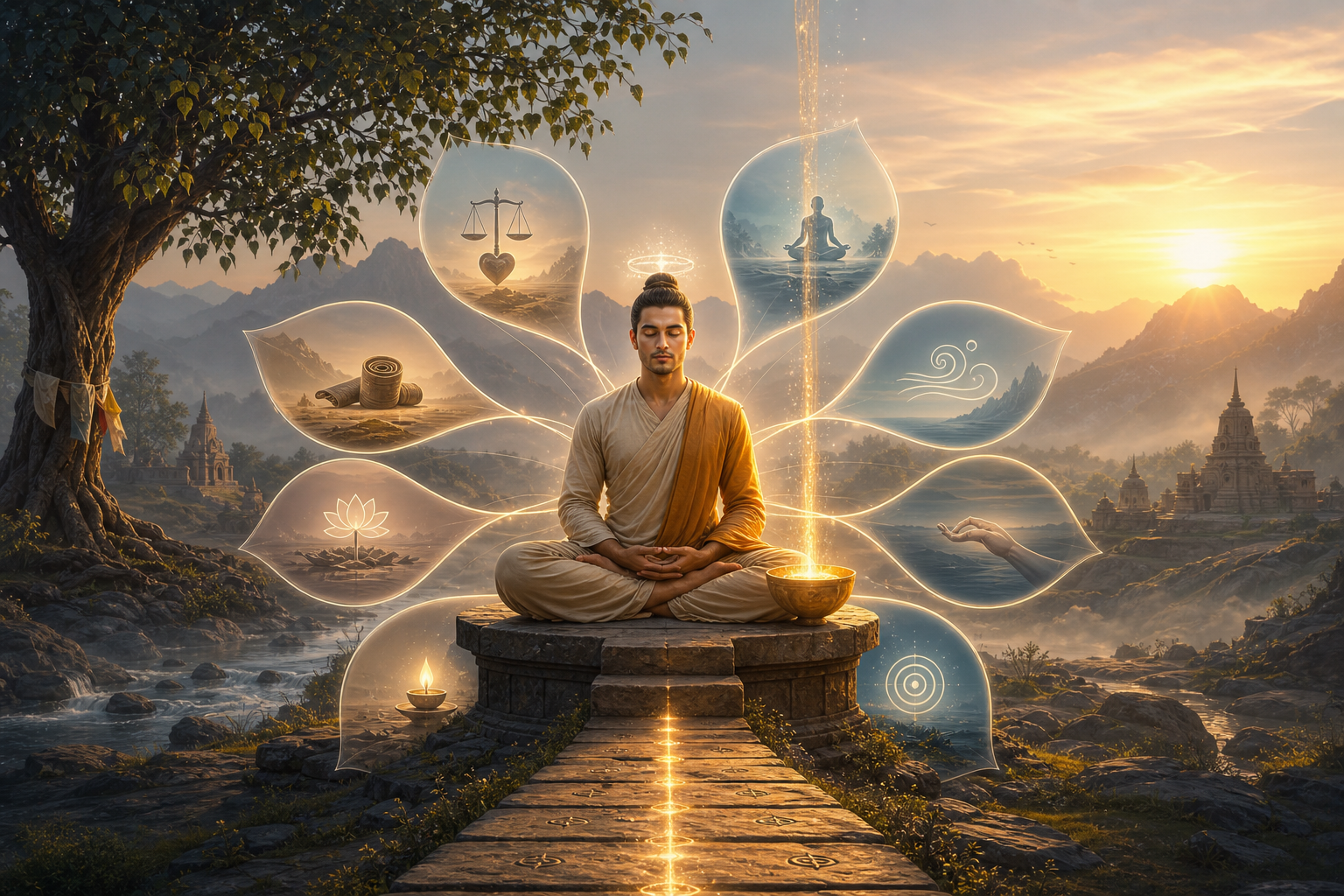
Raj Yoga is often translated as the royal path of yoga, yet its royalty is not restricted to political kings, inherited rank, or social privilege. In the spiritual vocabulary of India, the word raj suggests sovereignty, dignity, mastery, and inner command. It points toward a state in which the human mind is no longer dragged by every impulse, fear, memory, or craving. Raj Yoga therefore concerns the discipline through which consciousness becomes steady, luminous, and capable of recognizing its own deeper nature.
The brief teaching that Raj Yoga means getting things without much effort requires careful interpretation. It does not mean spiritual laziness, instant enlightenment, or the avoidance of discipline. Rather, it expresses a traditional insight: when a seeker receives guidance, practices within a living lineage, and benefits from the tapas of earlier saints, the path can become less confused and less wasteful. What appeared almost impossible to one generation can become accessible to another because knowledge, method, and grace have already been preserved.
This is why the comparison with Lord Buddha is meaningful. The Buddha undertook intense searching, long wandering, severe austerities, fasting, meditation, and profound inquiry before realizing the Middle Way. Later seekers do not have to reproduce every historical hardship in the same outward form. They can learn from that journey, honor the insight it produced, and avoid the extremes that the Buddha himself ultimately transcended. In this sense, receiving a tested path is a form of Raj Yoga: one receives the fruit of accumulated wisdom rather than beginning from complete darkness.
Raj Yoga is therefore not a royal entitlement; it is a royal responsibility. A king in the ordinary sense must govern a kingdom, but the practitioner of Raj Yoga must govern the field of the body, senses, breath, emotions, and thought. The true throne is not external power but inner steadiness. The real kingdom is the restless mental landscape that must be brought into harmony. The real victory is not domination over others but freedom from compulsive reactions.
In the classical Hindu framework, Raj Yoga is closely associated with Patanjali and the Yoga Sutras. Patanjali defines yoga through the restraint or stilling of the modifications of the mind, often summarized through the phrase citta-vritti-nirodha. This technical definition is central because Raj Yoga is not merely physical exercise, devotional feeling, or intellectual speculation. It is a rigorous science of attention, purification, and contemplative absorption.
The practical structure of this path is commonly explained through Ashtanga Yoga, the eight-limbed discipline described in the Yoga Sutras. These eight limbs are yama, niyama, asana, pranayama, pratyahara, dharana, dhyana, and samadhi. They move from ethical foundations to meditative absorption. Their order is important because Raj Yoga does not treat meditation as an isolated technique; it treats meditation as the flowering of an entire way of life.
Yama establishes restraint and moral clarity. Ahimsa, satya, asteya, brahmacharya, and aparigraha train the practitioner to reduce violence, falsehood, theft, excess, and possessiveness. Without this ethical ground, meditation can become unstable or self-centered. A mind that injures, deceives, grasps, or indulges itself without reflection cannot easily become a royal mind. It remains a servant of agitation.
Niyama turns the discipline inward through shaucha, santosha, tapas, svadhyaya, and Ishvara pranidhana. These observances cultivate purity, contentment, disciplined effort, self-study, and surrender to the Divine. The combination is psychologically sophisticated. It recognizes that inner freedom requires both effort and surrender, both self-examination and humility, both structure and devotion.
Asana, in the context of Raj Yoga, is primarily a stable and comfortable posture that supports meditation. Modern yoga culture often emphasizes postural variety, flexibility, and bodily performance, but classical Raj Yoga is concerned with making the body a reliable instrument for contemplation. The body is respected, strengthened, and steadied so that it does not constantly interrupt the deeper work of the mind.
Pranayama refines the relationship between breath, energy, and attention. Breath is not treated as a mechanical function alone. It is a bridge between voluntary and involuntary life, between body and mind, between outward activity and inward stillness. When breathing becomes calm and conscious, the nervous system settles, attention deepens, and emotional turbulence becomes easier to observe without being possessed by it.
Pratyahara is the withdrawal of the senses, not as rejection of the world but as freedom from sensory compulsion. In daily life, the mind is pulled outward by sound, image, taste, touch, memory, and digital distraction. Pratyahara teaches the practitioner to return inward without hatred toward the world. This is one of the most relevant aspects of Raj Yoga for contemporary life, where attention is constantly harvested by external stimuli.
Dharana is concentration, the ability to hold the mind steadily on a chosen point. Dhyana is meditation, the more continuous flow of awareness toward that object. Samadhi is absorption, where the division between observer, observing, and observed becomes increasingly subtle. These three inner limbs show why Raj Yoga is called royal: it trains the highest faculty of human life, the power of conscious awareness.
The claim that Raj Yoga gives everything on a platter can now be understood more precisely. The platter is not comfort without discipline; it is the availability of a complete map. A seeker who receives the map still has to walk, but the path is no longer blind. There is a difference between inventing a road through wilderness and traveling a road prepared by sages. Raj Yoga honors that difference.
There is also a deeper emotional truth here. Many spiritual aspirants begin with a feeling of exhaustion. They may feel that inner peace is distant, that the mind is too noisy, or that great saints belonged to another age. Raj Yoga gently corrects that despair. It suggests that the same fundamental transformation remains available, not because life is easy, but because human consciousness still responds to discipline, grace, and guidance.
Raj Yoga should also be distinguished from astrological Raj Yoga. In Vedic astrology, Raj Yoga can refer to planetary combinations associated with status, leadership, prosperity, or influence. That usage is meaningful within its own discipline, but it is not the main focus here. In the yogic and philosophical sense, Raj Yoga is concerned with mastery of consciousness and the realization of inner freedom.
Nor should Raj Yoga be separated harshly from other dharmic paths. Bhakti Yoga emphasizes devotion, Karma Yoga emphasizes selfless action, Jnana Yoga emphasizes knowledge, and Hatha Yoga emphasizes bodily and energetic preparation. Raj Yoga can include elements of all of them. Devotion softens the ego, action purifies motives, knowledge clarifies discernment, and bodily discipline supports meditation. The royal path is not narrow sectarianism; it is an integrated discipline of human transformation.
This integrative spirit is important for Hinduism, Buddhism, Jainism, and Sikhism. Each dharmic tradition has its own vocabulary, theology, and practice, yet all recognize the need to refine conduct, reduce ego, discipline the mind, and move toward liberation, awakening, or union with Truth. The Buddha’s search, the Jain emphasis on self-restraint and non-violence, the Sikh discipline of remembrance and seva, and the Hindu yogic tradition all affirm that ordinary consciousness can be elevated through sincere practice.
Raj Yoga is not only for monks, ascetics, philosophers, or those living in forests. Its principles can enter household life, professional life, family life, and civic life. A person who pauses before reacting, speaks truth without cruelty, performs duty without constant craving for praise, watches the breath during conflict, and returns daily to meditation is already practicing the spirit of Raj Yoga. The outer life may remain busy, but the inner government becomes more orderly.
At the same time, Raj Yoga should not be reduced to stress management. Calmness is valuable, but the classical aim is greater than relaxation. The path seeks discernment, self-knowledge, liberation from ignorance, and direct insight into the nature of consciousness. Stress reduction may be an early benefit, but the deeper promise is the transformation of identity itself: the practitioner gradually ceases to live only as a bundle of reactions.
The phrase without much effort also has to be balanced with the Sanskrit idea of abhyasa, steady practice. Raj Yoga is effortless only after repeated refinement, just as a musician appears effortless after years of disciplined training. The visible ease conceals invisible preparation. A mature practitioner may sit quietly and enter meditation with natural grace, but that naturalness is usually the result of sustained ethical, bodily, emotional, and contemplative cultivation.
Grace has an equally important place. Many seekers discover that effort alone can become rigid. Raj Yoga therefore benefits from humility before the Divine, reverence for the guru principle, and gratitude toward the traditions that preserve knowledge. The seeker practices, but does not claim ownership over every insight. The path becomes royal when discipline and grace meet: effort prepares the vessel, grace fills it.
For modern readers, Raj Yoga offers a powerful corrective to the fragmentation of contemporary life. The mind is trained to multitask, consume, compare, and react, while the heart longs for depth. Raj Yoga gathers the scattered personality into one field of awareness. It asks for ethical living, disciplined breathing, sense restraint, concentration, meditation, and surrender. This is not escapism; it is the restoration of sovereignty over attention.
Therefore, Raj Yoga is not only for kings. It is for anyone willing to become sovereign over the inner kingdom. Its royal quality lies in the dignity it gives to human life and the disciplined freedom it makes possible. When received through authentic guidance, it may feel as though wisdom has been placed before the seeker with extraordinary generosity. Yet the food must still be digested. The path may be given, but realization must be lived.
Inspired by this post on Hindu Pad.

Leave a Reply
You must be logged in to post a comment.