
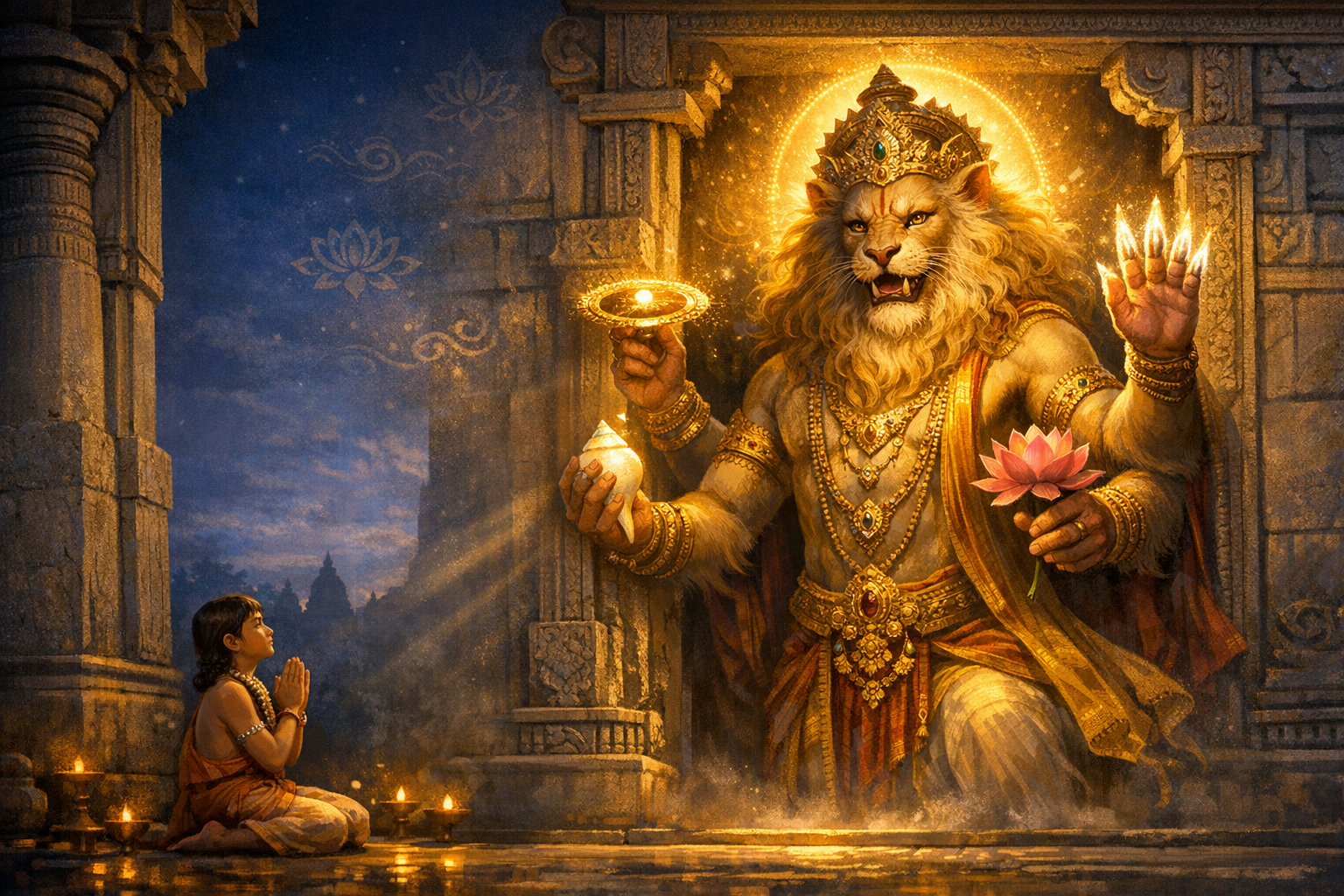
Within the Vaishnava understanding of the Dashavatara, the appearance of Narasimha—Vishnu manifest as the man-lion—occupies a uniquely intimate and intense place. Most divine descents are narrated as interventions for broad civilizational repair: restoring Dharma, countering Adharma, and realigning cosmic order. By contrast, Narasimha is remembered foremost as the Avatar who descended for a single devotee, Prahlada, embodying a personal assurance that devotion (bhakti) is never abandoned. Tradition also recalls this avatara-lila as exceptionally brief in worldly duration, earning Narasimha the evocative epithet of the ‘shortest’ Avatar: a theophany that blazed forth at dusk and withdrew once justice was done.
The textual foundations for Narasimha devotion are robust across Purana and Itihasa literature. The Bhagavata Purana (notably Skandha 7) offers the fullest narrative arc of Prahlada’s steadfast devotion amid persecution by his father, the Asura-king Hiranyakashipu. Corroborating outlines appear in the Vishnu Purana and Agni Purana, while the Narasimha-tapani Upanishad (of the Atharva tradition) attests to the Avatar’s contemplative and mantra-vidya dimensions. This confluence of narrative, theology, and mantra across sources has shaped both household veneration and temple liturgy for centuries.
Hiranyakashipu’s celestial boon famously sought to place the king beyond defeat by fastening his safety to liminal conditions and logical exclusions: not by man or animal; not by any weapon; not inside or outside; not on earth or in the sky; not by day or night; and not by any being created in the conventional order. Narasimha’s emergence at twilight (sandhya), on the palace threshold, with no forged weapon but divine nails (vajra-nakha), while placing the tyrant upon the lap—neither ground nor sky—demonstrates a theological grammar in which Dharma transcends the clever manipulations of literalism. The Avatar thus fulfills both the letter and spirit of cosmic law, while honoring Brahma’s boon and liberating the world from tyranny.
This is why Narasimha is frequently called the most personal of all Avatars. The narrative makes the soteriological claim visible: that devotion is seen, heard, and protected. Prahlada’s childlike faith—reciting the Divine Name, declining to hate, and refusing to abandon truth under pressure—becomes the axis around which Narasimha’s descent turns. For many households across Bharatavarsha, grandparents narrate the Prahlada story to children as a first lesson in courage and faith, making Narasimha an abiding emotional presence as well as a theological one.
The description of Narasimha as the ‘shortest’ Avatar is best read as a comment on the manifest, historical interval of this lila. Unlike Rama’s long terrestrial reign or Krishna’s expansive role across generations, Narasimha’s intervention is profoundly focused: arrival at dusk, the rending of tyranny, the pacification that follows, and withdrawal. Sri Vaishnava commentaries and temple traditions, however, also emphasize Nitya-Narasimha—the eternal, ever-accessible Lord—ensuring no contradiction between the brevity of the historical episode and the timeless accessibility of grace in worship and meditation.
Narasimha’s iconography encodes theology in form. Kevala-Narasimha presents the Lord alone, often four-armed with chakra and shankha, radiating protective majesty. Ugra-Narasimha portrays the dynamic moment of deliverance, sometimes with Hiranyakashipu across the lap, capturing the paradox of terrifying compassion: fierce to oppression, tender to virtue. Lakshmi-Narasimha or Malola-Narasimha, by contrast, manifests serenity (shanta), with Mahalakshmi seated upon the Lord’s lap, signifying pacified power and the completion of justice. Yoganarasimha reveals the Avatar as an anchor of contemplative stillness, prized within bhakti-yoga as a form that steadies mind and breath.
Regional traditions enrich these forms with local theologies. Ahobilam in today’s Andhra Pradesh venerates Nava-Narasimha—Jvala, Ahobila (Ugra), Malola, Kroda (Varaha-Narasimha), Karanja, Bhargava, Yogananda, Chatravata, and Pavana—each linked to a distinct devotional mood (bhava) and episode in the sacred landscape. On the eastern coast, Simhachalam honors Sri Varaha Lakshmi Narasimha, while numerous Yoganarasimha sanctums in Karnataka and Tamil Nadu speak to the Avatar’s integrative role across worship and meditation. These sites anchor living memory and demonstrate how scriptural motifs become embodied in architecture, ritual, and song.
The ritual calendar centers on Narasimha Jayanti, traditionally observed on Vaishakha Shukla Chaturdashi at dusk, aligning with the liminal hour of the theophany. Devotees often fast, perform abhisheka with pañchamrita, and recite kavacha-stotras seeking protection and fearlessness. The widely cherished invocation—Ugram Veeram Mahavishnum Jvalantam Sarvato Mukham, Nrisimham Bhishanam Bhadram Mrityor Mrityum Namamyaham—functions as both a succinct theology and a practical mantra of courage, recited during personal crises or public calamities as a reminder that Dharma answers even at the threshold moments of life.
Theologically, Narasimha articulates four interlocking claims central to Hindu Dharma. First, bhakti is efficacious and personal: the Divine is responsive to the devotee. Second, Dharma does not capitulate to semantic loopholes: cosmic law exceeds contrived immunities. Third, protection of the innocent is a sacred imperative, resonant with the classical ideal of Dharma-Yuddha in which force, when deployed, remains ethically bounded. Fourth, Divine power is inherently self-limiting: once justice is complete, wrath yields to peace, reflected in the gentle visage of Lakshmi-Narasimha.
Psychologically, Narasimha speaks to fear in a way that is both intimate and technical. The Avatar appears precisely when ordinary categories fail—neither inside nor outside, neither day nor night—mirroring the liminal distress many experience when rules, roles, and routines no longer suffice. In this register, Narasimha functions as a metaphysical assurance that clarity and courage can arise precisely at thresholds. Practitioners of bhakti-yoga often pair the Narasimha Gayatri—Om Nrisimhaya Vidmahe Vajra-nakhaya Dhimahi Tanno Nrisimhah Prachodayat—with breath awareness, using mantra and pranayama to integrate devotion and nervous-system steadiness.
Ethically, the narrative contrasts coercive power with principled strength. Prahlada’s unwavering truthfulness, refusal to demonize, and insistence on remembrance of Hari under duress offer a model of satya and kshama. Narasimha’s justice, in turn, is corrective rather than vindictive: precise, proportionate, and conclusive. This balance is why Narasimha is invoked in rites that seek both removal of obstacles and restoration of inner equilibrium, uniting protection with peace.
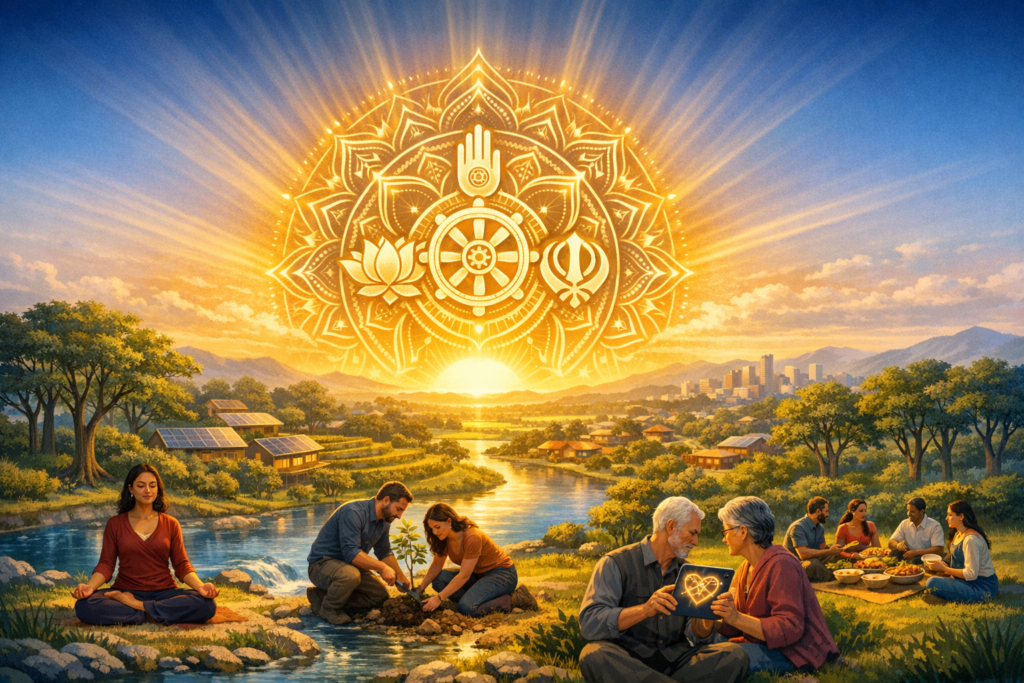
Narasimha’s symbolism also resonates across the wider dharmic family, nurturing unity rather than rivalry. In Buddhism, the motif of the lion (simha) marks fearless proclamation of Dharma—consider titles like Simhanada—while Jain tradition associates the lion with courage and the moral authority of the Tirthankaras. Sikh tradition’s ideal of the saint-soldier aligns with the harmonizing of devotion and protective strength. These convergences reflect a shared civilizational intuition: spiritual life demands compassion anchored by courage, and courage purified by compassion.
From the standpoint of aesthetics and performance, Narasimha has inspired a vast repertoire—kirtana in the Gaudiya tradition, kritis in Carnatic music, dance-dramas in Kuchipudi and Yakshagana, and temple sculpture across epochs. Iconographers distinguish Ugra and Shanta rasas, allowing communities to approach the same deity through different moods. The narrative’s threshold setting—pillar, dusk, doorway—also infuses temple architecture, where sanctum thresholds and prakaras symbolize passage from fear to fearlessness.
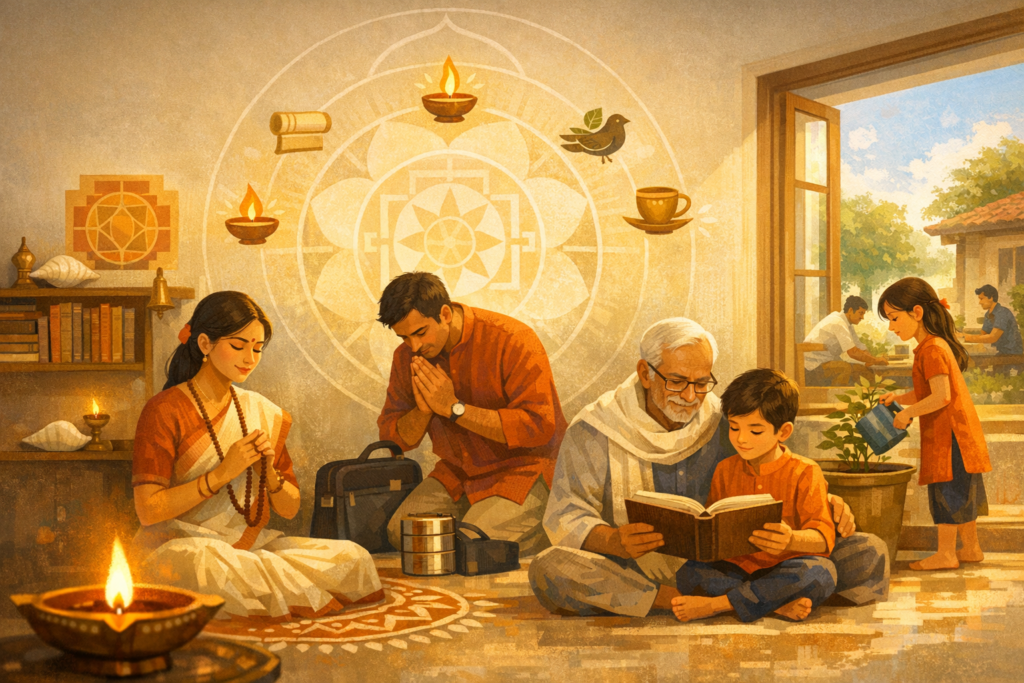
Historically, Narasimha worship has been integral to multiple royal and regional lineages, yet it has remained equally domestic and accessible. Household shrines often keep Narasimha images or kavacha texts as protective emblems, while temple festivals make this protection a public celebration. The continuity from scripture to sanctum to sitting room explains the Avatar’s enduring relevance: Narasimha is equally at home in philosophy, ritual, and lived experience.
A recurrent question in scholarly and devotional study concerns the paradox of ‘fierce grace’. Narasimha resolves the tension by situating wrath as an attribute in service of compassion. Ugra is not a permanent state but a functional mode: once dharma is reinstated, the Lord is pacified by Mahalakshmi and resumes a state of shanta. This movement from heat to coolness is itself a soteriological teaching about the arc of righteous action and the primacy of peace.
For contemporary seekers navigating social complexity and personal uncertainty, Narasimha offers three practical insights. First, cultivate Prahlada’s disciplines—remembrance, truthfulness, and non-resentment—so that help recognized as grace can truly reach. Second, steward strength with ethics; protection divorced from principle corrodes its own purpose. Third, honor thresholds: meditative practice at dawn and dusk, mantra recitation before stepping through figurative or literal doorways, and mindful breath during transitions all deepen resilience.
In summary, Narasimha’s lila concentrates the promises that run through Hindu Dharma: devotion is efficacious, justice is precise, and compassion is ultimate. The Avatar’s personal descent for Prahlada makes the theology experiential; the brevity of the episode underscores the economy of divine action; the multiplicity of forms—Ugra, Shanta, Yoga—ensures access for differing temperaments. Read alongside cognate ideals in Buddhism, Jainism, and Sikhism, Narasimha becomes a shared civilizational teaching: fearlessness in the service of truth, and truth guided by love.
Remembered at dusk, honored at thresholds, and invoked in moments when ordinary categories fail, Narasimha remains Vishnu’s fiercest grace—at once the most personal and, in worldly measure, the shortest Avatar—whose enduring presence protects, clarifies, and calms.
Inspired by this post on Hindu Blog.



Leave a Reply
You must be logged in to post a comment.