Sati Anasuya Jayanti honors the birth of Anasuya, the revered pativrata and spouse of Atri Rishi, and stands as a luminous celebration of fidelity, austerity, and household harmony in the Hindu calendar. In 2026, Sati Anasuya Jayanti falls on Monday, 6 April. The observance aligns with Krishna Paksha Chaturthi in the Vaishakh month as per the North Indian (Purnimant) tradition and with Krishna Paksha Chaturthi of Chaitra according to Amavasyant panchangas. This difference in month name reflects calendar conventions rather than a change in the underlying tithi, ensuring a unified observance across regions.
Anasuya is celebrated in Hindu scriptures as one of the foremost Women Rishis, whose life embodies dharma lived through steadfast virtue and compassionate service. Puranic accounts portray her as the mother of Dattatreya, a divinity associated with the combined wisdom of Brahma, Vishnu, and Mahesh (Shiva). Several retellings also ascribe to Atri and Anasuya the sons Durvasa (linked with Shiva’s ascetic fire) and Chandra (Soma, the lunar lord), underscoring the family’s centrality in sacred narrative. As a cultural archetype, Anasuya represents a model of spiritual strength within the grihastha (householder) path, where devotion and restraint become transformative spiritual disciplines.
The foundational legend, preserved in the Padma Purana and echoed in the Skanda Purana, describes the Trimurti arriving at Anasuya’s hermitage in the guise of mendicants to test the extents of her pativrata-dharma. Faced with an ethically paradoxical request, Anasuya resolved the dilemma through tapas-born insight and maternal compassion, transforming the supreme deities into infants and nourishing them. The gods, revealing their true forms, blessed her with boons, and the episode became a timeless emblem of how disciplined virtue (dharma) dissolves apparent contradictions and restores harmony.
From a calendrical perspective, the festival’s anchor is the tithi of Krishna Paksha Chaturthi. In the lunisolar Hindu calendar, a tithi is defined by a 12-degree elongation between the Sun and the Moon, making it a precise astronomical phase rather than a civil-day construct. Regions using the Purnimant system (where months end at the full moon) identify this Chaturthi within Vaishakh, while Amavasyant regions (where months end at the new moon) place it in Chaitra. The underlying tithi remains the same; only the month name varies. Observers outside India should consult a reliable local panchang to align rituals with the tithi in their own time zone.
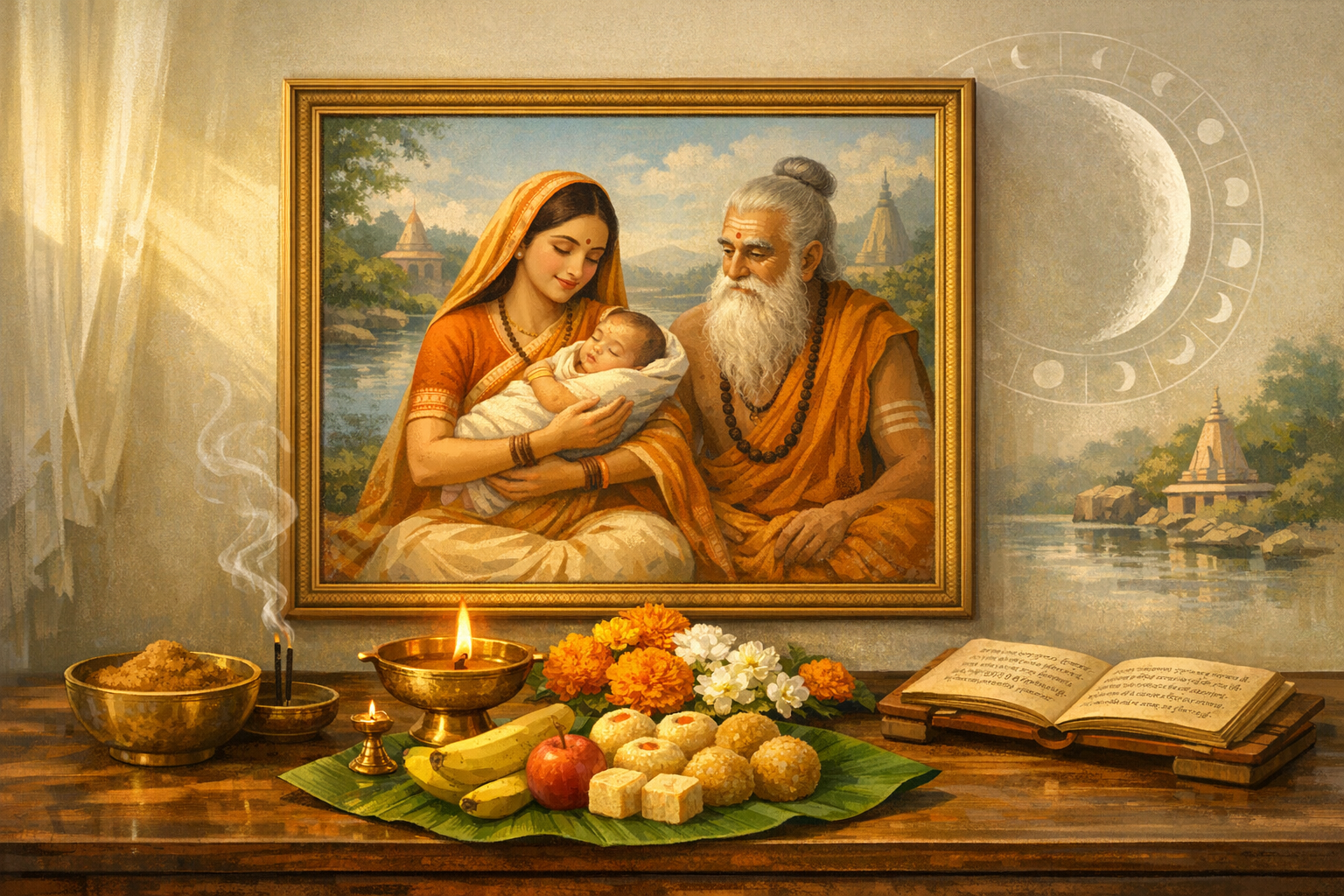
Sati Anasuya Jayanti 2026: Suggested Puja Vidhi (home observance). After a pre-dawn or morning snana (purificatory bath) and basic home sanctification, devotees may perform sankalpa (intention-setting) for Anasuya Devi’s Jayanti, invoking blessings for dharma, family harmony, and self-mastery. A simple altar with images or symbolism of Anasuya and Atri Rishi may be established. Panchopachara (five offerings)sandal paste or water, flowers, incense, lamp, and naivedyacan be offered with focused dhyana. Devotees often recite Devi stotras as well as Dattatreya stotras, or read select passages narrating Anasuya’s life from Puranic sources, concluding with aarti and shared prasada.
Vrat and food guidelines are traditionally sattvic, emphasizing simplicity and self-restraint. Many choose a partial or day-long upavasa (fast), partaking in light fruits and milk if needed, and concluding with home-cooked, onion–garlic-free meals after the puja. Acts of danam (charity)especially annadanam (food donation)carry special significance, reflecting Anasuya’s nurturing virtue. In several regions, families honor married women (sumangalis) with tokens of respect, symbolically celebrating marital well-being (dampatya-shri) and intergenerational continuity of dharmic values.
For householders, the Jayanti also serves as an annual recommitment to shared ethical aspirations: mutual respect, compassionate speech, and the discipline required for spiritual growth within domestic life. Couples may include a brief sankalpa for dampatya-shanti (marital harmony) and family health, aligning the observance with Anasuya’s archetype of devotion balanced by wisdom. Parents often encourage children to listen to the legend, integrating moral instruction with cultural memory in a living pedagogy of tradition.
Temple-centered observances frequently occur at sites associated with Atri–Anasuya. Chitrakoot’s Anasuya Ashram near the Mandakini is one such renowned center, where the narrative of Anasuya’s tapas is part of the region’s spiritual geography. In the Himalayas, the Anusuya Devi Temple near Gopeshwar (Chamoli, Uttarakhand) is revered by pilgrims who connect the Himalayan landscape’s austerity with Anasuya’s tapas-shakti. While local rites vary by tradition and region, the leitmotif remains devotion grounded in simplicity, service, and inner discipline.
Beyond sectarian boundaries, Sati Anasuya Jayanti resonates with core values held across dharmic traditions. In Buddhism, the cultivation of sīla (ethical conduct) and the paramitas (perfections) mirrors the virtues embodied by Anasuya. In Jainism, the anuvratas (small vows) of nonviolence, truthfulness, and restraint exemplify the same disciplined compassion. In Sikh traditions, grihastha dharma anchored in seva (selfless service), sat (truth), and nimrata (humility) harmonizes with the Anasuya ideal of household-centered spirituality. The festival thus encourages unity in diversity, reaffirming a shared civilizational ethic of inner strength, compassion, and self-restraint.
Planning for 6 April 2026 can follow a practical sequence: check a trusted panchang for local Chaturthi start–end times; arrange puja materials the previous evening; keep meals light and sattvic; perform sankalpa and panchopachara in the morning; set aside time for reading Puranic passages or listening to the legend; conclude with aarti, family sharing of prasada, and charitable giving. Those in different time zones should prioritize alignment with the tithi rather than the civil date if the local tithi boundary spans calendar days.
Frequently asked clarifications help reinforce accuracy. First, “Sati” in this context is an honorific denoting a chaste and virtuous woman; it does not refer to later historical practices. Second, Sati Anasuya Jayanti is distinct from Dattatreya Jayanti, which typically falls on Margashirsha Purnima and commemorates a different sacred event. Third, variations in month names (Vaishakh vs. Chaitra) arise from Purnimant and Amavasyant systems; the tithi of Krishna Paksha Chaturthi is the constant anchor.
As an intangible heritage practice, Sati Anasuya Jayanti weaves together narrative, ethics, and family life. Many households recall grandmothers narrating how Anasuya transformed a difficult test into grace, teaching children that dharma, lived steadily, becomes protective power. The festival’s measured cadenceaustere preparation, quiet worship, shared food, and serviceinvites participants to slow down, reflect, and re-center around qualities that fortify both spiritual aspiration and social harmony.
In sum, Sati Anasuya Jayanti 2026 offers a comprehensive pathway to renew devotion through knowledge and practice: a clear date (6 April 2026), a precise tithi anchor (Krishna Paksha Chaturthi), a puja-vidhi anchored in panchopachara and Puranic remembrance, and a broad dharmic significance that unites Hindu, Buddhist, Jain, and Sikh ethical visions. Observed with sincerity and simplicity, it becomes not only a remembrance of Anasuya Devi’s luminous virtue but also a contemporary guide for cultivating steadfastness, compassion, and harmony at home and in society.
Inspired by this post on Hindu Pad.